



 Shop
Shop- All categories
- Tropocollagen
- Tropocollagen Guna
Lenisna PLA 1x200 mg
Lenisna PLA 1x200 mg
In stock
In stock
 1 sold
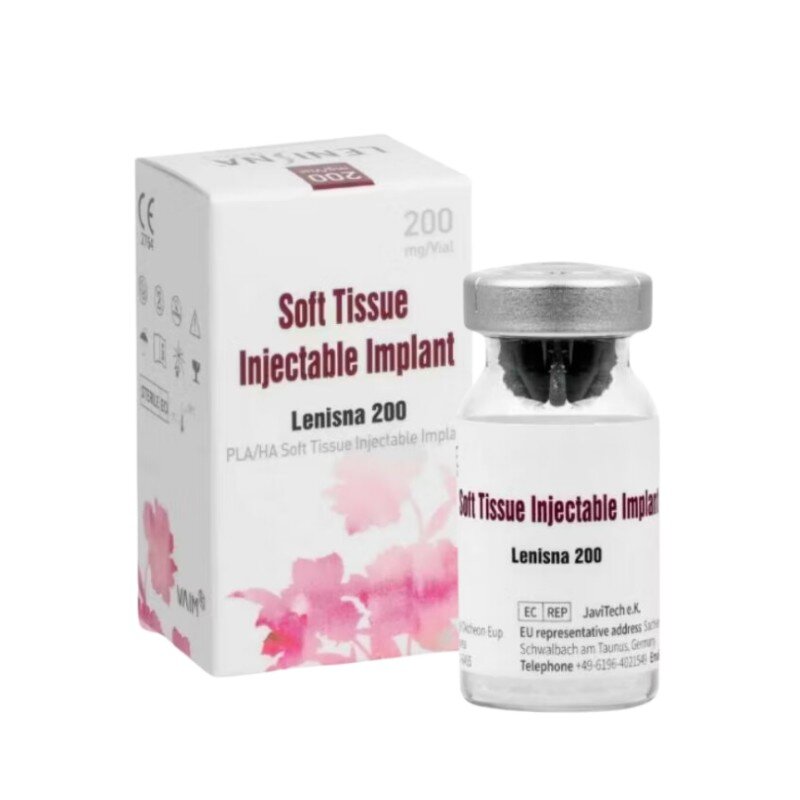
Lenisna PLA 1x200 mg is a professional injectable designed for practitioners seeking a combination of soft-tissue volume restoration and collagen biostimulation. Manufactured by VAIM Co., Ltd., South Korea, Lenisna uses a hybrid formulation combining poly-D,L-lactic acid (PDLLA) with non-cross-linked hyaluronic acid (HA).
Each 200 mg vial contains 170 mg PDLLA and 30 mg non-cross-linked HA. The PDLLA particles are reported at approximately 50–60 micrometres, although some product documentation reports a broader particle-size range depending on the technical specification.
The combination of these two components gives Lenisna a different positioning from a conventional cross-linked HA dermal filler. Rather than relying exclusively on HA to create immediate volume, Lenisna is designed around a dual-action concept: HA provides an initial filling effect, while PDLLA acts as a collagen-stimulating component intended to support progressive tissue improvement.
PDLLA Collagen Biostimulation
Poly-D,L-lactic acid is a biodegradable polymer used in injectable aesthetic medicine as a collagen biostimulator. Following implantation, the PDLLA microparticles are intended to stimulate a biological response within the treated tissue, supporting progressive collagen production.
This makes Lenisna particularly relevant for patients presenting with age-related volume loss, skin laxity, deep wrinkles and loss of facial definition. Instead of simply adding a fixed volume of filler, the treatment concept aims to encourage gradual improvement in tissue support and skin firmness.
Hyaluronic Acid Component
The formulation also contains 30 mg of non-cross-linked hyaluronic acid. HA is naturally present in the extracellular matrix and has strong water-binding properties.
Within Lenisna, the HA functions as part of the hybrid formulation and contributes to the initial filling and hydration characteristics of the product. This creates a distinction between Lenisna and PDLLA products that contain no HA component.
The immediate effect associated with the HA component can be followed by a more progressive change as the PDLLA component stimulates collagen production. Product information describes this as a transition from an initial filling effect towards longer-term collagen-supported tissue improvement.
Facial Volume Restoration
For aesthetic practitioners, one of the key applications of Lenisna 200 mg is addressing areas where facial volume has reduced with age.
Loss of subcutaneous volume can contribute to changes in facial proportions, deeper folds and a less defined facial contour. Depending on patient anatomy and the applicable product instructions, Lenisna may be incorporated into treatment plans addressing areas such as the cheeks, mid-face, jawline, chin, temples and nasolabial folds. Product materials also describe applications for deep wrinkles and tissue depressions.
Deep Wrinkles and Skin Laxity
Lenisna can also be considered where the primary concern is not simply volume loss but the combination of deep wrinkles, tissue laxity and reduced skin firmness.
The PDLLA component provides the biostimulatory element of the treatment, while the HA component supports the initial correction. This combination makes Lenisna relevant to clinics offering non-surgical facial rejuvenation and collagen-stimulating treatments.
Facial Contouring
Lenisna can be incorporated into treatment plans where the objective is subtle restoration of facial structure and definition. Treatment planning should be individualised according to facial anatomy and the patient's degree of tissue depletion.
Potential areas include the cheek and mid-face region, jawline, chin and temples, subject to the applicable product documentation and practitioner assessment. The aim is to restore appropriate tissue support rather than create excessive or disproportionate volume.
Body Applications
Some distributor and product materials describe Lenisna for body applications including the abdomen, buttocks, inner thighs and upper arms for concerns involving tissue laxity and contouring.
However, indications and permitted treatment areas can differ by jurisdiction. For a UK-facing B2B pharmacy website, claims relating to body use should therefore be checked against the current UK product documentation and IFU before publication.
Treatment Protocol
Published professional protocols vary. Some product materials describe a course of two to three treatments, with intervals ranging from approximately four to eight weeks depending on the protocol and indication.
Because preparation volume, injection plane, cannula/needle selection and treatment frequency can differ according to the manufacturer's applicable IFU and market, Skin On You should avoid presenting one third-party protocol as a universal instruction.
The product should be prepared and administered only by appropriately trained medical aesthetic professionals.
Injection Considerations
Lenisna is generally described as a product intended for subcutaneous or deeper tissue administration, with cannula-based treatment commonly described in professional materials. Some documentation also refers to supraperiosteal administration for selected applications.
Practitioners should follow the manufacturer's current instructions regarding reconstitution, injection depth, device selection, treatment dosage and post-treatment care.
Importantly, Lenisna should not be treated as interchangeable with every other PLLA or PDLLA injectable. Particle characteristics, formulation, concentration and manufacturer's instructions can differ substantially between collagen biostimulators.
Suitable Patient Profiles
Lenisna may be considered for appropriately selected adult patients presenting with:
- Facial volume depletion
- Deep facial wrinkles
- Skin laxity
- Reduced tissue firmness
- Loss of facial contour
- Soft-tissue depressions
- Selected morphological asymmetries
Regulatory documentation for Lenisna describes its intended purpose as intradermal and subcutaneous implantation to fill skin depressions and restore or enhance soft-tissue volume, with reconstructive use described for morphological asymmetry.
For aesthetic clinics, Lenisna therefore occupies an interesting position between dermal filler and collagen biostimulator. It offers a hybrid approach for practitioners who want to address both immediate tissue support and progressive collagen stimulation.
Overall, Lenisna PLA 1x200 mg provides 170 mg PDLLA and 30 mg HA in a single 200 mg vial. Its formulation is designed around gradual collagen stimulation combined with an initial HA-associated filling effect, making it particularly relevant to professional protocols for facial volume restoration, deep wrinkle correction, skin laxity and natural facial contouring.
Treatment Areas
Depending on the approved indication and current manufacturer IFU, Lenisna may be used for:
Face
- Cheeks
- Mid-face
- Zygomatic/cheek area
- Temples
- Jawline
- Chin
- Nasolabial folds
- Marionette/mouth-corner region
- Areas of facial volume loss
- Deep facial wrinkles
- Soft-tissue depressions
Professional documentation also describes selected body applications such as:
- Abdomen
- Buttocks
- Inner thighs
- Upper arms
Body applications should only be promoted where supported by the applicable local product documentation and regulatory status.
Usage
Lenisna 1x200 mg is supplied as a lyophilised powder and must be prepared before administration.
Published professional preparation protocols include reconstitution with sterile saline/water for injection, with some protocols allowing the addition of lidocaine at the practitioner's discretion. However, preparation volumes differ between published sources. Practitioners should therefore follow the current manufacturer's IFU supplied with the product rather than relying on a generic online protocol.
The product is intended for administration by appropriately qualified and trained healthcare professionals.
Ingredient ListPDLLA – 170 mg
Poly-D,L-lactic acid (PDLLA) is the primary collagen-biostimulating component. Its biodegradable microparticles are intended to stimulate progressive collagen production and support improvements in tissue firmness and structural support.
Non-Cross-Linked Hyaluronic Acid – 30 mg
Hyaluronic acid (HA) is a naturally occurring polysaccharide with strong water-binding properties. Within Lenisna, non-cross-linked HA contributes to the initial filling and hydration characteristics of the formulation.
Total
200 mg per vial = 170 mg PDLLA + 30 mg HA.
Product Dimensions / Size
1 vial × 200 mg
- Form: Lyophilised powder
- PDLLA: 170 mg
- Non-cross-linked HA: 30 mg
- PDLLA particle size: approximately 50–60 μm according to product information
- Packaging: 1 × 200 mg vial
Product Duration
The longevity of results varies according to the patient's anatomy, age, treatment area, treatment protocol and individual biological response.
Professional product information commonly reports results lasting approximately 18–24 months, with some manufacturer-associated materials describing effects extending beyond 24 months. This should be presented as an indicative duration rather than a guaranteed result for every patient.
Manufactured By
VAIM Co., Ltd. — South Korea
Regulatory documentation identifies VAIM Co., Ltd. as the manufacturer of Lenisna.
Frequently Asked Questions1. What is Lenisna PLA 1x200 mg?
Lenisna PLA 1x200 mg is a professional injectable containing 170 mg PDLLA and 30 mg non-cross-linked HA. It is designed for soft-tissue volume restoration and progressive collagen stimulation and is used within professional aesthetic treatment protocols. Regulatory documentation describes it as a dermal tissue reconstructive material intended for intradermal and subcutaneous implantation.
2. Is Lenisna a dermal filler or collagen biostimulator?
Lenisna can be described as a hybrid dermal filler and collagen biostimulator. Its HA component contributes to the initial filling effect, while PDLLA provides the collagen-stimulating component. For FACES Consent, Dermal Filler is the most appropriate selection if a dedicated Lenisna/biostimulator category is unavailable.
3. What are the main ingredients in Lenisna?
Each 200 mg vial contains 170 mg of PDLLA (poly-D,L-lactic acid) and 30 mg of non-cross-linked hyaluronic acid. The combination provides both a collagen-biostimulating component and an HA-based filling component.
4. What areas can Lenisna be used to treat?
Lenisna is primarily associated with facial volume restoration and contouring, including the cheeks, mid-face, temples, jawline, chin and nasolabial folds. Product materials also describe body applications, but treatment areas should always correspond to the current local IFU and regulatory indication.
5. How long do Lenisna results last?
Published professional information generally reports approximately 18–24 months of results, although longevity varies between patients and depends on treatment area, protocol and individual biological response. Some product information reports effects beyond 24 months. Practitioners should avoid guaranteeing a specific duration to patients.
Quantity
 1
1
Insurance for Lenisna PLA 1x200 mg
Compare insurance quotes from trusted partners.
Get your quote
Meet your seller

Skin On You
 5.0 (16,926)
255 products
6,295 sold
 We’re an MHRA licensed broker.
All-in-one platform for aesthetic clinics. Manage bookings and digital consent easily. Reduce paperwork and save time. Secure client data and records. Built for modern practitioners.


Get in touch