
The question now arrives before the consultation does. A clinic’s inbox gets “do you do payment plans?” from someone who has not yet asked what the treatment costs, who is delivering it, or whether they are a suitable candidate for it. The message is not a negotiation. It is a filter. If the answer is no, that enquiry often ends there and reappears in a competitor’s diary.
That sequence is different from the older pattern, where finance came up after a price was quoted and a client hesitated. Understanding why clients want finance for treatments now, and at what point in their decision they raise it, changes how a practitioner should answer.

The question moved to the front of the journey
Payment plans for aesthetic treatments used to be the last thing settled. For a growing share of clients it is now among the first, sitting alongside practitioner qualifications and location as a criterion for whether a clinic makes the shortlist at all.
This matters practically. A clinic that only mentions instalments once a client wavers never gets the chance with the client who filtered it out at the enquiry stage. Those enquiries do not show up in consultation-to-booking conversion figures, because the consultation never happened. clients asking for flexible payment options at first contact are not a sales objection to be handled. They are a segment that has already decided how it prefers to pay.
Four things driving the shift
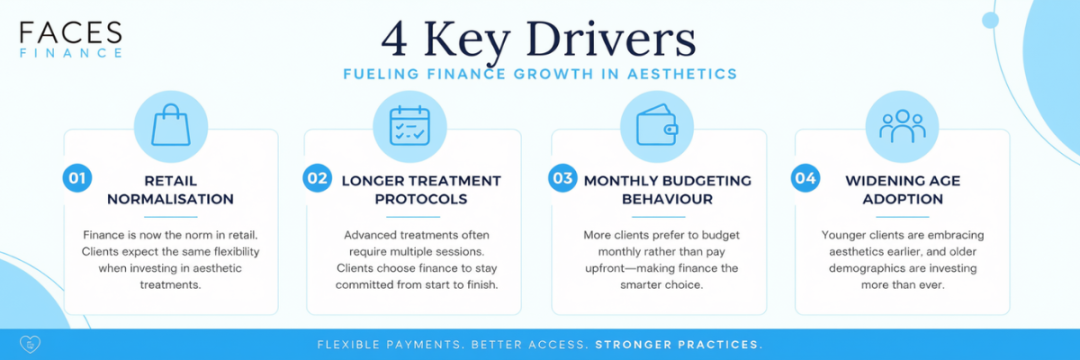
Retail normalised the mechanism
Spreading a cost is no longer a signal of financial difficulty for most people who do it. Experian’s analysis found more than 100 million buy now pay later transactions across 8.5 million UK customers during 2025, worth over £7 billion, with 98.5% of balances repaid on time. In March 2026 alone there were more than nine million transactions across nearly four million consumers, worth £621 million, at an average transaction value of around £60. Retail Technology Innovation HubRetail Technology Innovation Hub
That average is the useful number. At £60 a transaction, this is not people financing emergencies. It is people using a payment rail for ordinary purchases. Retail-style installment payment options trained a large part of the UK population to expect the choice at every checkout, and clients carry that expectation into a clinic without adjusting it for the setting. flexible payment options stopped being a concession and became a category of payment method.
Treatment plans got longer and more expensive
The clinical side of the industry moved toward protocols rather than single appointments. Skin programmes running to four or six sessions, energy-based device courses, body work and combination plans all carry a total cost that a client cannot reasonably absorb from one month’s disposable income.
This is the honest answer to why clients ask for finance. It is rarely that the client cannot afford the treatment. It is that the plan the practitioner assessed as clinically appropriate is priced as a course, while the client budgets by the month. The mismatch produces the familiar compromise: one session booked instead of four, a partial result, and no rebooking.
Budgeting behaviour, not affordability failure
Consumer research consistently finds that users cite convenience or a simple preference for the product as their primary reason for using instalment credit, with a smaller proportion citing explicit credit constraints. Many clients who ask about monthly payment options could pay in full and choose not to, because holding cash matters more to them than avoiding a payment schedule. Federal Reserve Bank of Philadelphia
Treating every such request as a sign of financial strain misreads the client and tends to produce an awkward conversation.
Adoption is spreading beyond the youngest cohort
25 to 34 year olds remain the largest user group, but adoption continues to expand across all age ranges, with particularly strong growth among older demographics. A clinic whose client base skews toward 45-plus should not assume the question will not come. Retail Technology Innovation Hub
Who is actually asking, and why that shapes the answer
The demand-side picture carries a caution that belongs in a professional article rather than a marketing one.
The FCA’s own research found that deferred payment credit users are on average younger, less creditworthy, hold higher levels of unsecured debt and are more likely to be in financial difficulty than the UK population, and are almost twice as likely to be in serious financial distress. The same research did not find consistent evidence that this borrowing causes medium-term indebtedness. Separately, Citizens Advice research found nearly a third of users due to make a payment had borrowed money to repay their instalments. FCA + 2
Both findings are true at once, and holding them together is the point. Most clients using treatment financing for clients are budgeting. A minority are not, and there is no reliable way for a practitioner to tell which is which across a consultation table.
That is precisely why affordability assessment sits with the lender and not with the clinic. Offering finance for clients through an authorised lender who runs a proportionate creditworthiness check is a safeguard for the practitioner as much as for the client. A declined application is the system doing its job, not an obstacle to route around.
What changed on 15 July 2026
Deferred Payment Credit came under FCA regulation on that date. DPC is the regulator’s term for interest-free credit repayable in twelve or fewer instalments within twelve months, provided by a lender who is not the business supplying the goods or services. Lenders must now give clear upfront information, carry out proportionate affordability checks, support customers in financial difficulty, and clients can complain to the Financial Ombudsman Service. The full position is set out in the FCA’s guidance on regulating buy now pay later and in policy statement PS26/1. FCA
For a clinic, the practical effect is that pay later for treatments is now a protected consumer credit product rather than an unregulated retail convenience. What that means for a clinic’s own permissions is covered in what it takes to offer finance in your clinic, and the misconceptions that cluster around it in 5 common myths about offering finance in aesthetic clinics.
Answering the question without making a financial promotion
This is where the demand shift creates real risk, because the client asks in writing and the reply is in writing.
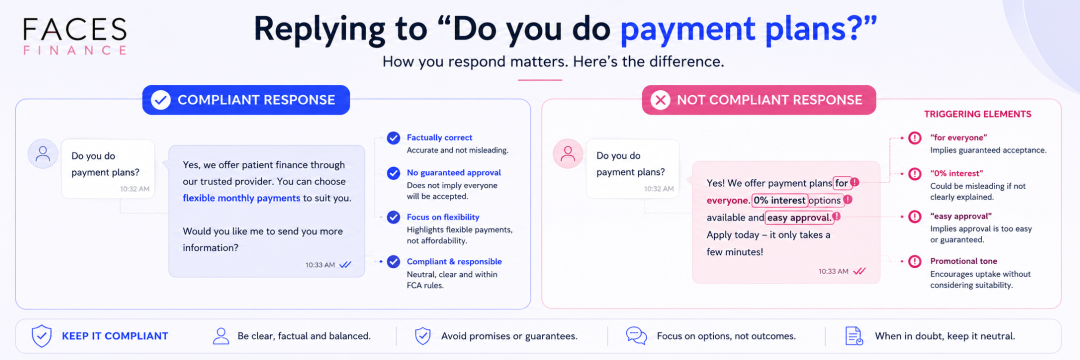
A communication inviting someone to take credit is a financial promotion. Under CONC 3.5, a promotion stating an interest rate or an amount relating to the cost of credit must carry a representative example given no less prominence than the figure that triggered it. A monthly repayment figure counts.
The distinction that keeps a reply on the right side of this is availability versus cost. A neutral statement that payment options for treatments are available at booking generally sits outside the trigger. A figure, a rate or a term does not. The same test applies to a website banner, a price list footer and a direct message.
Language matters too. Phrasing built around outcomes and benefits, of the “affordable treatment payments” variety, invites a judgement about affordability that neither the clinic nor the practitioner is in a position to make about an individual client. Descriptive wording is safer than persuasive wording. Where a lender supplies approved copy for client finance options, use it as written rather than rewriting it for tone.
The second rulebook is the CAP Code. Advertising for cosmetic interventions must not trivialise the procedure, exploit insecurities or apply undue pressure, as the ASA sets out in its guidance on social responsibility in cosmetic interventions. Time-limited framing is the recurring failure. In one ruling the ASA found that emphasis on an exclusive, time-limited offer portrayed the decision to book a cosmetic procedure as one to be taken quickly to avoid missing out, which trivialised the risks and was socially irresponsible. Several cosmetic clinics have been flagged through the ASA’s Active Ad Monitoring system, which uses AI to search proactively for non-compliant online ads. ASADWF
Attaching a countdown to a credit offer breaches both rulebo oks in one graphic. Promote availability, never urgency. The broader advertising position is covered in advertising Botox in the UK: what you can say.
Where it belongs when the client raises it first
Existing guidance on introducing finance assumes the practitioner brings it up. When the client opens with it, the order still holds but the discipline is harder.
Clinical indication first. The client who has asked about client payment plans before a consultation has anchored on a budget rather than a plan. Answering the payment question fully before assessing suitability lets the budget shape the clinical decision, which is the wrong way round. Confirm availability briefly, then move to assessment, then price, then payment.
Do not quantify in advance. Saying that finance plans for clients are available is fine. Estimating what a plan might cost per month before a treatment plan exists is both a financial promotion and a clinical commitment made without an examination.
Let a decline stand. Where affordability is the barrier, a client can reasonably reapply with a larger deposit or a smaller order value, which converts a dead end into a smaller booking. Where treatment finance options have been declined outright, that is the end of the finance conversation. Where the application sits inside the consent form or booking system the client is already using, the drop-off between interest and application narrows considerably.
The same shift is happening in training
Course fees running to four figures are a bottleneck for capable candidates, and academies see the same enquiry pattern clinics do. payment options for training courses are now a routine question at the point of enquiry rather than at the point of payment.
For an academy, training course payment plans fill cohorts that would otherwise run under capacity. For a practitioner, course financing options decide whether a qualification happens this quarter or a year later. Academies listed on Faces can offer instalments on aesthetic training courses and online courses through the same permissions structure, affordability assessment and advertising restrictions that apply to treatments. flexible finance for services works identically whether the service is a skin programme or a Level 7 module.
What to expect over the next twelve months
Two developments are worth tracking.
The first is a likely rise in declines. Analysts broadly expect regulation to reduce approvals as lenders apply creditworthiness assessment to every transaction, including low-value ones. Clinics should plan for a lower approval rate than the pre-July baseline and brief reception staff accordingly, so a decline is handled without embarrassment on either side.
The second is that the promotion rules themselves are under review. In April 2026 the FCA published CP26/15, consulting on removing provisions in CONC 3 that may be overly prescriptive or outdated and relying instead on the Consumer Duty’s consumer understanding outcome. Responses closed in June 2026. If the proposals land as drafted, the prescriptive triggers loosen while the clear, fair and not misleading standard stays, which makes a lender’s approved wording more valuable rather than less. Any clinic setting up finance for treatments this year should expect its promotional guidance to be reissued at least once.
Patient and Client Financing for Aesthetic Practices has moved from a differentiator to an expectation inside eighteen months. The clinics that will handle the next eighteen months well are the ones treating the enquiry as a payment preference to be answered accurately, rather than a signal to sell harder.
Getting set up
If clients are asking and the answer is currently no, that gap is a registration form rather than a strategic decision.
Open Finance Hub from your Faces dashboard, select Register, and upload your current professional indemnity insurance, training certificate and photo ID. Payl8r, the lender behind Faces Finance, is authorised and regulated by the FCA under firm reference number 675283 and onboards businesses as Introducer Appointed Representatives under its own permissions, which is the route most clinics use. Before publishing anything about it, read the advertising guidelines issued at approval and check the live merchant rate shown in Finance Hub rather than a figure quoted elsewhere.
FAQs
Should a clinic assess whether a client can afford the repayments?
No, and attempting to creates risk. Affordability and creditworthiness assessment is the lender’s regulated responsibility. A clinic that forms its own view invites a complaint that it advised on suitability, which sits outside its permissions. Confirm availability, let the client apply, and accept the outcome.
Is “payment plans available” safe to post without a representative example?
A neutral statement of availability generally sits outside the CONC 3.5 trigger. Adding a monthly figure, an interest rate or a repayment term does not. Where a lender supplies approved wording, use it exactly. Anything time-limited also risks the CAP Code rules on pressure in cosmetic interventions advertising.
Should finance be mentioned if the client has not raised it?
Where instalments are genuinely available, mentioning them alongside the price during the treatment plan discussion is standard practice and reads as neutral information. Producing them after a client has hesitated reads as a rescue attempt and lands as pressure. The difference is timing rather than wording.
Does offering instalments attract clients who cannot afford treatment?
The evidence does not support that framing. Most instalment use is budgeting behaviour by people who could pay another way, and the great majority of balances are repaid on time. The minority in genuine difficulty are identified by the lender’s assessment, which is a stronger filter than a clinic asking about income.
Are financed clients more likely to cancel or complain?
Agreements entered after 15 July 2026 over £100 fall under Section 75, making the lender jointly liable with the merchant if something goes wrong. That raises the value of proper consent records, aftercare documentation and a defined complaints route, since there is nothing to return in a clinical setting. Treat finance as part of the clinical record trail rather than separate from it.