
The assessment is finished and the plan is agreed: three sessions, six weeks apart, with a review at the end. The practitioner gives the total. The client goes quiet. Then the practitioner adds, half as an apology, “We do have finance, if that helps at all?”
The client usually hears one of two things. Either the clinic has decided she cannot afford the plan, or the clinic is now trying to close the sale. The practitioner meant neither. Both reactions are common, and they have the same cause. Finance came into the conversation at the wrong moment, in the wrong tone, and to some clients but not others.
Finance for clients is now routine in UK aesthetics, and the case for offering it has been made many times. Far less has been written about how to discuss finance with clients once it is live, in a way that is clear, fair and within the rules. This guide covers that second question.

Why Finance Talk Starts to Sound Like Selling
Raising it too early
If payment options come up before the treatment plan is settled, they stop sounding like information. They start to sound like a way of getting a bigger plan agreed. The client can no longer tell whether the recommendation came from the assessment or from knowing the cost could be spread. Once she has that doubt, it affects how she hears everything the practitioner says afterwards.
Turning the price into small numbers
Recasting a course as a series of small monthly payments is one of the oldest persuasion devices in retail. It works because a large number feels smaller once it is divided. In a clinical setting that effect is the problem. The client stops asking whether the plan is right and starts asking whether the instalment feels manageable.
The same habit also creates regulatory risk. Under CONC 3.5, a financial promotion that states an amount relating to the cost of credit must include a representative example given no less prominence. A repayment figure counts as that kind of amount. A figure said aloud across a consultation desk comes with none of that context.
Offering it selectively
Some practitioners mention finance only to clients who hesitate, or who look as though they might need it. That is a judgement about someone’s means, made on almost no evidence, and clients often pick up on it. It is also inconsistent. If a complaint arrives later, an inconsistent practice is hard to describe and harder to defend.
What a Clinic Can Say Out Loud
Most clinics using one of the available finance options for aesthetic clinics do so as an Introducer Appointed Representative (IAR) of the lender. The FCA Handbook defines that role narrowly. An IAR can do two things: make introductions, and distribute non-real-time financial promotions. A consultation is a live, spoken conversation. Those two facts together set the practical limits.
A practitioner can:
say that finance is available,
explain in general terms how it works, and
give or send the client the lender’s own approved information and application link.
A practitioner should not recommend a term, suggest which product suits the client, estimate what repayments would be, or predict whether an application will be approved. Anything that sounds like advice falls outside the introducer role.
That is less restrictive than it sounds, because the specifics have a proper place. The FCA began regulating Deferred Payment Credit on 15 July 2026. Since then, lenders must check affordability before lending. They must also give borrowers clear information upfront: how much is borrowed, when payments are due, and what happens if one is missed. The client gets accurate, personal figures from the lender during the application. The practitioner’s job is to point the client there, not to reproduce those figures from memory.
Professional standards point the same way. The GMC’s guidance for doctors offering cosmetic interventions says clinicians must not use promotional tactics that could encourage an ill-considered decision. It also says they must not let financial or commercial interests affect their recommendations. Nurse and dental prescribers work under their own professional codes. Even so, the GMC wording is a useful benchmark for any clinician handling aesthetic clinic payment plans.
The exact wording a clinic may use comes from the lender’s promotional guidelines, issued at onboarding. Those guidelines take precedence over general advice, this article included. The permissions background is covered in What It Takes to Offer Finance in Your Clinic. The most common misunderstandings about FCA licensing are addressed in 5 Common Myths About Offering Finance in Aesthetic Clinics.
Where Finance Belongs in the Consultation
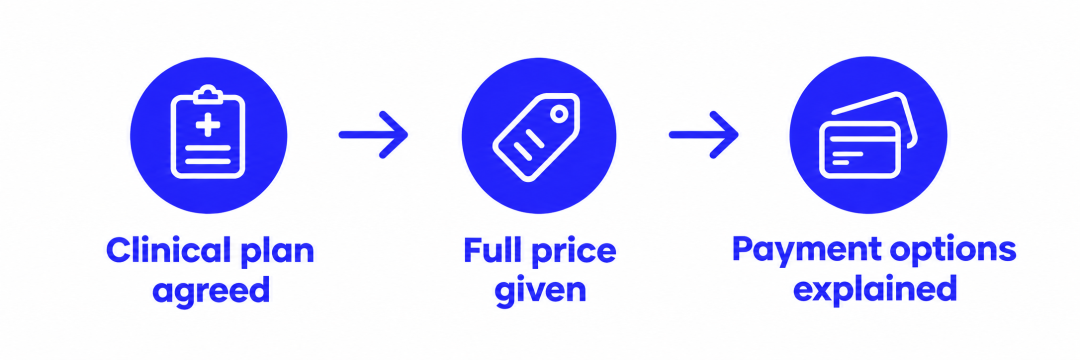
Clinical plan first
The assessment, indication, options, risks and agreed plan all come before money is mentioned. This protects the recommendation. The plan should be one the practitioner would make whether or not aesthetic treatment finance existed. If finance is never raised while the plan is being built, nobody can later suggest it shaped the plan.
Price second, stated in full
Transparent pricing means giving the full cost of the full plan. That includes:
every session,
any review appointment,
any top-up that is clinically expected, and
what happens to the price if the plan changes.
Quoting per session when the protocol needs three sessions leaves the client to do sums the clinic should have done for her. Discussing treatment costs with clients as one clear total also makes the next step simpler, because a single number is easier to decide how to pay. What Botox Costs in the UK, and Why Prices Vary explains why clients so often struggle to compare quotes between clinics. For how finance affects the price list itself, see How to Price Your Aesthetic Treatments When Offering Finance.
Payment method third, and to every client
This is the point at which how to introduce finance options becomes relevant. Once the price is given, the practitioner lists every way it can be paid. That might be card on the day, pay-per-session where the protocol allows, or finance through the clinic’s lender. The same neutral sentence is used for every client.
Identical wording has three benefits. It removes any suggestion about who needs help paying. It keeps the line neutral, because a fixed sentence is hard to stretch into a pitch over time. And it gives the clinic a consistent practice it can describe and evidence if it is ever questioned. For most clinics, that is the whole answer to how to offer finance to clients: the same way, at the same point, every time.
Wording That Explains Without Persuading
A good finance conversation with clients is short and factual. A line like the following works for many clinics, subject to the lender’s guidelines:
“The total for the plan is [price]. You can pay by card at each session, or if you’d rather spread the cost, finance is available through [lender]. You apply directly with them on your phone. They make the decision, and they’ll show you the full cost and repayment schedule before you agree to anything. You don’t need to decide today.”
Each part of that line does a job:
Naming the lender tells the client who the credit is with.
Saying the lender decides keeps the decision where it belongs.
Explaining that the lender shows the figures tells the client where the numbers will come from.
The last sentence takes away time pressure, which the GMC’s emphasis on reflection time supports directly.
Some phrases should be dropped entirely.
“It’s only [amount] a week” shrinks a credit agreement into a small number. It invites exactly the comparison that CONC and the CAP Code exist to control.
“You’ll definitely get approved” is something nobody at the clinic can know. Implying otherwise misrepresents the lender’s assessment.
“Most of our clients pay this way” is social proof aimed at a borrowing decision.
“If you book today” attaches urgency to credit. It breaches the spirit of both advertising codes at once and has no place in a clinical conversation.
The same approach answers how to explain finance to customers at reception or on the phone: the same sentence, in the same order, followed by the same handover to the lender.
When the client asks what it would cost each month
Practitioners find this the hardest question to answer without sounding evasive. The honest answer is also the compliant one. The lender works out the figure from the amount, the term and the client’s own application, and shows it in full before anything is signed.
Knowing how to explain payment plans at this general level, without giving a number, is worth practising. The natural instinct is to offer a rough figure. A rough figure said aloud is exactly the kind of cost information that should only ever appear with its full context around it.
When the client is declined
A decline means the lender’s affordability check has done its job. The practitioner’s response should be brief and neutral. Where it is clinically sound, the plan can be staged or reduced and paid for another way. What should never happen is any hint of how to get around the decision. A client who later feels the clinic helped her work around an affordability check has a legitimate grievance.
Treatment Affordability Is Part of Suitability
The lender decides whether a client can afford the credit. The practitioner still decides whether the treatment is appropriate. Treatment affordability is part of that decision in ways a lender cannot see. A client might mention that she needs the result before an event, sound anxious about the cost, or describe the plan as a stretch. Each of these is clinically relevant information about pressure and motivation, the same kind of information the practitioner would weigh in any suitability assessment.
In those cases, payment plans for aesthetic treatments are not the first thing to reach for. A smaller first stage, more time to reflect, or a later start date may suit the client better. None of these damages the relationship.
A client who feels steered into credit is more likely to complain. Since the FCA’s regime took effect, borrowers who are unhappy with a DPC lender can complain to the lender and then take the matter to the Financial Ombudsman Service. A dispute about a financed treatment can therefore end up with the lender, which then looks at how the introduction was made.
Record the payment conversation in the consultation notes. Note that payment options were described in the standard way and that the client was given time to decide. It takes a single line and makes the practice easy to evidence later.
Build It Into the System, Not the Script
The less the spoken conversation has to carry, the easier it is to keep neutral. That is the practical side of how to make finance part of the consultation: put the information where the client meets it before and after the consultation.
Clinics using Faces Finance can offer client finance options at three points: through the consent form, through the booking link, or through a direct finance link sent after the consultation. Each route takes the client to the lender’s own application, with the lender’s own disclosures. The client can read the terms at home, with no practitioner in the room. That is exactly the setting the reflection-time principle has in mind.
The price list and website can include a neutral line saying finance is available, using the lender’s approved wording and no repayment figures. Clients who have already seen that line arrive knowing the option exists. The mention in the consultation then becomes a reminder rather than a surprise.
Then brief the team. Everyone who might be asked about instalments, reception included, needs to know how to offer payment plans within the same limits:
the standard sentence,
no figures,
no predictions about approval, and
no views on which option suits the client.
Why Clients Choose Flexible Payment Options for Treatments gives staff the background to the questions clients tend to ask. The Revenue Maths Behind Buy Now, Pay Later covers the commercial side, which should stay entirely out of the consultation.

What to Change Before the Next Consultation
Write the sentence down. Keep one version, checked against the lender’s promotional guidelines. Everyone in the clinic uses it at the same point: after the plan, after the full price, with every client. Remove any figure from it. After a month of consultations, check whether anyone has drifted from it. That fixed line is most of the answer to how to talk about finance with clients without sounding like a sales pitch, because a sentence that never changes cannot be adjusted to close a sale.
Check the sentence again whenever the lender reissues its guidelines. The FCA is reviewing its consumer credit promotion rules through consultation CP26/15, so those guidelines are likely to change at least once in the next year.
Set Up Finance the Right Way
Clinics on Faces can register for Faces Finance from Finance Hub in the dashboard. The lender’s promotional guidelines arrive with onboarding. Use them to write the clinic’s one standard sentence before the first financed consultation. Then add the finance link to the consent form, so every client can read the terms at home before deciding.
FAQs
Should finance be mentioned before or after the price?
After. The clinical plan comes first, then the full price, then the ways it can be paid. Raising finance earlier makes it look as though the plan was built around the option to spread the cost.
Can a practitioner give a client a rough idea of the monthly cost?
No. The lender calculates repayments from the amount, the term and the client’s application, and shows the full schedule before anything is agreed. A rough figure given in conversation has none of the context the rules require alongside cost information. It can also turn out to be wrong.
Should all financing options for aesthetic treatments be mentioned to every client?
Yes, in the same wording and at the same point. Offering financing options for aesthetic treatments only to clients who seem hesitant implies a judgement about their means. It also makes the clinic’s practice inconsistent and harder to evidence.
What should a practitioner say if a client asks whether applying affects her credit file?
The lender explains what checks it runs during the application, and that is where the client should get the answer. The clinic should not guess. For general background on the protections that now apply to this kind of credit, the FCA’s consumer guide to Buy Now Pay Later is a reliable page to share.
Can reception staff answer questions about finance?
Yes, within the same limits as practitioners. Talking about finance with clients at reception should follow the clinic’s standard sentence, avoid figures and predictions, and hand the client over to the lender’s application. Staff should have completed the training the lender provides at onboarding.