
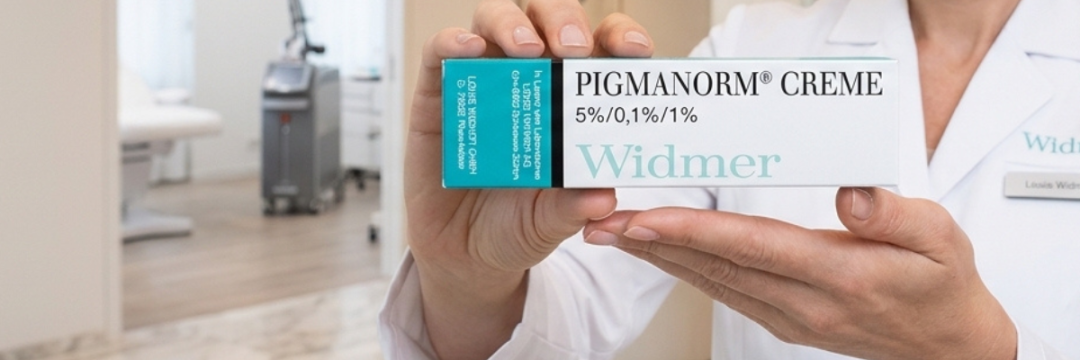
Two tubes with the same name can contain different steroids. Pigmanorm Cream is made in a German version with hydrocortisone and a Swiss version with the dexamethasone. Many aesthetic practitioners only find this out when a client brings in a carton printed entirely in German. That detail sums up the problem with this cream in UK practice: it works well, but it is widely misunderstood and often supplied outside the rules meant to protect clients.
Pigmanorm combines three prescription-only actives, and each one fades pigment in a different way. With an accurate diagnosis, a defined course and strict sun protection, it is one of the strongest topical options for melasma and post-inflammatory pigmentation. Without them, it can leave skin red, thinned and darker than before treatment started.
How the Hydroquinone, Tretinoin and Hydrocortisone Formula Works
Pigmanorm Widmer cream is a modern version of the triple combination described by Kligman and Willis in 1975. The German summary of product characteristics for Pigmanorm Creme Widmer lists each gram as containing 50mg hydroquinone, 1mg tretinoin and 10mg hydrocortisone. That gives strengths of 5%, 0.1% and 1%. Each ingredient does a specific job, and the combination works better than any of them alone.
- Hydroquinone 5%: inhibits tyrosinase, the enzyme that converts tyrosine into melanin. It also damages melanosomes and reduces melanocyte activity, so new pigment production slows.
- Tretinoin 0.1%: speeds up epidermal turnover, so pigment already in the skin is shed faster. It also disperses pigment granules and helps hydroquinone penetrate.
- Hydrocortisone 1%: calms the irritation tretinoin causes. Irritation itself triggers pigment, so this matters. Corticosteroids also slightly suppress melanocyte metabolism.
The two versions differ in more than the steroid. The Swiss product made by Louis Widmer uses hydroquinone 5%, tretinoin 0.03% and dexamethasone 0.03%. The German version, with the hydrocortisone base above, is the one listed in the NHS dictionary of medicines and devices as Pigmanorm cream imported from Germany. Prescribers should confirm which version a patient holds before advising on strength, irritation risk or duration.
Who This Triple Cream Suits, and Who Should Avoid It
The licensed indication in Germany covers melanin-related hyperpigmentation, including melasma (chloasma) and post-inflammatory hyperpigmentation. In practice, Pigmanorm cream is most useful for:
- epidermal melasma that has not responded to sun protection and non-prescription brighteners
- post-inflammatory hyperpigmentation after acne, eczema or aesthetic procedures, once the inflammation has settled
- pigment priming before peels in clients with darker skin types who are prone to rebound pigmentation
Diagnosis comes first. A lightening cream should never be applied to a pigmented lesion that hasn’t been assessed. A changing, irregular or solitary dark patch needs dermatology review to rule out lentigo maligna or another melanoma before any treatment starts. Dermal melasma, which looks blue-grey and shows little contrast under a Wood’s lamp, responds poorly to topicals of any strength.
The cream is not suitable for:
- Pregnancy and breastfeeding: tretinoin is contraindicated.
- Damaged skin: broken, eczematous or sunburnt skin.
- Steroid-sensitive conditions: rosacea and perioral dermatitis, which the corticosteroid can worsen.
- Known allergy to any of the ingredients.
- Competitive athletes: the German product information warns that the corticosteroid component can produce a positive result in doping controls.
Application, Treatment Cycles and Common Mistakes
Unless the prescriber directs otherwise, the product information advises applying the cream sparingly once a day to the pigmented areas only. Most prescribers recommend the evening, because tretinoin breaks down in light and the skin is more sensitive afterwards.
A practical routine for clients:
- Cleanse and dry. Cleanse gently and pat the skin fully dry. Applying to damp skin increases penetration and irritation.
- Apply a thin layer. Use a thin layer over the affected patches, keeping clear of the eyes, nostrils and lips.
- Wash hands. Wash hands straight after applying.
- Moisturise if needed. If the skin is dry, a bland moisturiser can go on later. Many prescribers suggest waiting about an hour.
- Protect from the sun every morning. Apply a broad-spectrum SPF 50, reapply through the day, and wear a hat outdoors. For melasma, a tinted sunscreen containing iron oxides adds protection against visible light, which also drives pigment.
Mild redness, stinging and peeling are common in the first two weeks while the skin adapts to tretinoin. If irritation is marked, applying every other night for a week or two usually helps more than stopping altogether. Visible fading usually takes four to eight weeks.
Treatment Cycles and Why Duration Matters
Continuous long-term use is the most common mistake. Every active ingredient has a reason to limit the course length:
- Hydroquinone: prolonged use is linked to exogenous ochronosis, a blue-black discolouration that is very hard to reverse and more common in darker skin types.
- Hydrocortisone: continuous steroid use on the face risks skin thinning, telangiectasia and perioral dermatitis.
Many prescribers therefore use a defined course of up to around three months. They then switch to a maintenance plan without hydroquinone, such as azelaic acid, a gentler retinoid or tranexamic acid, and repeat a course only after a break. Melasma is chronic and relapses easily, so the maintenance plan matters as much as the clearing phase.
Other frequent errors:
- Applying the cream twice daily or to the whole face, which increases irritation and the steroid dose with no extra benefit.
- Stacking it with acids, scrubs or other retinoids.
- Continuing it up to the day of a peel, laser or microneedling session. Stop it several days beforehand, as the prescriber directs, and restart only once the skin has fully healed.
Recording Use in Clinic
Record the formulation, start date, prescriber and planned stop date on the client’s medical record. Note it on digital consent forms for aesthetic treatments before any resurfacing procedure. Add sun protection and stop-date reminders to post-treatment aftercare forms so the client has them in writing.

UK Legal Status and Prescribing Rules
The legal position on Pigmanorm cream UK supply is clear. Hydroquinone is banned from cosmetic products in the UK. It can only be supplied as a medicine against a prescription. Products containing corticosteroids must also be prescribed. The Southwark Trading Standards guidance on illegal skin lighteners sets out both rules. Councils regularly seize unlabelled creams sold online and over the counter, and some of those contain far higher hydroquinone levels than any prescribed product.
Pigmanorm Creme Widmer 30g has no UK marketing authorisation. It is supplied as an imported unlicensed medicine on a named-patient prescription. That places extra responsibility on the prescriber. They need to:
- justify why a licensed alternative isn’t suitable
- explain to the client that the product is unlicensed in the UK
- document the decision and arrange follow-up
Non-prescribing practitioners can’t supply it. Instead, they should work with a prescriber who assesses the client, confirms the diagnosis and sets the course length. This guide to finding an independent aesthetic prescriber explains how that partnership works. Practitioners can connect with a Faces-registered prescriber, who issues the prescription.
What Sets the Cost of an Imported Pigment Cream
There is no single published Pigmanorm cream price for the UK, and a client should be wary of any seller quoting one without asking for a prescription. Four things shape the cost:
- Import: the cream is brought in from Germany as an unlicensed medicine, which adds sourcing and handling costs that UK-licensed products don’t carry.
- Pack size: dm+d lists a 15g pack, while the 30g tube holds twice the quantity. The larger pack usually works out cheaper per gram.
- Prescription and follow-up: a prescriber’s assessment and review are part of the true cost of a safe course.
- Usage: used sparingly once daily on localised patches, a 30g tube typically lasts several weeks to a few months.
Practitioners logged in to the Faces platform can view current pricing on the product page. The cheapest route on paper is often the most expensive in practice. Unregulated creams that cause irritation, rebound pigmentation or ochronosis cost far more to correct than a properly prescribed course.
The clinics that get the best results from Pigmanorm Creme Widmer 30g treat it as a course with a clear diagnosis, a stop date and a maintenance plan, not a cream to use indefinitely. Building those three things into every consultation protects the client’s skin and the clinic’s reputation.
Stock This Triple Pigment Cream Through a Prescriber
Practitioners treating melasma and post-inflammatory pigmentation can log in to Faces to view Pigmanorm Creme Widmer 30g from Smartway Pharmacy, dispensed with next working day delivery once a prescription is in place. No prescriber yet? Connect with a Faces-registered prescriber to have the client assessed and the course prescribed.
FAQs
Where can this cream be bought legally in the UK?
In the UK, Pigmanorm Creme Widmer 30g can only be supplied legally by a registered pharmacy against a valid prescription, because hydroquinone, tretinoin and hydrocortisone are prescription-only. Creams sold without a prescription through market stalls, social media or unregulated websites are illegal. They may be counterfeit or contain undeclared ingredients. A prescriber’s assessment also confirms that the pigmentation is safe to treat.
What is the difference between the Swiss and German versions?
The German version contains hydroquinone 5%, tretinoin 0.1% and hydrocortisone 1%. The Swiss version contains hydroquinone 5%, tretinoin 0.03% and the stronger corticosteroid dexamethasone at 0.03%. The lower tretinoin level in the Swiss cream can make it slightly less irritating. The prescriber should confirm which version is being supplied.
Is it the same as the Kligman formula?
It is closely based on it. The original 1975 Kligman formula combined hydroquinone 5%, tretinoin 0.1% and dexamethasone 0.1% in a compounded cream. The Widmer cream is a commercially manufactured, standardised version of that triple combination, with consistent strength and stability batch to batch.
Can it be used during pregnancy or breastfeeding?
No. Tretinoin is contraindicated in pregnancy, and the cream should not be used while breastfeeding. Melasma that appears in pregnancy often improves after delivery. Strict sun protection is the safest approach until pregnancy and breastfeeding are over, when a prescriber can reassess.
Can it be used on the body as well as the face?
It can be prescribed for pigmentation on other areas, but large treatment areas increase absorption of both hydroquinone and the corticosteroid. Prescribers usually limit it to small, defined patches. Thin-skinned areas such as the neck and the skin around the eyes need particular caution.