
Most clinic consent forms still name eyelid droop and bruising as the worst of it. From 15 July 2026 the leaflet in the patient’s hand names something else, iatrogenic botulism, with an instruction to seek immediate medical attention up to four weeks after treatment. That holds whether the vial on the tray was Botox anti-wrinkle injections or Azzalure 125 units for frown lines, because the wording is being revised across every brand licensed here. A patient who reads it at home and then rings the clinic is not being dramatic. She is doing what the manufacturer told her to do, and every aesthetic clinic offering toxin treatments needs a written answer to that call rather than an improvised one.
The MHRA has strengthened the safety warnings attached to every type A product authorised in the UK. The change is small on paper and significant in the treatment room, because it moves a rare complication from something practitioners knew about into something patients are explicitly told to act on.

What the MHRA Botulinum Toxin Warnings Change in Practice
The regulator published its position as a Drug Safety Update on iatrogenic botulism, volume 19, issue 12, developed with input from the JCCP, Save Face, NHS England’s patient safety team and UKHSA. The MHRA botulinum toxin warnings are not describing a newly discovered risk. Distant spread has appeared in UK product information since 2007.
Three things are genuinely new. Iatrogenic botulism is now named explicitly in the Summary of Product Characteristics and the Patient Information Leaflet rather than being implied by the wording on spread of effect. Patients are told directly to seek immediate medical attention if symptoms appear. And the revised documents roll out across manufacturers over the coming months rather than on one date, so for a period the leaflet in the box may not match the leaflet a patient reads online.
The practical consequence is that consent and aftercare wording written against the older leaflet is now behind the product information your patient will be handed. That is the gap to close.
Botulism Meaning and Why the Iatrogenic Form Behaves Differently
The botulism meaning most practitioners carry is the foodborne one: contaminated preserves, a bacterial illness. The mechanism is the relevant part. Botulinum neurotoxin is produced by Clostridium botulinum, a spore-forming anaerobe present in soil, water and marine sediment. Once in the body the neurotoxin reaches the neuromuscular junction and blocks acetylcholine release, producing a bilateral, symmetrical, descending flaccid paralysis that begins with the cranial nerves and moves down.
The iatrogenic form is caused by the procedure itself, when excess toxin enters the bloodstream and acts beyond the intended treatment area. UKHSA puts the incubation period commonly at four to eight days, occasionally as short as one day, occasionally several weeks. There is usually no fever, no sensory loss and no loss of awareness, which is what separates it clinically from the stroke and Bell’s palsy that anxious patients tend to reach for first.
Botulism Symptoms and the Four-Week Window
The discriminator is whether the presentation is systemic and progressive.
What is expected after treatment
Localised effects are common and vary by site: injection-site pain, swelling and redness, ptosis, blurred or double vision, dilated pupils, headache. UKHSA is explicit that localised effects which are not progressing in severity, and are not accompanied by systemic neurological symptoms, do not indicate iatrogenic botulism and do not require antitoxin.
What warrants an emergency response
The botulism symptoms that need escalating are difficulty swallowing, slurred speech or a change in voice, difficulty breathing or shortness of breath, and muscle weakness away from the treated area. The MHRA also names severe drooping of the upper eyelids. Symptoms can appear within days or up to four weeks after treatment. This is a medical emergency, the patient should be told to call 999, and they should not drive themselves.
The clinicians route
Clinicians managing a suspected case should follow the UKHSA guidance on clinical management of iatrogenic botulism. Antitoxin is arranged through the Botulism Service at UKHSA Colindale, via the duty doctor on 020 8200 4400, in and out of hours.
One detail changes how urgently this is treated. Antitoxin binds circulating toxin only. It does not displace toxin already bound at the neuromuscular junction, so it limits further progression rather than reversing existing weakness. Where clinical suspicion is strong, treatment is not delayed for laboratory confirmation, and serum for testing must be taken before antitoxin is given. Confirmation by assay has low sensitivity in iatrogenic cases because circulating toxin levels are low, so a negative result does not close the question. Where a clinic has access to a Complications Consultant, this is the point to use it, alongside rather than instead of emergency care.
Botulinum Toxin Type A Products Licensed for UK Use
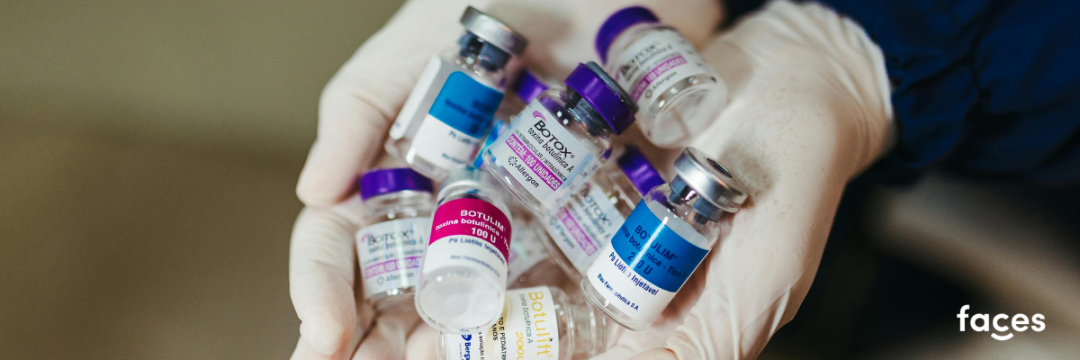
The Botulinum toxin type A products authorised in the UK carry different licences, different unit systems and different dosing, and the MHRA’s instruction is to follow product-specific guidance rather than a house protocol applied across brands. The full list and current product information sits on the MHRA products database.
Botox is onabotulinumtoxinA, supplied as 50, 100 and 200 unit vials for reconstitution with preservative-free 0.9% sodium chloride. Licensed aesthetic dosing is 20 units to the glabellar complex across five points at 4 units each, 24 units for lateral canthal lines at 12 units per side, and 20 units for horizontal forehead lines given alongside glabellar treatment. Treating all three areas in one session totals 64 units.
Bocouture 50 units is the aesthetic presentation of incobotulinumtoxinA, free of complexing proteins, with a standard glabellar dose of 20 units across five points that the Bocouture product information allows to be increased to 30. It is stored below 25°C before reconstitution, which changes how a clinic plans stock and cold chain. Dosing area by area is covered in more depth in this guide to Bocouture dosing by treatment area. In the UK the aesthetic indications sit with that brand, while Xeomin 100 units holds the therapeutic licence for the same active substance, covering blepharospasm, cervical dystonia, limb spasticity and chronic sialorrhoea.
Azzalure 125 Speywood units is abobotulinumtoxinA. The Azzalure glabellar injection technique is 50 Speywood units divided across five points at 10 units each, two into each corrugator and one into the procerus near the nasofrontal angle, with the thumb or index finger held firmly below the orbital rim to prevent extravasation. Dysport 500 units vials contain the same active substance in the therapeutic presentation, licensed for indications including axillary hyperhidrosis, cervical dystonia and spasticity.
Alluzience ready-to-use liquid toxin removes reconstitution entirely. Each vial holds 125 Speywood units in 0.625 ml at a fixed 200 Speywood units per ml, with a glabellar dose of 0.25 ml given as 0.05 ml per point. The Alluzience prescribing information reports median onset at three days, effect demonstrated for up to six months, and a minimum three-month treatment interval.
Relfydess 1.5ml single vial is relabotulinumtoxinA, also ready to use, at 100 units per ml with 150 units per vial. The Relfydess summary of product characteristics gives 50 units for glabellar lines across five sites, 60 units for lateral canthal lines across six sites, and 110 units for combined treatment, with median onset at two to three days and one vial per patient per session. What that means for stock planning and waste is set out in this piece on Relfydess as a Botox alternative.
Units are not interchangeable between any of these. A conversion ratio applied across brands is not supported by any of the product information, and dose error is one of the risk multipliers the MHRA names.
Dose, Site and Technique: Where Botulinum Toxin Injections Carry Most Risk
The MHRA identifies four circumstances in which the risk of spread and botulism rises: patients with predisposing conditions, high doses, off-label use or administration into unapproved sites, and counterfeit or unauthorised product.
For botulinum toxin injections in aesthetic practice, the first three are worth translating into clinic behaviour.
Cumulative dose creeps upward without anyone deciding to increase it. Three licensed upper-face areas already total 64 units of onabotulinumtoxinA. Add masseters, platysma and hyperhidrosis work in the same appointment and the session total climbs while every individual area still looks conservative on the record card. Record the session total, not only the per-area figures.
Lower-face and neck work carries more distant-spread risk because of proximity to the muscles of swallowing, and it sits outside the licensed indications for every product listed above. The reasoning behind depth, dose and patient selection for that area is covered in this guide to platysma band treatment technique.
Screening matters more than it did. Ask directly about neurological diagnoses, any history of dysphagia and any history of aspiration, and about concomitant medicines that affect neuromuscular transmission. Keep intervals no more frequent than twelve weeks, which is both a licensing point and an immunogenicity one.
Toxin Supply and Why Provenance Is Now a Clinical Question
Toxin provenance is the reason the MHRA is revisiting this at all. Between 4 June and 6 August 2025, 41 confirmed botulism cases were reported across the North East, East Midlands, East of England, North West, and Yorkshire and Humber. The MHRA crackdown on illegal Botox supply followed, and its Criminal Enforcement Unit has opened a number of investigations.
Since May 2023, working with Border Force, the unit has seized more than 4,700 vials. Almost all originated in South Korea, including brands such as Botulax, reNTox, Innotox and Toxpia, none of which is authorised for UK sale. Selling or supplying unlicensed product carries up to two years in prison and unlimited fines under the Human Medicines Regulations 2012.
These are prescription-only medicines, supplied against a prescription or a Patient Specific Direction, and prescribers are expected to satisfy themselves that whoever administers the product is appropriately trained and working to the prescription. In practice that means ordering through a registered pharmacy, recording batch numbers against each patient, keeping cartons until treatment is complete, and maintaining cold chain on delivery. Sourcing through the Faces Pharmacy with connected prescribers and next day delivery keeps that audit trail intact in one place. It also removes the pricing pressure that drives the problem, since the economics of undercutting are explained well in this breakdown of what Botox costs in the UK. Licensed stock across brands is listed under toxins and diluents for practitioners.
What to Change in Your Botulinum Toxin Protocol
Six changes cover most of the exposure created by the update to botulinum toxin product information.
Update consent so it names iatrogenic botulism, states the four-week symptom window and records that the emergency instruction was given. The Faces’ botulinum toxin consent form templates can carry this as standard wording across every practitioner in a clinic.
Rewrite aftercare as something the patient keeps. A verbal warning at the door does not survive eleven days. The aftercare form should list the four escalation symptoms and the instruction to call 999.
Write a reception script for calls about swallowing, speech or breathing, so a non-clinical team member escalates rather than books a review.
Add neurological history, dysphagia and aspiration to the medical form questions, and record product, batch and session total for every treatment.
Report suspected reactions through the Yellow Card scheme, including cases where the product used is unlicensed or unknown.
Check your insurance position and your route to complications support before you need either.
The revised SmPCs and leaflets land across manufacturers over the coming months rather than all at once. Clinics that write consent by reference to the current product information, rather than transcribing wording from a leaflet into a template, will only have to do this once.
Update Your Consent Before Your Next Treatment Day
Bring your consent form and aftercare form wording in line with the updated product information before your next treatment day, and order licensed stock from online pharmacies UK with batch traceability and next day cold chain delivery through Faces. Set up your consent and aftercare templates once, and every practitioner in the clinic sends the same warning home with every patient.
FAQs
What is botulism?
Botulism is a rare, potentially life-threatening illness caused by a neurotoxin that blocks the release of acetylcholine at the neuromuscular junction, producing descending flaccid paralysis. It occurs in several forms, including foodborne, wound, infant and iatrogenic, the last caused by a therapeutic or cosmetic injection where toxin acts beyond the intended area.
What is botulinum toxin?
It is a purified neurotoxin produced by Clostridium botulinum, used as a prescription-only medicine to relax targeted muscles. In UK aesthetic practice the type A form is licensed for glabellar lines, lateral canthal lines and horizontal forehead lines, and therapeutic licences cover conditions such as cervical dystonia, spasticity, axillary hyperhidrosis and overactive bladder.
What causes botulism?
The illness is caused by exposure to botulinum neurotoxin, whether ingested in contaminated food, produced by bacteria in a wound, or introduced by injection. In the iatrogenic form, excess toxin enters the bloodstream and reaches muscles beyond the treatment site. Risk rises with high doses, unapproved injection sites, predisposing conditions and unlicensed or counterfeit product.
What does botulism look like?
It presents as symmetrical weakness that starts in the head and descends: drooping eyelids, blurred or double vision, slurred speech, difficulty swallowing, then weakness in the limbs and, in severe cases, the respiratory muscles. There is typically no fever, no sensory loss and no confusion. After an injectable treatment, isolated local effects that are stable are not botulism; weakness or swallowing and breathing difficulty away from the treated area is a medical emergency.