
A client walks in holding a phone screen full of before-and-after photos and asks for the treatment “that dissolved my friend’s double chin in three sessions.” She’s already looked up where to buy Lemon Bottle fat dissolving solution online herself and wants to know why a clinic visit costs more than a vial delivered to her door. This is now a routine consultation in UK aesthetics clinics, and it puts practitioners in an odd position: patients are often better informed about where to source the product than they are about what’s actually in it, how it’s used, or how it’s regulated.
That gap is worth closing properly, because Lemon Bottle sits in a regulatory category that catches a lot of practitioners off guard.
What Lemon Bottle Actually Is
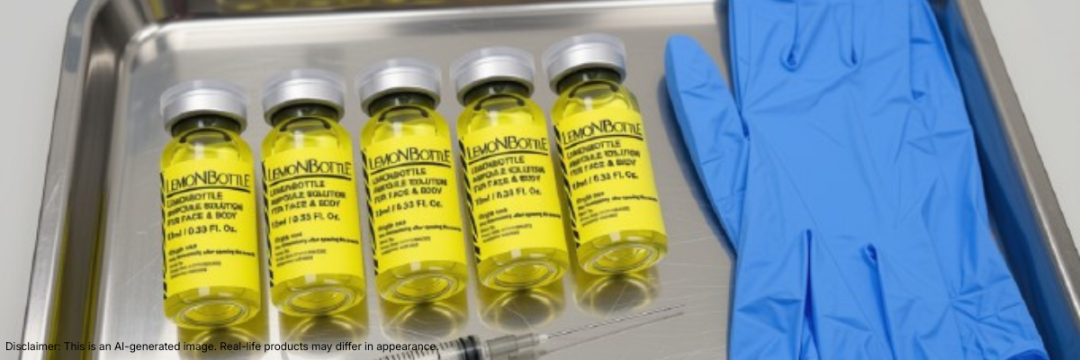
Lemon Bottle is a brand-formulated injectable lipolysis solution manufactured in South Korea, built around riboflavin (vitamin B2), lecithin and bromelain, rather than the deoxycholic acid used in products such as Aqualyx. The manufacturer’s positioning as a “natural” alternative is doing regulatory work as much as marketing work: because the formulation doesn’t contain deoxycholic acid or another recognised active pharmaceutical ingredient, it has consistently been classified as a cosmetic product rather than a medicine in the UK.
Riboflavin is proposed to support fat cell metabolism, lecithin is a phospholipid thought to help emulsify fat for clearance, and bromelain is a plant enzyme credited with reducing local inflammation and swelling. The mechanism is plausible in outline, but it hasn’t been through the kind of controlled trial work that deoxycholic acid products have undergone, and the full excipient list isn’t consistently published by suppliers. That matters practically: it’s the detail a hospital team would need if a patient presented with a reaction and nobody could say precisely what had been injected.
The UK Regulatory Position Before You Start
Because Lemon Bottle fat dissolving injections don’t contain a recognised medicinal ingredient, the Medicines and Healthcare products Regulatory Agency treats the product as falling outside its remit as a medicine. That means it doesn’t require a marketing authorisation, and it doesn’t need a UKCA or CE mark to be sold in the UK, since it isn’t classed as a medical device either. Instead, it’s treated as a cosmetic product under the General Product Safety Regulations, enforced by the Office for Product Safety and Standards and reportable through local Trading Standards.
Is Lemon Bottle safe to use in practice?
The honest answer is that the safety picture is still thin. There’s no statutory requirement for training before someone administers it, which the Joint Council for Cosmetic Practitioners has flagged as a specific gap it wants closed. The JCCP has advised that the product should not be a first-line choice and that appropriate caution should be exercised, noting that MHRA-regulated products give practitioners a higher level of confidence in what they’re injecting. In April 2025 the General Pharmaceutical Council went further, warning pharmacies that “non-medicinal, unregulated, unlicensed” products including Lemon Bottle had potentially caused serious harm, and reminding suppliers that unlicensed products aren’t required to meet the same safety and efficacy standards.
None of this means the product is banned or that clinics can’t offer it, it means the practitioner is carrying more of the risk assessment themselves than they would with a licensed alternative, and that should be reflected in consultation, documentation and consent.
How to Use Lemon Bottle: Preparation and Technique
Preparation
Vials should arrive sealed, with a visible batch number and expiry date, and the solution should be clear rather than cloudy or containing particulate. Standard aseptic technique applies: skin cleaned with an appropriate antiseptic, single-use needles, and a documented batch record kept against the patient’s notes in case of a later reaction or product recall.
Injection technique
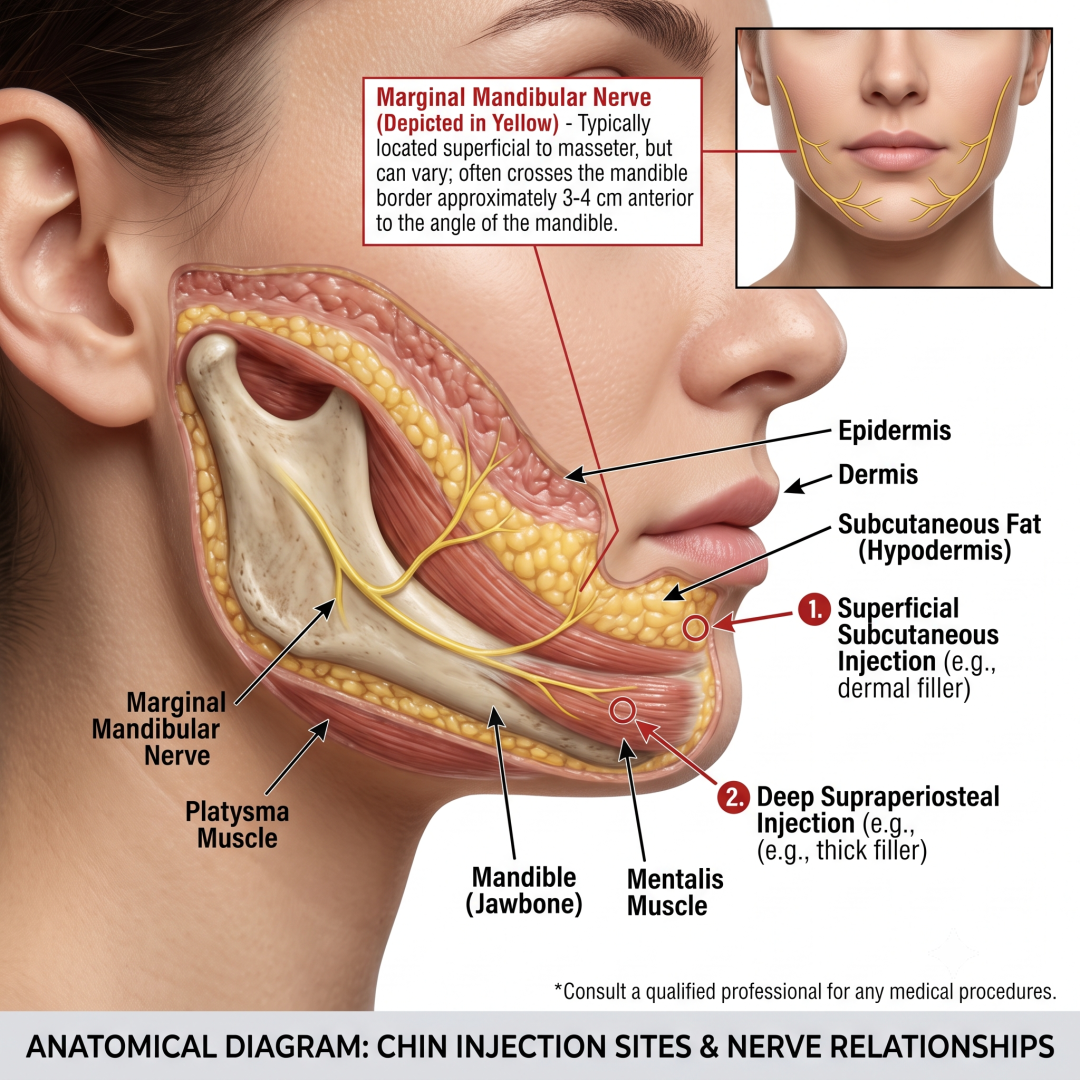
The area is typically marked out in a grid, with injection points spaced roughly 1 to 2cm apart to give even distribution rather than pooling in one spot. Uneven spacing is one of the more common causes of lumpy or asymmetric results, so marking the grid before starting, rather than freehanding it, reduces that risk considerably. Injections are placed into the subcutaneous fat layer, not into muscle, and not so superficially that the product sits in the dermis, which increases the risk of surface irregularity.
Needle choice generally follows area: finer needles, around 30G to 32G, for facial work such as the chin and jowls, and slightly larger 25G to 27G needles for body areas where more volume needs to be delivered per point.
Dosing by area
Because the product is unlicensed, dosing isn’t standardised in the way it would be for a licensed medicine, and figures vary somewhat between suppliers and training providers. As a general working range: facial points are commonly dosed at 0.3 to 0.5ml per point, while body points run from around 1 to 3ml per point, with total session volumes scaled to the size of the area, often 10 to 20ml for a chin or small area, up to 30 to 50ml for a larger zone such as the full abdomen. Facial sessions are usually spaced 2 to 4 weeks apart, with body areas sometimes brought in closer, around 7 to 10 days, depending on the practitioner’s protocol and how the patient responds. Most patients complete a course of 2 to 6 sessions rather than a single treatment.
Given the variation between manufacturers’ guidance sheets, practitioners are better served treating these as a starting range to be confirmed against their specific supplier’s documentation and their own training, rather than a fixed prescription.
Treatment Areas and Anatomical Considerations
The chin and jawline are the most requested areas, and also the ones requiring the most anatomical care, injections placed too laterally or too superficially near the jawline risk the marginal mandibular nerve, so depth and placement matter more here than in larger body areas. The abdomen, flanks and thighs tolerate a larger grid and higher volumes, but still warrant a pinch test to confirm there’s a genuine subcutaneous fat pad to target rather than muscle or skin laxity being mistaken for fat. Upper arms and bra-line fat are treated similarly, with attention to avoiding superficial vessels, which are more visible and closer to the surface in these areas than practitioners sometimes expect.
Contraindications, Cautions and Common Mistakes
Standard injectable contraindications apply: pregnancy and breastfeeding, active infection at the treatment site, known allergy to any disclosed ingredient, and caution around anticoagulant use given the bruising risk. Because the full ingredient list isn’t always transparent, allergy screening is necessarily less precise than with a fully disclosed licensed product, and that limitation is worth stating plainly to the patient rather than glossing over.
The most common technical mistakes seen in practice are over-treating a single small area in one session in pursuit of faster results, inconsistent grid spacing leading to lumping, and skipping a proper pinch-test assessment on patients whose “stubborn fat” is actually loose skin or muscle laxity that fat dissolving won’t address.
Expected Results, Onset and Aftercare
Some patients notice mild changes within 24 to 48 hours, though this early response is more likely to reflect fluid shifts than true fat reduction. Genuine contouring typically becomes visible from around 2 to 4 weeks, with results continuing to develop over 6 to 8 weeks per session as the body clears the broken-down fat. This staged timeline is worth explaining clearly at consultation, since it’s a frequent source of dissatisfaction when patients expect liposuction-speed results.
Photographing Lemon Bottle before and after results at consistent angles and lighting, session by session, is genuinely useful here, not for marketing, but for the practitioner and patient to track a slow-moving change objectively rather than relying on memory. Aftercare is straightforward: good hydration, avoiding massage or heat to the area for 48 hours, cold compresses for comfort, and avoiding alcohol in the first two days to limit swelling.
Sourcing and Professional Responsibility
Given the incomplete public ingredient disclosure and inconsistent supply chain, sourcing matters more with this product than with a licensed alternative. Buying from an unverifiable supplier with no batch traceability leaves a practitioner unable to answer the most basic clinical governance question if something goes wrong: what, exactly, did the patient receive. Documented consent that reflects the product’s unlicensed status, a clear aftercare record, and a plan for what happens if a complication arises are not optional extras for a product sitting in this regulatory space, they’re the minimum that protects both patient and practitioner.
A Practical Next Step
Before adding Lemon Bottle injection treatments to a clinic menu, review supplier documentation for batch traceability, confirm the practitioner’s training covers grid technique and anatomical risk areas specifically, and make sure consent paperwork explicitly names the product’s unregulated status rather than implying parity with licensed alternatives.
Related reading on Faces Consent: Glutathione Injections: The UK Regulatory Reality covers a very similar regulatory grey area, and Exosomes: What’s Legal, What’s Hype, What Sells is useful background on assessing hype-driven, lightly regulated products more generally.
FAQs
Is Lemon Bottle safe?
It carries more uncertainty than a licensed fat dissolver because it hasn’t been through the same clinical evidence process, and regulators including the GPhC have warned it has potentially caused serious harm when supplied or administered without proper oversight. It isn’t inherently unsafe when used competently by a trained practitioner with a reputable, traceable supplier, but the risk sits with the practitioner’s judgement rather than a regulatory approval.
Is Lemon Bottle regulated by the MHRA?
No. Because it doesn’t contain deoxycholic acid or another recognised medicinal ingredient, it’s treated as a cosmetic product under general product safety law rather than as a medicine.
How many Lemon Bottle treatment sessions are typically needed?
Most protocols run 2 to 6 sessions depending on the area and the patient’s response, spaced anywhere from 7 days to 4 weeks apart.
Can anyone inject Lemon Bottle in the UK?
There’s currently no statutory requirement restricting who can administer it, which is a gap the JCCP has been campaigning to close. That absence of a legal restriction doesn’t mean untrained administration is advisable.
What’s the difference between Lemon Bottle injections and Aqualyx?
Aqualyx contains deoxycholic acid, has UK clinical use dating back over a decade, and sits within a more established evidence base, while Lemon Bottle relies on a different, less-studied mechanism and unlicensed status.