
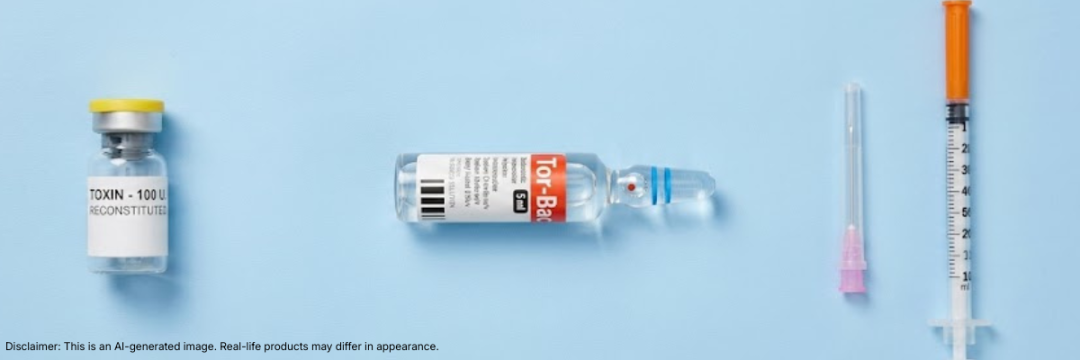
Two ampoules sit on the tray. Both are labelled 0.9% sodium chloride. One reconstitutes the toxin and the patient barely flinches; the other does the same job and the patient winces at every point. The difference is rarely the technique. It is what else is in the ampoule.
That second ingredient is benzyl alcohol, and it is the single thing that separates bacteriostatic saline from the plain saline most practitioners trained on. Understanding why it changes the injection experience, and where it must not be used, matters more than most reconstitution conversations allow for.
What is Torbac?
What is Tor Bac is one of the most common questions from injectors moving away from preservative-free diluents. Tor-Bac is a brand of bacteriostatic saline: a sterile solution of 0.9% w/v sodium chloride and 0.9% w/v benzyl alcohol (9 mg/ml each) in water for injection. The sodium chloride makes it isotonic, matching the body’s own salt concentration so it does not draw fluid in or out of cells. The benzyl alcohol is the preservative, and it is the reason the product behaves differently from a standard ampoule.
A point of vocabulary first, because it trips people up in search and in conversation. Some practitioners call it Torbac water, but that is a misnomer. Bacteriostatic water contains no sodium chloride and is hypotonic; bacteriostatic saline contains 0.9% sodium chloride and is isotonic. For reconstituting toxin, isotonicity is what you want, which is why the saline form is the one stocked for aesthetic use.
The benzyl alcohol component, and what it actually does
Everything that distinguishes Torbac saline from plain saline comes down to that 0.9% benzyl alcohol. It does two clinically useful things at once.
It keeps the solution sterile after opening
Benzyl alcohol is bacteriostatic, meaning it inhibits bacterial growth rather than killing organisms outright. In a multi-use Torbac saline solution presentation, that allows the same container to be drawn from over a working period, commonly cited as up to 28 days when stored correctly, without the contamination risk you would accept with preservative-free saline. Plain 0.9% sodium chloride has no preservative; once the seal is broken it should be treated as single-use, because any residual volume becomes a growth medium. For a busy clinic reconstituting several vials across a day, the difference is practical, not theoretical.
This is also where presentation matters. Single ampoules are single-use by design, regardless of preservative content. The multi-use advantage applies to vial and bottle formats, not to a snapped 5ml ampoule.
It blunts the sting of the injection
Benzyl alcohol is a mild local anaesthetic in its own right; it has a long history of use as a topical numbing agent, as the Taylor & Francis pharmaceutical reference on benzyl alcohol’s local anaesthetic and antibacterial roles sets out. When toxin is reconstituted with it, that small anaesthetic effect travels with each aliquot to the injection site. There is also a pH contribution: work on toxin injection comfort has pointed to pH normalisation as part of why preserved diluents feel gentler.
Plain 0.9% saline versus Torbac, in practice
Strip away the marketing and the comparison is simple. Plain saline reconstitutes toxin perfectly well and has done for decades; it is licensed, cheap and universally stocked. Its limitations are that it offers no preservative protection once opened and no analgesic benefit. A Torbac injection of reconstituted toxin trades a small added cost, and a few important contraindications, for reduced sting and a sterile multi-use window.
The cost difference is genuine but modest. The comfort difference is the part patients notice and remember, and patient comfort is a large driver of rebooking and referral.
What the regulators actually say about your diluent
Here the regulatory position and common clinical practice diverge, and it is worth being precise about which is which.
The licensed instruction is unambiguous. The Summary of Product Characteristics is the regulatory document that governs how a medicine may be used, and for the toxins themselves it specifies reconstitution with 0.9% sodium chloride. The Bocouture 100-unit SmPC on the electronic Medicines Compendium directs reconstitution with sodium chloride 9 mg/ml (0.9%) solution for injection, introduced gently down the vial wall to avoid foam formation, and the manufacturer’s reconstitution guidance specifies the unpreserved form. The other licensed botulinum toxin products carry the same instruction. On a strict reading of the licence, preservative-free saline is the diluent the marketing authorisation anticipates.
Bacteriostatic saline sits outside that. Using a benzyl-alcohol-preserved diluent to reconstitute toxin is an off-label choice, and the diluent itself is unlicensed. The MHRA guidance on the supply of unlicensed medicines (specials) is the controlling regulatory document: an unlicensed product may be supplied only to meet the special clinical needs of an individual patient that a licensed equivalent cannot meet, and the prescriber takes full responsibility for that decision. Because a licensed preservative-free 0.9% sodium chloride exists, choosing the bacteriostatic alternative is a clinical judgement the prescriber must be able to justify and document, not a default.
The comfort rationale practitioners cite for making that off-label choice, that the benzyl alcohol reduces injection sting, comes from clinical practice and study rather than from any regulatory endorsement. No medicines regulator lists reduced injection pain as an approved property of bacteriostatic saline. Practitioners who rely on that reasoning should treat it as the off-label clinical justification behind their prescribing decision, recorded as such, rather than as a licensed indication.

Using Torbac Saline for Botox reconstitution
Reconstitution technique does not change because the diluent has a preservative. Using Torbac Saline for Botox follows the same principles as any diluent: match the volume to the dilution you want, introduce the saline slowly down the inside wall of the vial rather than firing it straight onto the powder, and swirl gently. Foaming and vigorous agitation can shear the toxin protein and are best avoided.
The volume is your decision, not the diluent’s. A 100-unit vial of onabotulinumtoxinA reconstituted with 2.5ml gives 4 units per 0.1ml, a widely used working concentration; reconstituting with 1ml concentrates the dose for tighter, more localised placement, while larger volumes spread it for broader, softer effect. Whichever you choose, the benzyl alcohol load stays small. At 9 mg/ml, a 2.5ml reconstitution introduces roughly 22.5 mg of benzyl alcohol per vial, which is far below any threshold of adult concern when injected intramuscularly or intradermally in the face. For the mechanics of matching volume to outcome across different products, the Faces blog walks through it in detail in how to reconstitute and dilute Botox correctly, with product-specific notes in the guides to Azzalure dosing and dilution and getting Bocouture right area by area.
The diluent choice does not change the aftercare conversation, but it is worth standardising. Onset of effect runs from roughly day three to day fourteen, with peak effect at around two weeks and duration of three to four months for most patients. Standard toxin aftercare applies regardless of diluent: keep the area clean, avoid rubbing or massaging the treated muscles, stay upright for the first few hours, and avoid heat, alcohol and strenuous exercise for the rest of the day. Issuing a written aftercare form at the point of treatment removes the ambiguity and gives the patient something to refer back to rather than a half-remembered verbal instruction.
Cautions, contraindications and the mistakes that matter
The same benzyl alcohol that makes the product comfortable carries the cautions practitioners must hold firmly.
The headline risk sits at the extremes of age. Benzyl alcohol is metabolised in the liver to benzoic acid; neonates, and particularly preterm infants, lack the enzyme capacity to clear it, and accumulation causes the potentially fatal “gasping syndrome” first described in the New England Journal of Medicine report by Gershanik and colleagues. This is not an aesthetic-dose phenomenon, but it explains why benzyl alcohol products are contraindicated in neonates and used cautiously in young children. For aesthetic practice, the operative contraindications are pregnancy and breastfeeding: suppliers list Torbac as contraindicated in pregnant or breastfeeding patients, and aesthetic toxin treatment is itself avoided in these groups, so the two align.
A separate caution is hypersensitivity. Benzyl alcohol can provoke hypersensitivity reactions in a minority of patients, so a known benzyl alcohol allergy is a reason to reach for plain saline instead.
These are precisely the items a sound pre-treatment process should capture rather than rely on memory for. A structured medical consent form that screens for pregnancy, breastfeeding and any known benzyl alcohol or preservative sensitivity turns the contraindication list into a documented check, and it protects the prescriber who carries legal responsibility for an unlicensed product. If a patient does react unexpectedly, whether a hypersensitivity response or any complication that sits outside routine experience, a second clinical opinion is worth having on hand. The Complications Consultant Aesthetic Help Line exists for those moments, giving practitioners access to senior clinical guidance when something does not look right.
The regulatory point is the one most often glossed over. In the UK, Torbac is an unlicensed “special” and is prescription-only. The MHRA guidance on supplying unlicensed medicines is explicit: an unlicensed product may only be supplied to meet the special clinical needs of an individual patient where a licensed equivalent cannot, and the prescriber carries full responsibility. Because a licensed plain 0.9% sodium chloride exists, the decision to use a preserved alternative must be a clinical one the prescriber can justify, and supply is typically capped to a small number of ampoules per named-patient prescription. Stocking it casually as a default, without that prescribing rationale, is the common compliance mistake.
Formats, alternatives and what to actually order
Torbac reaches clinics in two broad formats. Single sealed ampoules suit practitioners who want a fresh, single-use diluent per session and no question over open-vial sterility; the TorBac Bacteriostatic Saline 5ml (single ampoules) serve that workflow. Higher-volume practices that reconstitute repeatedly tend to prefer boxed Torbac ampoules such as the Bacteriostatic 0.9% Sodium Chloride Solution (TorBac) 10 x 5ml, which reduces per-unit handling. Multi-dose Torbac vials and bottle presentations extend the same container across a storage window for clinics that draw little and often.
On the question of a Torbac alternative: plain preservative-free 0.9% sodium chloride remains the licensed default and the correct choice in pregnancy, breastfeeding or benzyl alcohol allergy. The other direction the market is moving is toward reconstitution-free toxins entirely, such as the ready-to-use liquid formulation covered in the Faces piece on Alluzience, the UK’s first liquid toxin, which removes the diluent decision altogether.
Closing
Before the next stock order, the useful exercise is to separate the two decisions the diluent forces: comfort and sterility on one side, and a documented prescribing rationale on the other. Clinics that want the comfort data behind every injection can order single-ampoule or boxed Torbac through Faces Pharmacy with same-clinic prescribing support. To Buy Torbac online with next-day delivery and a prescriber attached to the order, set it up through your Faces Consent account rather than stocking it without a named-patient justification.
FAQs
Is bacteriostatic saline better than normal saline for toxin?
Not universally. It reduces injection sting and allows safe multi-use within an open-vial window, with no measured loss of efficacy. Plain saline is licensed, cheaper and the safer choice in pregnancy, breastfeeding or benzyl alcohol allergy.
How long can a Torbac vial be used after opening?
Multi-dose vial and bottle presentations are commonly cited as usable for up to 28 days when stored correctly, because the benzyl alcohol inhibits bacterial growth. Single ampoules are single-use only, preservative or not.
Can Torbac be used to mix anything other than botulinum toxin?
It is used as a diluent for a range of compatible injectables, including reconstituting powdered toxins and some other agents. Compatibility with the specific product, and the prescriber’s clinical justification, govern its use.
Why is Torbac prescription-only and unlicensed?
It is supplied in the UK as an unlicensed “special”. Under MHRA rules, unlicensed products require a prescriber to take responsibility and may only be supplied where a licensed equivalent does not meet the patient’s needs.
Does benzyl alcohol affect how the toxin works?
The controlled trials to date show comfort benefits without a reduction in efficacy. The benzyl alcohol acts as preservative and mild anaesthetic, not on the toxin’s mechanism.