
A client books a “B12 boost” because a colleague swears it cleared their winter fatigue. They have no diagnosis, no recent bloods, and they want it today. For a lot of practitioners that booking raises three quiet questions at once. Do I need a prescriber? How much do I give? And where exactly does the needle go? None of those questions has a vague answer. The clinical detail is well established, and the legal position has tightened sharply in the last year. Getting both right is what separates a defensible treatment from a complaint waiting to happen.
What B12 Actually Does?
Vitamin b12, or cobalamin, is a cofactor the body cannot manufacture. It drives two enzyme reactions that matter clinically. The first converts homocysteine to methionine, which supports DNA synthesis and red cell production. The second metabolises methylmalonyl-CoA, which keeps the myelin sheath around nerves intact. That second pathway explains why prolonged deficiency causes neurological damage and not simply anaemia. Stores sit mainly in the liver and last years, so deficiency develops slowly and quietly, which is precisely why it gets missed.
Knowing Who Genuinely Benefits
A “boost” culture has grown up around these injections, but the treatment exists to correct a real shortfall. B12 deficiency has a small number of common causes worth recognising before reaching for an ampoule.
Pernicious anaemia, an autoimmune loss of intrinsic factor, is the classic one. Dietary shortfall is increasingly common as more clients adopt plant-based eating, because vitamin b12 foods are almost entirely animal-derived: meat, fish, eggs and dairy, with fortified cereals and yeast extracts the main vegan options. Malabsorption from coeliac disease, Crohn’s, gastric surgery or long-term metformin and proton-pump inhibitors accounts for much of the rest.
The presentation of vitamin b12 deficiency is broad and easy to attribute to something else. Typical b12 deficiency symptoms include persistent fatigue, breathlessness, glossitis and pallor. The vitamin b12 deficiency symptoms that should prompt urgent referral rather than a wellness injection are neurological: paraesthesia, unsteady gait, memory or mood changes. One caution carries real weight. Folate must be checked alongside B12, and folate deficiency should never be treated in isolation when B12 is low, because doing so can mask the anaemia while neurological damage progresses. The current NICE guidance on B12 and folate deficiency sets this out clearly.
Sourcing B12 the Right Way
Clients arrive having already searched. Phrases like where can i buy b12 injections online and b12 injectable buy online are typed thousands of times a month, usually by someone hoping to skip the consultation entirely. The honest answer is that licensed product cannot legally be bought that way. Any site inviting you to buy vitamin b12 injectable online with no prescriber in the loop is selling either an unlicensed product or an unlawful one, and a clinic that relies on it inherits that risk.
For practitioners the supply chain runs through a registered pharmacy against a valid prescription. When a clinic needs to purchase vitamin b12 injections online, the legitimate route verifies the prescriber and the patient before stock moves. Faces Pharmacy lets verified practitioners buy vitamin b12 injections through a regulated platform. That structure answers the client typing buy vitamin b12 injections online UK far better than a grey-market listing, because the treatment becomes traceable from prescription to administration.
Hydroxocobalamin or Cyanocobalamin
Both correct deficiency, but UK practice favours hydroxocobalamin, and for a good reason. It binds plasma proteins more tightly and is retained far longer, which is why a single dose holds therapeutic levels for roughly eight to twelve weeks and supports a maintenance interval of two to three months. Cyanocobalamin clears faster and requires more frequent dosing, so it has largely fallen out of routine use here. Most vitamin b12 injections you will handle in a UK clinic are therefore 1mg/1ml hydroxocobalamin ampoules, supplied ready to use with no reconstitution required.
Dosing Schedules That Match the Evidence
The schedules below follow the BNF and standard UK haematology guidance. They exist because B12 stores need rebuilding before a maintenance rhythm makes sense.
Loading
For deficiency without neurological features, the standard loading regimen is hydroxocobalamin 1mg intramuscularly three times a week for two weeks, six injections in total. Where neurological symptoms are present, loading runs 1mg on alternate days until there is no further improvement, which is a presentation that belongs with a GP or specialist rather than a wellness clinic.
Maintenance
Once stores are replete, maintenance is 1mg every two to three months for deficiency of dietary origin, or every two months where there has been neurological involvement. Wellness clients without a diagnosis sit outside these licensed indications entirely, which is exactly why the prescriber assessment is not optional paperwork.
Injection Technique, Step by Step
Choosing the Site
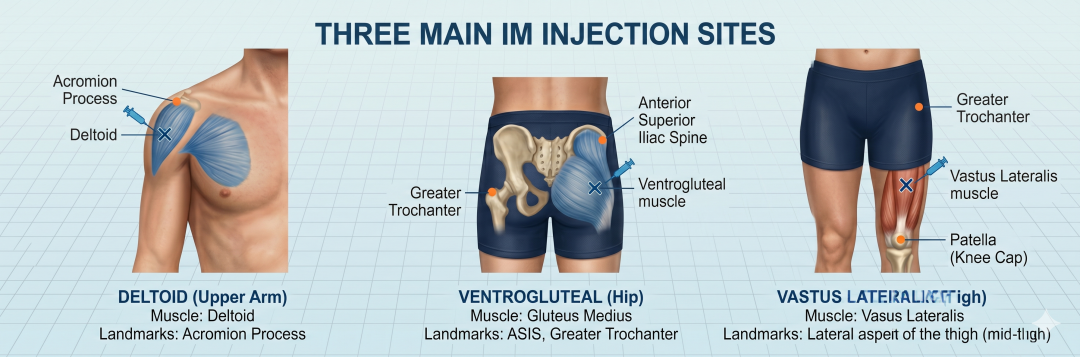
A 1ml dose of low-viscosity hydroxocobalamin is comfortably accommodated by the deltoid, which is why it is the default for routine B12. Landmark roughly two to three finger-widths below the acromion process, into the densest part of the muscle, well clear of the shoulder bursa. For larger volumes, repeated dosing or clients with limited deltoid mass, the ventrogluteal site is the safer alternative: it carries the greatest muscle depth and sits away from major nerves and vessels. The dorsogluteal site has been phased out of current guidance because of its proximity to the sciatic nerve and superior gluteal artery.
Needle Selection
A 23 to 25 gauge needle at 25mm suits most adult deltoids. Build matters more than people assume. A standard 25mm needle can deposit medication subcutaneously in a larger client, blunting absorption, while a shorter 16mm needle is appropriate for a very lean arm. For ventrogluteal administration in a heavier client, a 38mm needle reaches the muscle reliably.
Administering
Insert at 90 degrees in one smooth, confident motion, since hesitating halfway is what makes it hurt. The Z-track method, displacing the skin laterally by two to three centimetres before insertion and releasing it after withdrawal, seals the needle path and reduces leakage and irritation. Routine aspiration is no longer recommended by the WHO or CDC for the deltoid, ventrogluteal or vastus lateralis sites, as those sites carry negligible vessel risk. Inject slowly, wait around five seconds after depressing the plunger, then withdraw and apply light pressure. Do not massage the site vigorously.
Comfort and Aftercare
B12 injections are well tolerated, and a topical anaesthetic is rarely needed for a single deltoid dose, though the same comfort principles apply as with any injectable. Our guide to using lidocaine in aesthetics is a useful reference if you want to think through pain management more broadly. Document consent before treating and issue written aftercare afterwards. This is where a single client journey pays off: Faces Booking System lets clients book the treatment directly from your clinic, pay a deposit to hold the slot, complete their consent form before they arrive, and receive their aftercare form automatically once the appointment is done. Everything sits on record and timestamped, which is the paper trail that protects you if a client later queries the treatment.
Common Mistakes and Cautions
The avoidable errors cluster in a few places. Treating a “boost” request without confirming there is anything to correct. Injecting subcutaneously through a needle too short for the client. Treating folate without checking B12 status. And relying on a remote or bulk prescription that no longer meets the regulators’ face-to-face standard. True allergy to hydroxocobalamin is rare but real, so a brief history matters. For managing any reaction or unexpected outcome, the Complications Consultant gives access to clinical support, and practitioners who want formal sign-off on technique can do so through accredited training academies.
Before You Offer B12
If you are adding B12 to your menu this season, sort the supply chain before the first booking. Set up your Faces account, connect with a prescriber if you do not prescribe yourself, and order hydroxocobalamin, traceable and ready for a properly consented client. Confirm your insurance covers the treatment, then list it on your treatments so clients can reserve a slot, pay a deposit and complete their consent in one place before they ever sit in your chair.
FAQs
Do B12 injections need a prescription in the UK?
Yes. Licensed hydroxocobalamin is a prescription-only medicine, so a prescriber must authorise it. Since 1 June 2025 that authorisation should follow a face-to-face assessment.
Which site is best for a B12 injection?
The deltoid for a standard 1ml dose. Switch to the ventrogluteal site for repeated dosing or clients with limited deltoid mass.
How often are B12 injections given?
A loading phase of 1mg three times weekly for two weeks, then maintenance of 1mg every two to three months, adjusted for the cause and any neurological involvement.
Can a non-prescriber administer B12?
Yes, against a valid prescription or patient-specific direction for the named client, following a prescriber’s assessment.
Why hydroxocobalamin over cyanocobalamin?
It is retained far longer, allowing a two to three month maintenance interval instead of frequent repeat dosing.