
1,915,491 dermal filler consent forms have now been recorded on Faces. Between 1 January and 23 November 2026 alone, practitioners completed 308,361 of them: 943 a day, or one every 92 seconds.
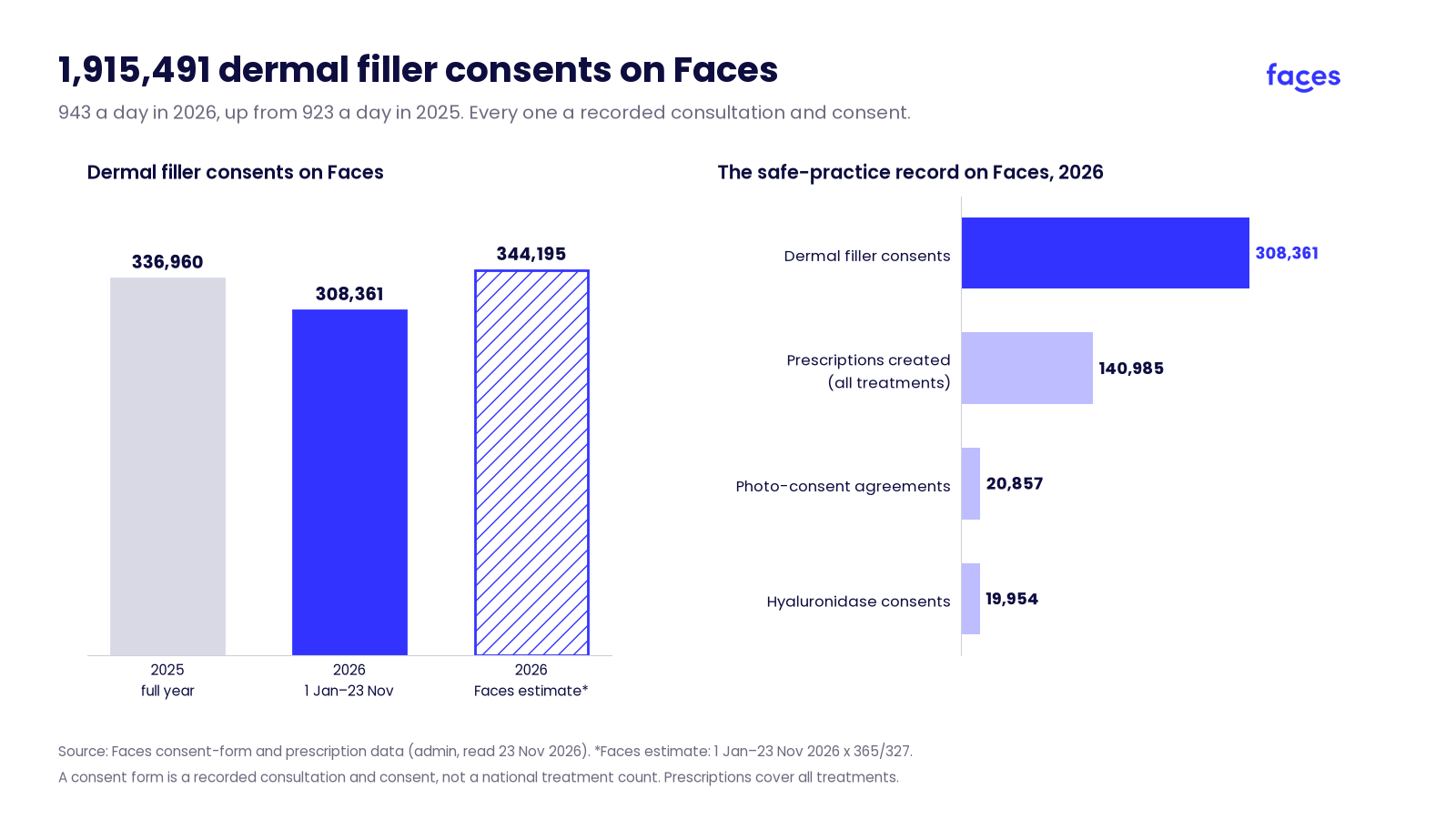
That is the headline from the third edition of the Faces UK Aesthetics Data Index, built from consent records on Faces. The daily pace is up on 2025, when practitioners recorded 336,960 dermal filler consents across the whole year, or 923 a day. On a full-year basis we estimate around 344,195 for 2026, which would edge past 2025 (Faces estimate: 308,361 x 365/327 days). Each one is a formally recorded consultation and consent, sitting on the same record as the booking.
Dermal filler on Faces, in numbers
- 1,915,491 dermal filler consent forms recorded on Faces, all time.
- 308,361 from 1 January to 23 November 2026: 943 a day, up from 923 a day across 2025.
- 344,195: our full-year 2026 estimate, ahead of 2025’s 336,960 (Faces estimate, 308,361 x 365/327).
- 113,993 hyaluronidase consents recorded on Faces all time, and 19,954 so far in 2026. Hyaluronidase is the prescription-only enzyme used to dissolve hyaluronic acid filler, so every one of these records a prescriber-led correction pathway.
- 140,985 prescriptions created on Faces in 2026 across all treatments, around 431 a day.
- 20,857 photograph consent agreements in 2026, so before-and-after images are recorded with permission too.
All Faces figures come from a read-only pull of the Faces admin consent-form leaderboard and monthly KPIs on 23 November 2026. No fresh pull was possible for this edition.
What’s happening: an inquest, a consultation and a missing number
On 20 November, BBC News reported that an inquest jury in Gloucestershire had concluded a tragic, accidental death after a liquid Brazilian butt lift in 2024, and that the coroner will send a prevention of future deaths report to the government. It was an unfortunate incident, and a hard reminder that this is not a good outcome for anyone involved. Our thoughts are with the family. Ashton Collins, director of the safer cosmetics organisation Save Face, told BBC News on 23 November that the crackdown should be sped up.
The Department of Health and Social Care (DHSC) is already consulting on new rules. Its proposals, announced on 21 October 2026 by health minister Karin Smyth MP, would treat filler injected anywhere other than the face, including liquid BBLs, as cosmetic surgery; restrict other high-risk procedures to named regulated healthcare professionals, including independent prescribing nurses, midwives and pharmacists, working for providers registered with the Care Quality Commission (CQC); and keep a separate licensing scheme for lower-risk treatments such as botulinum toxin and lip filler on the way. The minister’s statement also recognises that “many practitioners in this area are well trained and provide a good, safe service”. The consultation closes on 13 January 2027.
There is one line in the government’s own consultation document that stands out for anyone who works with data. It says that, because the sector is fast-growing and largely unregulated, “there is a lack of data on the number of businesses” providing these treatments “and the volume of procedures being undertaken”. On 4 November the Commons Science and Technology Committee made the same point from another angle, warning that under-reporting of harm means regulators work without the evidence base they need.
That is the gap this data starts to fill. Nobody can measure risk properly without knowing how many treatments happen. On Faces, every dermal filler consent is a counted, timestamped record.
Why it matters: good practice leaves a record
Whatever the product, the same steps separate good practice from bad. Every one of them can be recorded:
- A proper consultation and medical history before anything is booked in, with time to think.
- Written, informed consent for the specific treatment. Faces has a free dermal filler consent form template that sits on the client’s record.
- Photographs taken with permission, using a photographs usage agreement.
- A traceable product from a regulated supply chain. Faces Pharmacy in Stafford holds an MHRA wholesale dealer’s licence, WDA(H) 60090.
- Clear aftercare, using a dermal filler aftercare template the client keeps.
- A correction pathway. Hyaluronidase is a prescription-only medicine, so a prescriber needs to be involved. Faces records it with a hyaluronidase consent form and a hyaluronidase aftercare template, and practitioners can find a prescriber on the platform.
Good practice looks the same whoever is holding the syringe, and the best practitioners can already prove it. For more on this, read why record keeping matters in aesthetic clinics and Digital Consent Forms for Aesthetics: Beyond a Signature.
Smarter regulation: build on the tools that already exist
Prescribing is the safety net of UK aesthetics. Every prescription-only medicine in this sector, from botulinum toxin to hyaluronidase, should start with a prescriber’s consultation, a recorded consent and a licensed product from a regulated pharmacy. On Faces, 140,985 prescriptions have been created this year, each one linked to a prescriber and an audit trail.
We support the focus on high-risk procedures such as liquid BBLs. The opportunity now is to make the coming licensing scheme work in practice. The consultation document itself notes that restrictions may result in demand “shifting to providers who decide to provide them unlawfully” or overseas. The Science and Technology Committee, chaired by Dame Chi Onwurah MP, said any training or standards must be “reasonably obtainable” and that regulation should not push female-led businesses off the market.
The answer is innovation, not just restriction. Digital consent, e-prescribing with verified consultations, licensed pharmacy supply and anonymised volume data can give government and local authorities the traceability they need, while keeping every practitioner who trains and works to standards inside the system rather than pushing treatments out of sight. At Faces we are looking to support the industry with anonymised, aggregate data that helps innovation and safety, and we would welcome conversations with policy teams as the consultation runs to 13 January 2027.
How big is UK filler? Faces data against the market
Dermal filler is one of the core treatments of UK aesthetics. Rare‘s April 2026 audit of 24,937 UK medical aesthetics clinic websites found 71% offer fillers and 66.3% offer both botulinum toxin and fillers. Its May 2026 audit counted 19,289 UK dermal filler clinics.
It is also a category the big manufacturers say is holding firm. Galderma‘s nine-month results, published on 22 October 2026, show its Fillers and Biostimulators sales up 8.5% at constant currency for the first nine months of 2026, despite what it called “continued softness in the Fillers market”. On Faces, the daily pace of dermal filler consents is up too.
Faces market-share estimate (working shown). There is no official count of UK injectable treatments. One industry estimate, published by the third-party booking and deals site Injectablesbooking, puts it at 1.5 million to 1.9 million injectable treatments in 2026. On Faces, the two biggest injectable treatments, botulinum toxin (every brand counted together: 517,728 consents to 23 November) and dermal filler (308,361), are on course for about 922,087 consents in 2026 (Faces estimate: 826,089 x 365/327). That is equivalent to a Faces estimate of roughly 49% to 61% of that industry figure. This is an estimate, not an official market share: a consent form is not always a single treatment, and the Injectablesbooking figure is itself an estimate. But it shows how much of the UK’s injectable activity Faces can see.
Top 5 dermal filler brands, and who’s using them
These are five of the hyaluronic acid filler brands UK practitioners use most, based on how often UK clinics name them (Rare.Monitor) and what practitioners order on Faces. It is not a sales ranking of the whole UK market, and none of these brands has endorsed Faces. All five are available through the multi-seller dermal filler range on Faces.
1. Juvéderm (Allergan Aesthetics, an AbbVie company)
Juvéderm from Allergan Aesthetics is the most-named filler brand on UK clinic websites: Rare’s May 2026 audit found it on 66.1% of brand-naming UK filler clinic sites. Clinics that offer it are listed on Juvéderm UK’s Find a Clinic. In March 2026 Allergan Aesthetics shared research on ‘undetectable’ aesthetics and the role of HA injectables in natural-looking results. See Juvéderm on Faces.
2. Restylane (Galderma)
Restylane from Galderma is second in Rare’s ranking, named by 45.1% of brand-naming UK filler clinic sites. On 16 September 2026 Galderma published new Restylane Volyme data for temple hollowing, part of the growing clinical evidence behind the range. See Restylane on Faces.
3. Teosyal (Teoxane)
Teosyal from Teoxane UK is third in Rare’s UK clinic ranking. In 2026 Teoxane launched babyGLOW in the UK, a standardised skin-quality protocol built on TEOSYAL Puresense Redensity 1, followed by babyGLOW for HIM. See Teosyal on Faces.
4. Lumifil
Lumifil is a UK-based filler brand, manufactured in South Korea, and the most-ordered filler range on Faces in 2026: 12,168 units across its listed products between 1 January and 23 November. See Lumifil on Faces.
5. Revolax
Revolax is distributed in the UK by its licence holder, Fox Pharma. Practitioners ordered 7,383 units of Revolax on Faces between 1 January and 23 November 2026. See Revolax on Faces.
Whatever the brand, the checklist above applies. For a closer look at individual products, see our dermal filler product analysis.
A comment from Ash
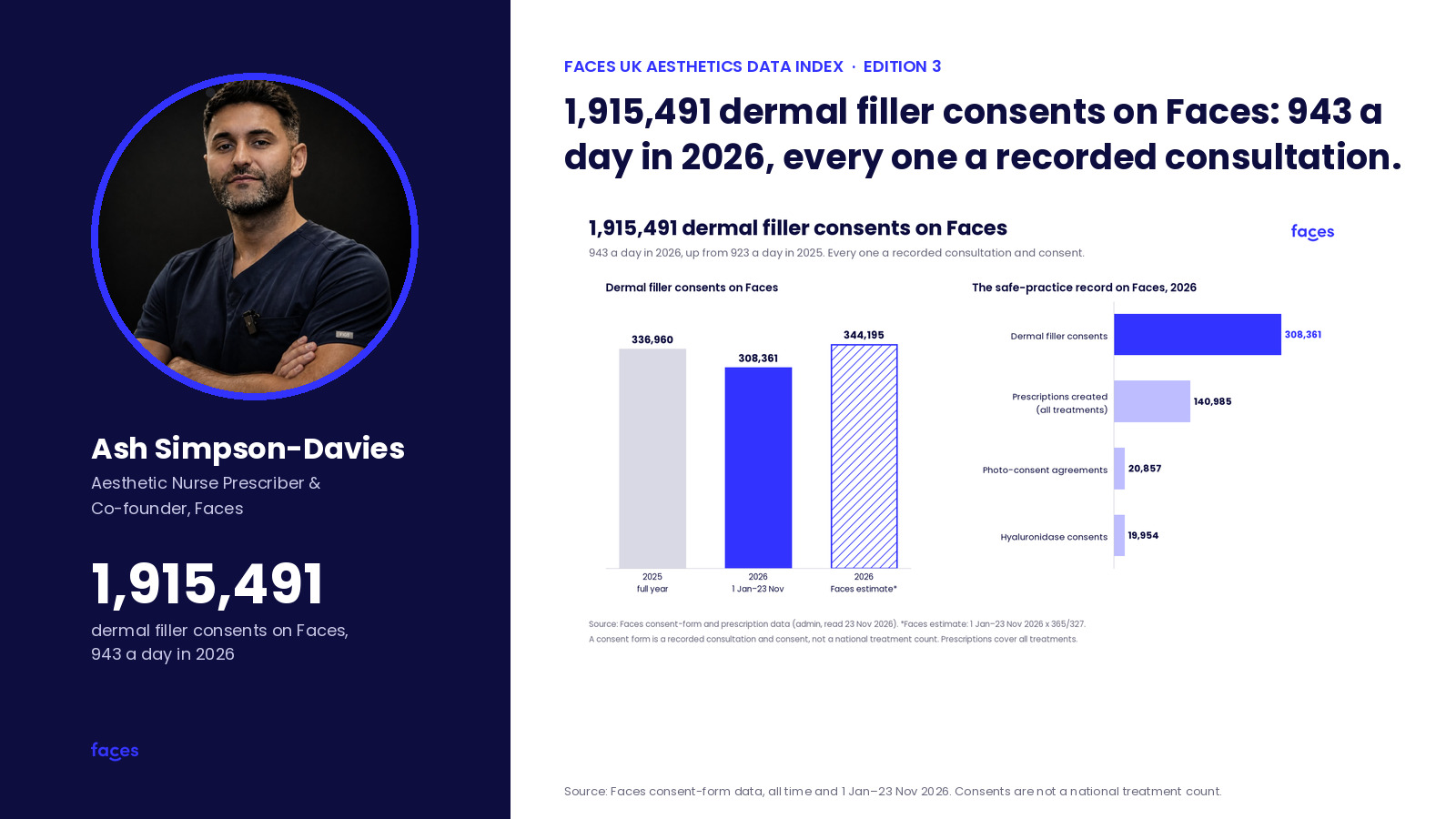
Ash Simpson-Davies, an aesthetic nurse prescriber and co-founder of Faces, said:
“Dermal filler is one of the most popular treatments in UK aesthetics, and on Faces alone practitioners have recorded 1,915,491 filler consents, 943 a day this year. Behind every one should be a proper consultation, a medical history, written consent, a traceable product from a regulated supply chain and clear aftercare, with a prescriber and hyaluronidase ready if anything needs correcting. That is what good practice looks like, and prescribing sits at the heart of it. The government’s own consultation says it lacks data on how many procedures happen. Digital consent, e-prescribing and audit trails already exist, and they can help make the coming licensing scheme work for everyone who trains and works to standards, without adding barriers that push treatments out of sight. At Faces we want our data to support that.”
Why Faces can see this
Faces is clinic software for aesthetic, beauty and healthcare practices: online booking, consent forms, aftercare forms, records, e-prescribing and team tools in one place. The same platform includes Faces Pharmacy and the multi-seller Faces marketplace, so a clinic can order stock without leaving the system that holds its diary and consent records. That is why this data exists: each consent sits on the same record as the booking.
Software supports professional judgement; it does not replace it. If you need a prescriber, read How to Find an Aesthetics Prescriber in the UK. You can see how the platform works on the Ash from Faces and Faces Pharmacy YouTube channels, and follow @facesconsentapp on Instagram and @facespharmacy on TikTok.
Get the next Index first
This is the third edition of the Faces UK Aesthetics Data Index, after our UK toxin league table and our microneedling edition. If you are a journalist, a professional body, a brand, a policy team, or a PR agency such as Kendrick PR, Cosmetic PR or 5WPR (whose Med Spa Index ranked brands including Juvéderm), and you want the next edition first, comment INDEX on the social posts that accompany this article, or get in touch through Faces.
Clinics that want booking, consent and ordering in one place can register for Faces at no cost to start.
FAQs
Is a consent form the same as a treatment?
No. A completed consent form is a recorded consultation and consent. It is strong evidence of activity, but not every consent becomes a treatment, and some treatments are recorded elsewhere. These figures describe activity on Faces, not a national count.
How is the full-year figure estimated?
We multiply the 1 January to 23 November count by 365/327 (the days in the year divided by the days covered). 308,361 x 365/327 = about 344,195. It is a Faces estimate and assumes the rest of the year runs at the same daily rate.
How is the 49–61% figure calculated?
It is a Faces estimate, not an official market share. We take our full-year estimate of botulinum toxin plus dermal filler consents on Faces (about 922,087) and compare it with one industry estimate of 1.5 million to 1.9 million UK injectable treatments in 2026, published by the third-party booking and deals site Injectablesbooking. 922,087 is roughly 49% of 1.9 million and 61% of 1.5 million. A consent form is not always a single treatment, and the Injectablesbooking figure is itself an estimate.
How is botulinum toxin counted in the market estimate?
Practitioners can use a generic botulinum toxin form or a brand-named form on Faces. Because these are the same type of treatment, we add them together and report botulinum toxin as one treatment (517,728 consents from 1 January to 23 November 2026).
Are face fillers covered by England’s proposed restrictions?
Under the October 2026 proposals, filler injected anywhere other than the face would count as cosmetic surgery, and non-resorbable facial fillers are on the high-risk list. Hyaluronic acid filler in the face is expected to fall under the separate licensing scheme for lower-risk treatments. Check the consultation document, your insurer and your training provider for your own practice.
Why does hyaluronidase matter?
Hyaluronidase can dissolve hyaluronic acid filler, which is why having a prescriber and a clear correction pathway in place is part of good practice. It is a prescription-only medicine.
Where can I get a dermal filler consent form and aftercare sheet?
Faces has a free dermal filler consent form template and dermal filler aftercare template, plus a hyaluronidase consent form. All can be used digitally on Faces, linked to the client’s booking and record.
This article is general information for aesthetics and beauty professionals. It is not clinical, legal or regulatory advice. Brand details are taken from each brand’s own published information and from Rare.Monitor’s published summaries. Always follow your own training, product guidance, insurer requirements and professional body.
Ashley James Simpson-Davies INP MSc RN