
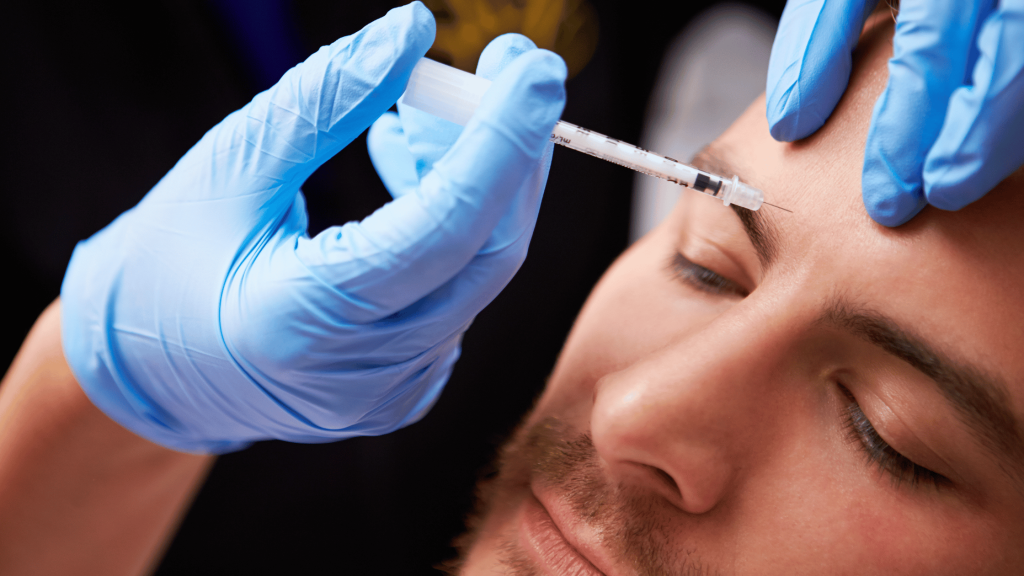
A patient returns three days after a glabella treatment with one eyebrow sitting noticeably lower than the other. Was the dose wrong, the injection point off by a few millimetres, or is this simply how her anatomy is responding? For any aesthetic practitioner administering Botox regularly, this scenario is familiar. Complications from Botox are uncommon, but understanding exactly why they happen — and how to manage them when they do — separates a confident injector from one who is guessing.
How Botox Works and Why Complications Occur
Botox is a purified form of botulinum toxin type A, produced from Clostridium botulinum. It acts at the neuromuscular junction, blocking the release of acetylcholine from nerve endings and preventing the targeted muscle from contracting. The muscle doesn’t die or get damaged — it’s temporarily switched off, which is why the effect wears off gradually as new nerve terminals regenerate over three to four months.
Complications almost always trace back to one of three causes: the toxin diffusing beyond the intended muscle, incorrect dosing for the muscle mass being treated, or pre-existing anatomical variation the practitioner didn’t account for. Diffusion is dose- and volume-dependent, which is why dilution choices and injection depth matter as much as the total unit count.
Common Side Effects Practitioners See Day to Day
Most complications practitioners encounter are minor and self-limiting:
- Bruising and pinpoint bleeding at the injection site, more likely in patients on anticoagulants or fish oil supplements
- Transient headache, usually resolving within 24 to 48 hours
- Injection site tenderness or a mild inflammatory bump
- Temporary asymmetry while the toxin takes full effect, typically settling by day fourteen
These are expected outcomes of an intramuscular injection and should be covered in the consultation, not treated as unusual events.
Side effects of Botox on forehead treatments
The forehead is where diffusion-related complications show up most visibly, because the frontalis, corrugators and orbicularis oculi sit close together and share fascial planes.
Brow ptosis is the most common forehead-specific complication. It happens when toxin migrates into the lower frontalis fibres that support brow elevation, or when too much of the muscle is treated without leaving an untreated strip above the brow to maintain lift. Injecting too low — within 2 to 3cm of the orbital rim — significantly raises this risk.
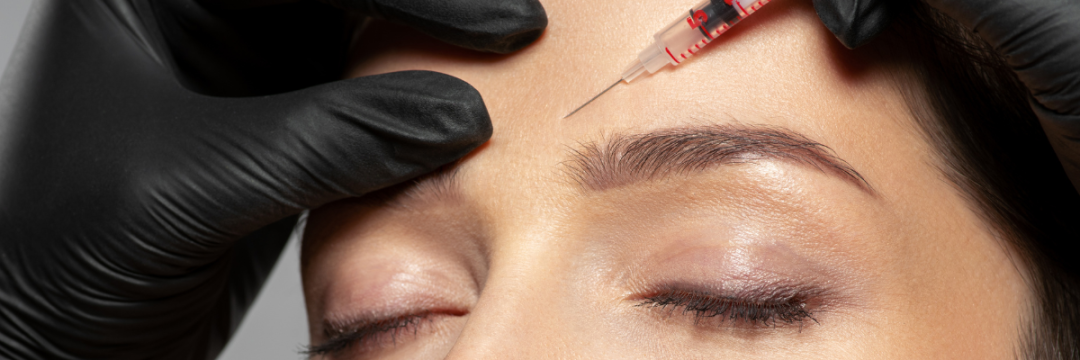
Eyelid ptosis is rarer but more troubling for patients, caused by diffusion into the levator palpebrae superioris, usually from glabella injections placed too low or too medial. It can take four to six weeks to fully resolve, and apraclonidine drops are sometimes used off-label to stimulate Müller’s muscle and provide temporary lift while the effect wears off.
A frozen or unnatural forehead appearance isn’t a medical complication in the strict sense, but it’s a leading cause of patient dissatisfaction, and it comes down to dosing too much of the frontalis without preserving natural movement in the mid-forehead.
Botox neurological side effects
True neurological complications are rare, but practitioners should understand the mechanism, not just the symptom list. Distant spread of toxin effect (DSTE) occurs when botulinum toxin travels beyond the injected muscle group via the lymphatic or vascular system, affecting unrelated muscles. Reported cases — almost all associated with therapeutic doses far higher than typical cosmetic use, or with pre-existing neuromuscular disease — include dysphagia, generalised muscle weakness, and in extreme cases, breathing difficulty.
Patients with myasthenia gravis, Lambert-Eaton syndrome, or motor neurone disease are at meaningfully higher risk and should not be treated in an aesthetic setting without specialist input. Aminoglycoside antibiotics can also potentiate the neuromuscular blocking effect, so current medications need to be checked at consultation, not assumed unchanged from the patient’s last visit.
Botox neurological side effects long-term
Long-term neurological safety data on repeated cosmetic use is reassuring but incomplete. Studies following patients over years of regular treatment have not shown cumulative toxin buildup — each treatment clears independently — but there is ongoing academic discussion about whether years of muscle inactivity in areas like the frontalis lead to compensatory overactivity in untreated muscles, altering a patient’s resting expression over time. This is a functional, not neurotoxic, effect, and it reinforces why dosing should be reassessed at every visit rather than repeated automatically.
Is Botox dangerous?
The honest answer is that Botox carries genuine but low risk, and the risk profile changes entirely based on who is administering it. In a supervised prescribing pathway, with correct dosing and a practitioner who understands facial anatomy, serious complications are rare. The danger increases sharply with unlicensed product, incorrect reconstitution, unsupervised non-prescribers, or treatment of contraindicated patients.
The so-called danger zones — the area along the orbital rim, the temporal region near the frontal branch of the facial nerve, and the perioral muscles when treating platysmal bands or a gummy smile — are dangerous specifically because of proximity to vasculature and nerve branches, not because the toxin itself becomes more toxic in those areas.
Dosing and Product Selection: Botox 50 Units, Botox 100 Units and Botox 200 Units
Vial size should be chosen based on treatment volume and reconstitution workflow, not simply cost per unit.
Botox 50 Units suits practitioners running smaller clinics or lower patient throughput, minimising wastage from reconstituted product that must be discarded after the manufacturer’s recommended window. It’s well suited to single-area treatments such as isolated glabella or crow’s feet correction.
Botox 100 Units is the standard choice for full upper-face treatment — glabella, frontalis and crow’s feet combined typically uses 40 to 64 units depending on muscle mass and patient goals, making a 100-unit vial efficient for one or two patients per reconstitution.
Botox 200 Units suits higher-volume clinics or practitioners treating larger areas such as combined upper face plus masseter reduction (typically 20 to 30 units per side) or hyperhidrosis, where total unit requirements are substantially higher.
Reconstitution should always follow the current SmPC guidance for dilution volume and storage, and product should only be sourced through a verified pharmacy pathway with a valid prescription in place — never as a personal import or from an unverified supplier.
Managing a Suspected Complication in Clinic
When a complication presents, the first step is distinguishing expected temporary asymmetry from something requiring escalation. Mild ptosis or bruising can typically be managed with reassurance, photography for the notes, and a scheduled review. Anything suggesting dysphagia, breathing difficulty or generalised weakness needs same-day medical assessment, and the patient should be advised to attend A&E rather than wait for a clinic appointment.
Practitioners who want a second opinion on an unusual presentation, rather than guessing, can consult Complications Consultant, designed specifically for this kind of clinical decision-making outside of a formal referral pathway.
Reducing Risk Through Sourcing and Documentation
Risk management starts before the needle is anywhere near the patient. Product should come through an aesthetics pharmacy UK supply route for licensed practitioners with full batch traceability, and prescribing should sit with a verified independent prescriber for Botox treatments, not an informal arrangement.
Documentation closes the loop: a signed Botox consent form before treatment, and a structured Botox aftercare form afterward, give both the practitioner and patient a clear reference point if a complication is later queried.
FAQs
What are the worst side effects of Botox?
The most serious, though rare, side effects are difficulty swallowing or breathing caused by distant spread of the toxin. These require immediate medical assessment. Most other side effects, including bruising, headache and temporary asymmetry, are mild and resolve without intervention.
What are the danger zones of Botox?
The danger zones are areas where major nerves or blood vessels sit close to the injection plane — particularly along the orbital rim, the temporal region near the frontal branch of the facial nerve, and the perioral muscles. Careful depth and placement in these areas significantly reduce complication risk.
What happens if Botox gets into your bloodstream?
Botox is injected intramuscularly and is not designed to enter the bloodstream directly. If it does spread systemically, at the very high doses associated with reported cases, it can cause generalised muscle weakness; at standard cosmetic doses this is exceptionally rare and almost always linked to pre-existing neuromuscular conditions.
What happens after 10 years of Botox?
Long-term studies have not shown toxin accumulation with repeated treatment, since each dose clears independently between sessions. Some patients notice compensatory changes in untreated muscles over years of consistent use, which is a functional adaptation rather than a toxic effect, and is manageable by reviewing dosing at each visit.