
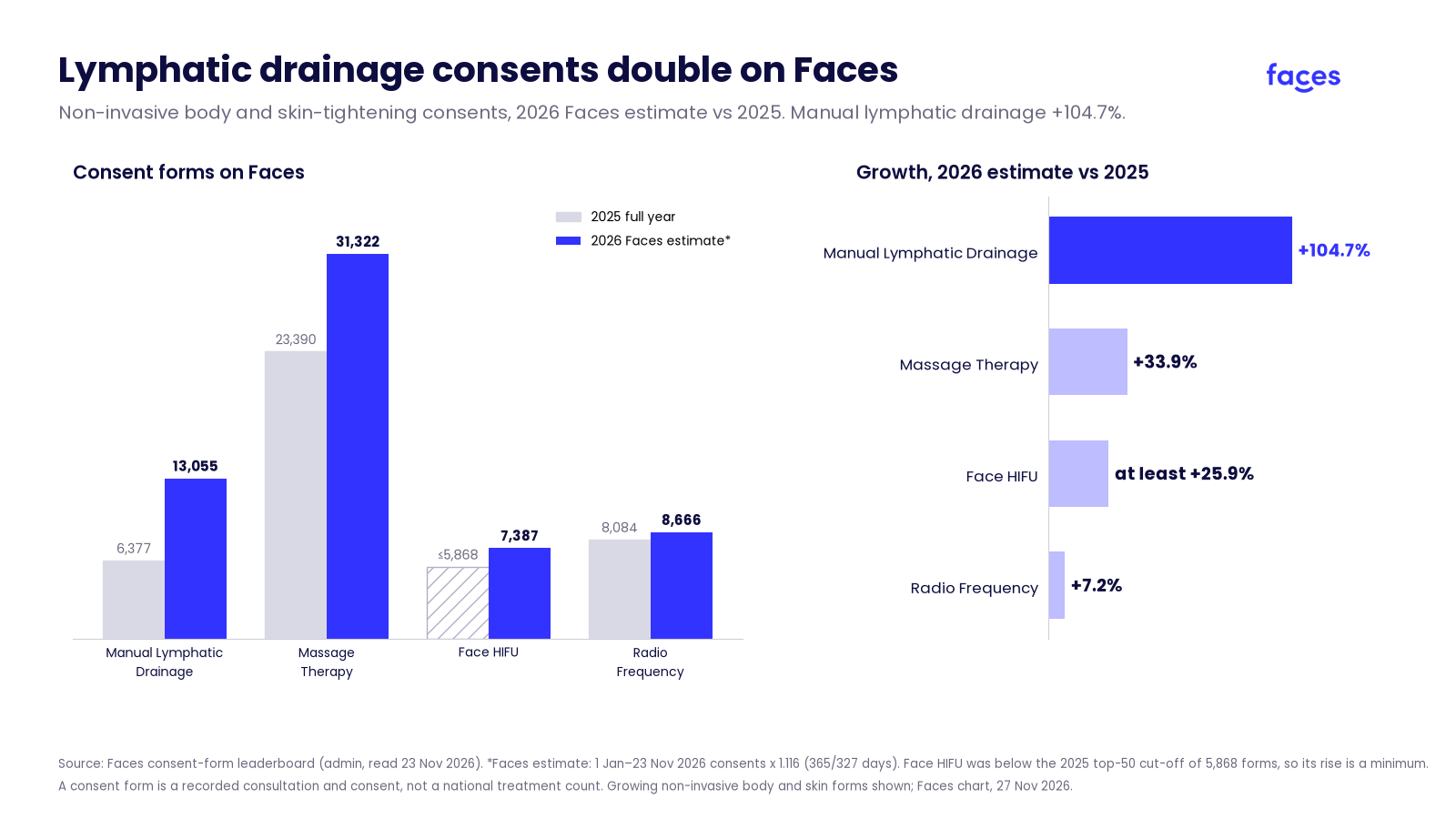
Manual lymphatic drainage consents on Faces have doubled. Practitioners recorded 11,698 of them between 1 January and 23 November 2026, already 83% more than in the whole of 2025 (6,377). On a full-year basis we estimate 13,055 for 2026: up 104.7%.
That is the headline from the fifth edition of the Faces UK Aesthetics Data Index, built from the consent forms practitioners complete on Faces. It is part of a wider move to non-invasive body and skin care. Massage therapy consents are up 33.9%, Face HIFU (high-intensity focused ultrasound) consents are up at least 25.9% and radio frequency consents are up 7.2%. Together, those four forms are on course for 60,429 consents in 2026, at least 38.2% more than in 2025 (Faces estimate: consents from 1 January to 23 November x 1.116, which is 365/327 days).
Non-invasive body and skin on Faces, in numbers
- Manual lymphatic drainage: +104.7%. 6,377 consents in 2025; 11,698 from 1 January to 23 November 2026 (about 36 a day); Faces estimate for the full year 13,055.
- Massage therapy: +33.9%. 23,390 in 2025; 28,066 to 23 November; Faces estimate 31,322. More than 96,000 massage therapy consents have been recorded on Faces all time (96,295).
- Face HIFU: at least +25.9%. 6,619 to 23 November; Faces estimate 7,387. In 2025 it sat below the 50th-placed form (5,868 consents), so the real rise is at least 25.9% and could be higher.
- Radio frequency: +7.2%. 8,084 in 2025; 7,765 to 23 November; Faces estimate 8,666. Faces has recorded 31,758 radio frequency consents all time.
- All four together: at least +38.2%. At most 43,719 in 2025; 54,148 to 23 November; Faces estimate 60,429.
All Faces figures come from a read-only pull of the Faces admin consent-form leaderboard on 23 November 2026. The 2026 full-year figures are Faces estimates (year to date x 1.116). A consent form is a recorded consultation and consent, not a count of national treatments, and these forms are device-neutral, so they do not tell us which machine was used.
What’s happening: party season, social video and hands-on care
Lymphatic drainage is having a moment. On 23 November HELLO! called it a party-season favourite, citing almost 130 million TikTok views and 310,000 mentions over the past 12 months, and its experts were clear that it eases puffiness and fluid but does not remove fat. The booking platform Treatwell has named lymphatic drainage as one of its expanding categories, up 17.5% (reported by HJI on 30 September; the figure covers Treatwell’s platform across Europe), and lists it in its autumn 2026 trends guide.
Clinics are broadening too. The data firm Rare. found that 90% of UK non-surgical aesthetic clinic locations offered treatments beyond injectables in July 2026, including energy-based devices and body contouring, across the 35,797 locations it tracks. A separate read of 419 UK clinic websites by PatientPulse Research found radiofrequency skin tightening on 259 of them and ultrasound skin tightening (HIFU) on 121, under a dozen different names each.
Faces sees the same shift in its consent records, and it is a positive one. Clients are choosing treatments with little or no downtime, and practitioners are adding them to their menus with a proper consent and aftercare process behind them. For background, see our guide to body contouring treatments and HIFU vs thread lift.
The scale: how Faces compares with the UK market
There is no official count of how many lymphatic drainage, HIFU or radiofrequency treatments are carried out in the UK each year, so we cannot give a credible Faces market share for these treatments, and we have not invented one. What we can do is compare like with like: volumes with volumes, not pounds.
- Growth. Faces’ 104.7% rise in manual lymphatic drainage consents compares with the 17.5% rise in lymphatic drainage bookings that Treatwell reported. They measure different things (recorded consents on Faces in the UK, bookings across a European marketplace, over periods Treatwell did not specify), but both are counts of activity, and both are rising.
- Reach. Radiofrequency is offered on more UK clinic websites than HIFU (259 vs 121 of 419 in the PatientPulse sample), and on Faces the two are close in volume (8,666 vs 7,387 estimated for 2026), with HIFU growing faster.
- Breadth. With nine in ten clinics now going beyond injectables (Rare.), Faces’ consent records give a live view of which non-invasive treatments clinics are actually adding.
Why it matters: non-invasive doesn’t mean no assessment
Good practice looks the same whoever performs the treatment, and every step of it can be recorded:
- A consultation and medical history, with contraindications checked: for example pregnancy, active infection or swollen lymph nodes before lymphatic drainage, and implants or pacemakers before radiofrequency.
- Written consent that explains what the treatment can and cannot do. Lymphatic drainage moves fluid, not fat, and its effects are temporary.
- A practitioner trained on the technique or the specific device, following the maker’s guidance.
- Clear aftercare and a way to report and follow up any problem.
- A timestamped record that shows who did what, and when.
Lymphatic drainage also has a clinical side. The NHS lists specialised massage techniques among the ways lymphoedema is managed, usually by a specialist treatment team, and MLD UK lists manual lymphatic drainage therapists trained at the schools it recognises. When a client’s swelling has a medical cause, the right step is a referral. BBC News made the same point in October when it looked at the trend’s social videos.
Digital consent makes all of this easy. On Faces, practitioners can use a free manual lymphatic drainage consent form template and manual lymphatic drainage aftercare template, a Face HIFU consent form template and Face HIFU aftercare template (or the general HIFU aftercare template), a radio frequency consent form template and radio frequency aftercare template, and a massage therapy consent form template and massage therapy aftercare template, all linked to the client’s booking and record. That audit trail is innovation that helps good practitioners show they work to standards. For more, see Digital Consent Forms for Aesthetics: Beyond a Signature and why record keeping matters in aesthetic clinics.
Top 5 non-invasive devices UK clinics know, and who uses them
Faces’ HIFU and radio frequency consent forms are device-neutral, so this is an editorial pick, not a ranking. Device details come from each maker’s own UK or official pages, and none of these companies has endorsed Faces.
1. Ultherapy PRIME (Merz Aesthetics)
Ultherapy PRIME from Merz Aesthetics uses micro-focused ultrasound with real-time visualisation, and its UK site describes it for lifting and sculpting the face, neck and décolletage. UK clinics that offer it are listed on the Ultherapy PRIME clinic finder. In August Merz Aesthetics announced a new US FDA clearance for the knees, part of its push into body treatments.
2. Ultraformer MPT (CLASSYS)
Ultraformer MPT is a HIFU device made by CLASSYS for lifting, tightening and body contouring. In the UK and Ireland it is distributed by Cure Medical, whose device specialists advise clinics and arrange demonstrations.
3. Sofwave
Sofwave delivers ultrasound to the mid-dermis with its SUPERB technology. In its third-quarter 2026 results, published on 3 November, the company reported revenue up 35% year on year and about 1.1 million treatments since launch. Clinics offering it are on its provider finder.
4. Thermage FLX (Solta Medical)
Thermage FLX is a radiofrequency skin-tightening treatment from Solta Medical, part of Bausch Health. Bausch Health said on 19 November that Solta Medical has passed 10 million treatments worldwide across its portfolio, with Thermage passing 7 million tips. UK clinics are on Solta’s UK clinic finder.
5. EvolveX (InMode UK)
EvolveX from InMode UK is a hands-free body platform that combines bipolar radiofrequency with electrical muscle stimulation. InMode UK says patient demand has shifted towards non-invasive body treatments without downtime. Clinics are listed on its find-a-provider page.
Manual lymphatic drainage is a hands-on technique, so there is no device to name. Whatever the method, the checklist above applies.
A comment from Ash
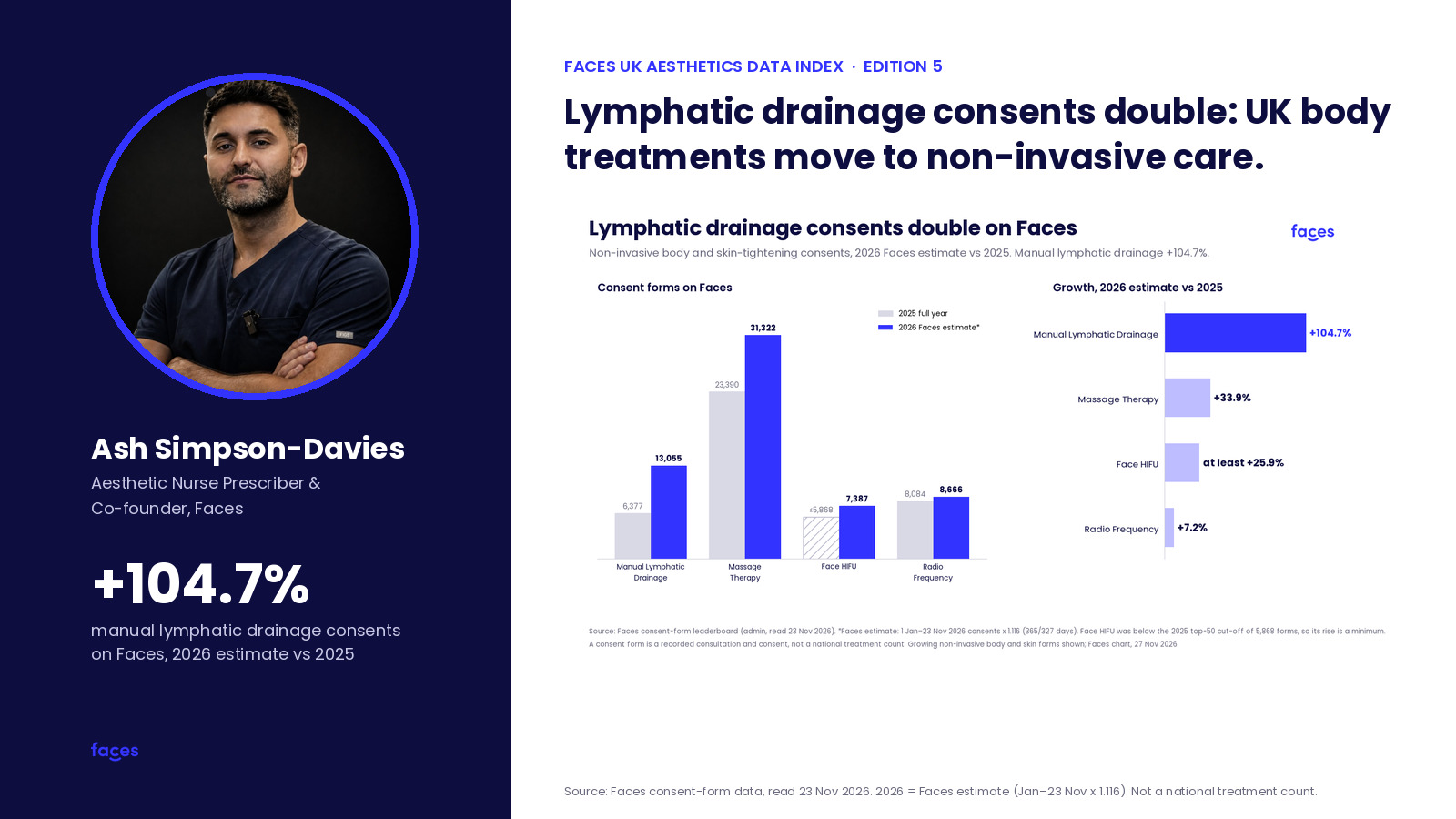
Ash Simpson-Davies, an aesthetic nurse prescriber and co-founder of Faces, said:
“Manual lymphatic drainage consents on Faces have doubled this year, and HIFU, radiofrequency and massage are all growing with it. Clients want results without downtime, and clinics are building body and skin menus around non-invasive care. As a prescriber, I find that exciting, because it shows people choosing treatments that fit their lives. Non-invasive doesn’t mean no assessment, though. Every treatment should still start with a consultation, a recorded consent that checks contraindications, a trained practitioner and clear aftercare. Digital consent makes that the easy part, and it’s why we can see trends like this as they happen.â€
Want the data? Journalists, brands and PR agencies
Faces holds anonymised, aggregate data on consents across beauty and medical aesthetics. If you are a journalist, a device brand or a PR team such as Kendrick PR, Cosmetic PR, 5WPR or DeVries Global, and you would like the method or the figures, get in touch via Faces. Earlier editions: the UK toxin league table, the microneedling edition and the dermal filler edition. You can also follow Ash from Faces and Faces Pharmacy on YouTube, @facesconsentapp on Instagram and @facespharmacy on TikTok.
If you run a clinic, you can register for Faces and use all our consent forms and aftercare forms free.
FAQ
Does lymphatic drainage remove fat?
No. It encourages fluid to move, which can ease puffiness for a few days, but it does not remove fat or tighten loose skin. That is why a consent form that sets realistic expectations matters.
Why is the HIFU rise “at least†25.9%?
Face HIFU was not in Faces’ top 50 consent forms for 2025, and the 50th form had 5,868 consents. So 2025 was 5,868 or fewer, and our 2026 estimate of 7,387 is at least 25.9% higher.
Is this a Faces market share?
No. There is no official UK count of these treatments, so we have not estimated a share. The figures are consent forms recorded on Faces, compared with 2025 on the same basis.
Where can I get a lymphatic drainage, HIFU or radio frequency consent form?
Faces has free templates: manual lymphatic drainage consent form template, Face HIFU consent form template and radio frequency consent form template, each with an aftercare sheet. See all consent forms.
This article is general information for aesthetics and beauty professionals. It is not clinical, legal or regulatory advice. Device details are taken from each maker’s own published information. Always follow your own training, device guidance, insurer requirements and professional body.
Ashley James Simpson-Davies INP MSc RN