
A practitioner who has run a fixed Azzalure protocol for years is asked by a patient why the clinic down the road advertises results “within 24 hours.” Both clinics use a Galderma toxin. Both quote Speywood units. The difference sits in the vial: one is a powder that has to be reconstituted, the other arrives as a ready-to-use liquid. That single distinction shapes preparation time, dosing accuracy, onset and, increasingly, what patients ask for by name. Understanding where Alluzience and Azzalure genuinely differ, and where they are effectively the same drug, makes the choice a clinical one rather than a marketing one.
The same toxin in two different formats
Both products are abobotulinumtoxinA, the same active molecule found in Dysport, produced by Ipsen and brought to the aesthetic market by Galderma. Both are measured in Speywood units, which are specific to this toxin family and are not interchangeable with the units used by onabotulinumtoxinA (Botox) or incobotulinumtoxinA (Bocouture). Fifty Speywood units does not equal fifty Allergan units. Mixing those scales is one of the more dangerous conversion errors in practice, and the MHRA-approved Azzalure Summary of Product Characteristics states plainly that the units cannot be cross-converted.
The mechanism is identical too. The toxin binds to presynaptic cholinergic nerve terminals, cleaves SNARE proteins, and blocks acetylcholine release at the neuromuscular junction. The treated muscle relaxes, dynamic lines soften, and movement gradually returns as the nerve terminal regenerates. What separates the two products is how they reach the syringe.
Powder vs liquid: the same toxin, prepared differently
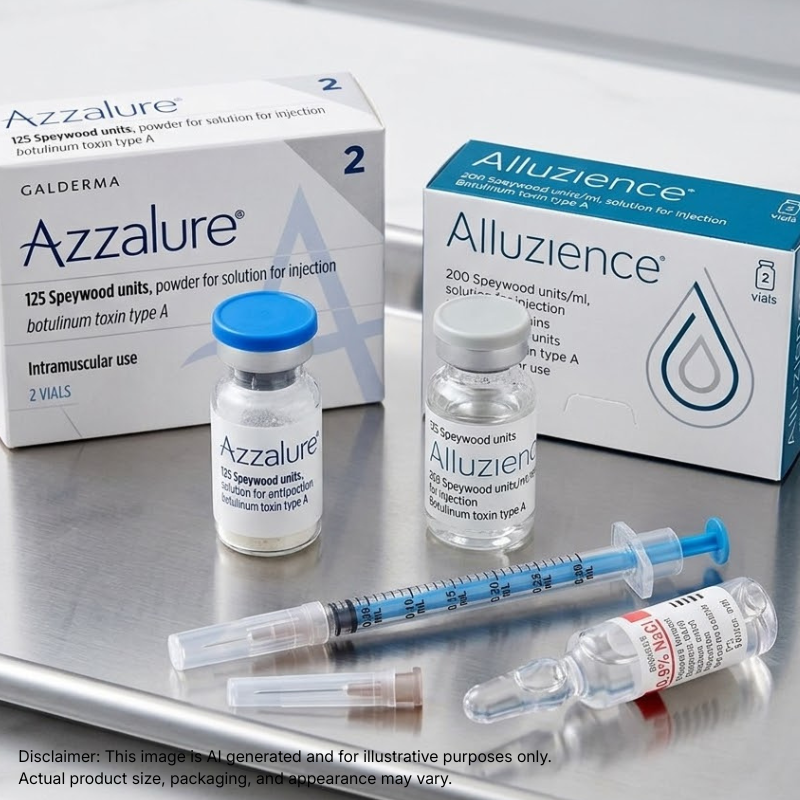
Azzalure arrives as a freeze-dried powder that you reconstitute with saline before use, so the concentration is set by the volume you add. Alluzience arrives as a ready-to-use liquid at a fixed 200 Speywood units per ml, with no mixing step.
Same active molecule, same units, same glabellar dose — the difference is handling. The liquid format removes the dilution variable; the powder format gives you control over spread and a lower cost per vial.
Azzalure, the reconstitution workhorse
Azzalure is supplied as a lyophilised powder in a 125 Speywood unit vial. It holds a UK licence for two areas: moderate to severe glabellar lines seen at maximum frown, and lateral canthal lines (crow’s feet) seen at maximum smile, in adults under 65. That dual licence is part of why Azzalure remains a default upper-face toxin across the UK. The product is widely stocked, well understood, and has a long real-world safety record behind it.
Getting the dilution right
Because Azzalure is a powder, it has to be reconstituted with 0.9% sodium chloride, and the volume chosen sets the concentration:
- 0.63 ml of saline gives 200 Speywood units per ml, delivering 10 units in each 0.05 ml.
- 1.25 ml of saline gives 100 units per ml, delivering the same 10 units in a larger 0.1 ml volume.
The dose per point is unchanged; what changes is the injected volume, and therefore the spread. Higher dilutions diffuse more, which can be useful across a broad frontalis but risky near the brow. Getting Azzalure dilution consistent from session to session is what makes results reproducible, and inconsistent reconstitution is one of the most common reasons a patient’s “same treatment” behaves differently between visits. Faces covers this in its guide to Azzalure dosing and dilution without the guesswork, and the wider principles are set out in its piece on how to reconstitute and dilute botox correctly.
Dosing by area
Mapping Azzalure units per area to the anatomy, rather than to a fixed template, is what separates a natural result from a frozen or asymmetric one, because corrugator bulk and brow position vary considerably between patients. The licensed doses are:
- Glabella: 50 Speywood units total, across five points — two into each corrugator, one into the procerus at the nasofrontal angle, palpated at maximum frown.
- Crow’s feet (per side): 30 units, across three superficial points at the outer orbicularis oculi, roughly 1–2 cm from the orbital rim and angled away from the eye.
Using Azzalure in the frontalis
The forehead is where caution matters most. Azzalure dosage frontalis is not a licensed indication, and the frontalis is the only brow elevator, so over-treating it drops the brow and produces heaviness or a hooded look. Off-label frontalis dosing is therefore conservative and individualised: low-dose points placed high enough to preserve some lift, and almost always balanced against glabellar treatment so the depressors and the single elevator are not left fighting each other. Treating the frontalis in isolation, or at a glabellar-style dose, is a frequent cause of post-treatment brow ptosis — one of the areas where injectors moving between toxins benefit from a refresher through the Faces training academies before changing their forehead protocol.
Alluzience, ready to use out of the vial
Alluzience is the first ready-to-use liquid botulinum toxin treatment licensed in the UK and Europe, launched in 2022. Each vial contains 125 Speywood units in 0.625 ml of clear solution at a fixed concentration of 200 units per ml, as set out in the MHRA-approved Alluzience Summary of Product Characteristics. There is no powder and no reconstitution step, which removes the dilution variable and the calculation errors that come with it. Its UK licence currently covers glabellar lines only. Faces sets out the background in its overview of Alluzience, the UK’s first liquid toxin.
The formulation carries a second advantage worth knowing. Alluzience is manufactured without human or animal-derived proteins such as human serum albumin and lactose, which is relevant for patients with a cow’s milk protein allergy — a genuine if uncommon caution attached to lactose-containing toxins.
Alluzience dosing
The licensed Alluzience dosage for glabellar lines mirrors Azzalure: 0.25 ml of solution (50 Speywood units), divided into five sites at 0.05 ml (10 units) each, following the same corrugator-and-procerus pattern. Because the concentration is fixed, the volume-to-unit relationship is identical for every practitioner and every vial, which is the main argument for dosing consistency. For off-label areas, the International Board on Alluzience consensus in the Aesthetic Surgery Journal suggests four to eight points across the frontalis depending on presentation, and discrete points for a lateral brow lift, always at practitioner discretion.
What the results look like
Onset is the headline. The prescribing information records a median onset of three days, with a subset of patients reporting an effect within 24 to 48 hours, and effect demonstrated for up to six months after a single treatment. Honest Alluzience before and after documentation should reflect that range rather than promising 24-hour results for everyone, since 24 hours is the fast end of the curve, not the average. Photographing at maximum frown under consistent lighting — at baseline, two weeks, and the review point — gives a fair record of both onset and longevity, and scheduling that two-week review through the Faces booking system keeps the follow-up from slipping.
Onset and duration side by side
For a patient who returns three or four times a year, the practical question is whether a longer interval suits their habits and budget, or whether the established dual-area Azzalure licence matters more:
- Azzalure: median onset 2–3 days, peak around day 30, duration up to 4 months (some responders at 5).
- Alluzience: similar 2–3 day median with a faster early tail, duration demonstrated to 6 months in the glabella.
Side effects, contraindications and common mistakes
The safety profiles overlap heavily because the active molecule is the same. The most frequent Azzalure side effects are headache and injection-site reactions such as bruising, redness and transient swelling, with eyelid or brow ptosis, dry eye and asymmetry possible when placement or dose drifts. Rarely, effects of toxin spread beyond the treated area have been reported across all botulinum products.
Both toxins are contraindicated in:
- Myasthenia gravis, Lambert-Eaton syndrome and amyotrophic lateral sclerosis.
- Active infection at the injection site.
- Known hypersensitivity to the product.
- Pregnancy and breastfeeding.
The two predictable errors in practice are unit confusion when switching from a non-Speywood toxin, and over-treating a single muscle group without accounting for its antagonists. If a patient does react badly or an unexpected complication appears, having a structured adverse-event route to fall back on matters, and the Complications Consultant gives practitioners senior clinical input to call on, so issues like ptosis or asymmetry are assessed and managed properly rather than left to guesswork.
Cost, stock and supply
Trade pricing for both products is quoted per vial and is usually shown only to verified, logged-in practitioners, which is why a single public Azzalure price UK figure is hard to pin down and varies by supplier and pack size. As a general guide, the dual-vial pack lowers the effective per-unit cost against single vials, and Alluzience usually carries a modest premium over Azzalure that buyers weigh against its longer duration and no-reconstitution handling. On Faces, Azzalure 125IU (2 Vials) and the Alluzience 125IU 2 Vials Twin Pack are both listed across the pharmacy network, with prices visible after sign-in. Comparing the Azzalure price against Alluzience on a cost-per-treatment basis, rather than cost-per-vial, gives a truer picture once duration is factored in.
Two supply points matter for both. Each is classified as a prescription-only medicine under the Human Medicines Regulations 2012, overseen by the Medicines and Healthcare products Regulatory Agency, so neither can be bought without connecting to a prescriber through the platform first. The Faces’ prescriber network handles that link inside the same order flow, and prescribers working to the JCCP guidance on responsible prescribing for cosmetic procedures must assess the patient before any toxin is supplied from stock. Because both are cold-chain products stored at 2–8°C, ordering against the courier cut-off is essential; Faces runs next-day delivery on cold-chain stock provided orders clear before the daily deadline, with weekend handling rules to check before a Friday order. Azzalure remains one of the most widely stocked toxins across the UK, so availability is rarely the limiting factor for an Azzalure UK order; Alluzience can move in and out of stock more often given its newer position in the market.
What practitioners are reporting
Early Alluzience reviews from UK injectors tend to centre on two things: the convenience of skipping reconstitution, which saves chair time and removes a source of dosing error, and patient satisfaction with the faster perceived onset. The counterpoint from long-term Azzalure users is reliability, the breadth of the licence (particularly for crow’s feet), and a cost that is often lower per vial. Neither product is “better” in the abstract; the feedback splits along what each clinic values most.
How to choose in practice
For a patient who wants the quickest visible change, a longer gap between appointments, and whose concern is the glabella, Alluzience is the more natural fit. For a practitioner who treats crow’s feet on licence, manages cost tightly, or wants the most established track record, Azzalure holds its ground. A growing number of clinics simply stock both and match the toxin to the patient. The more useful next step than choosing a side is auditing your own dilution and unit records across a month of treatments, since consistency in preparation tends to explain more variation in results than the brand on the vial.
Order through Faces with the paperwork built in
For practitioners searching Alluzience buy online, the product sits alongside Azzalure in Faces pharmacy, where you can compare live stock and sign-in pricing and buy Azzalure online directly, with prescribers available to connect with. To start, you need to create an account, register and submit your requirements. Once approved, you can purchase your chosen toxin. Watch the tutorial below to get set up:
FAQs
Are Azzalure and Alluzience the same units?
Yes. Both use Speywood units and both contain abobotulinumtoxinA. Fifty units of one equals fifty units of the other, but neither converts to Botox or Bocouture units.
Does Alluzience really last longer than Azzalure?
The prescribing information demonstrates effect up to six months for Alluzience in the glabella, against up to four to five months for Azzalure. Individual duration still depends on dose, muscle bulk and metabolism.
Can Azzalure be used on the forehead?
The frontalis is off-label for Azzalure, which is licensed for glabellar and lateral canthal lines. Off-label frontalis treatment is done at low, conservative doses and almost always alongside the glabella to avoid brow heaviness.
Why does Alluzience cost more?
The premium reflects the ready-to-use liquid formulation, zero reconstitution waste and longer demonstrated duration. On a cost-per-treatment basis the gap narrows.
Do I need a prescriber to order either?
Yes. Both are prescription-only medicines and require a connected prescriber before purchase, regardless of supplier.