
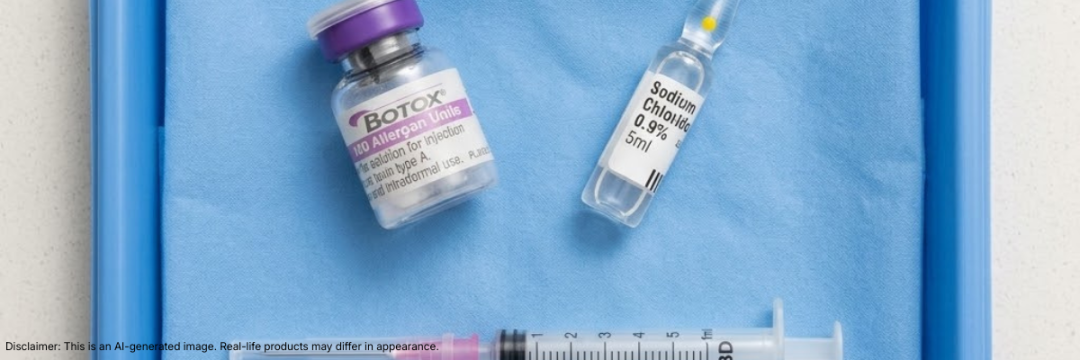
Two injectors share a treatment room. One reconstitutes a 100-unit vial with 1 ml of saline, the other with 2.5 ml. Both draw up “20 units” for a glabella, both believe they are delivering the same treatment, and both are partly right. The dose is identical. The volume entering the muscle is not, and a few weeks later that difference shows up in how the product has spread and how the result reads at review. Reconstitution is the quiet step that decides much of what happens afterwards, yet it gets less attention than injection technique or product choice.
This guide covers what is in the vial, which diluent to use, how much, the technique itself, storage, and the dosing implications across the face.
What is actually in the vial
Botox is a vacuum-dried powder of botulinum toxin type A. It contains no liquid until it is reconstituted, and the powder layer is so thin it can be hard to see at the bottom of the glass. The mechanism is worth keeping in mind because it explains why precision matters. Once injected, the toxin binds to cholinergic nerve terminals and cleaves a protein called SNAP-25, which the nerve needs to release acetylcholine. Without acetylcholine reaching the muscle, the fibre cannot contract. The effect is a temporary, reversible chemodenervation. Nerve terminals sprout and recover over roughly three to four months, which is why treatment is repeated rather than permanent.
That same diffusion behaviour is the reason dilution is a clinical decision and not just a mixing instruction. The toxin spreads from each injection point through the tissue, and the volume it is dissolved in influences how widely it travels. Used for moderate to severe glabellar, lateral canthal and forehead lines, the product is licensed as a prescription-only medicine and forms the basis of mos anti-wrinkle injection treatments offered in UK clinics.
Choosing the diluent: what the licence says
The reconstitution fluid is the first decision, and here UK guidance is unambiguous. According to the BOTOX summary of product characteristics, the product must only be reconstituted with sterile, unpreserved normal saline (0.9% sodium chloride for injection). That is the licensed instruction for every facial indication.
In practice, a large number of practitioners prefer preserved (bacteriostatic) saline, which contains benzyl alcohol. The appeal is real: benzyl alcohol acts as a mild local anaesthetic, so patients tend to report less stinging on injection, and it has antimicrobial properties. The Global Aesthetics Consensus has acknowledged that many practitioners use bacteriostatic saline for this reason. The point practitioners sometimes miss is that this is an off-label choice with a prescription-only medicine. A practitioner survey published in the Journal of Aesthetic Nursing found bacteriostatic use to be common while the clinical reasoning behind it was often unclear among those using it.
There is nothing wrong with making an informed off-label decision, but it should be a decision, recorded and justifiable, not a habit copied from a training course. If comfort is the goal, weigh it against the simpler route of staying on-licence and managing discomfort through needle choice and technique.
How much saline: the dilution table
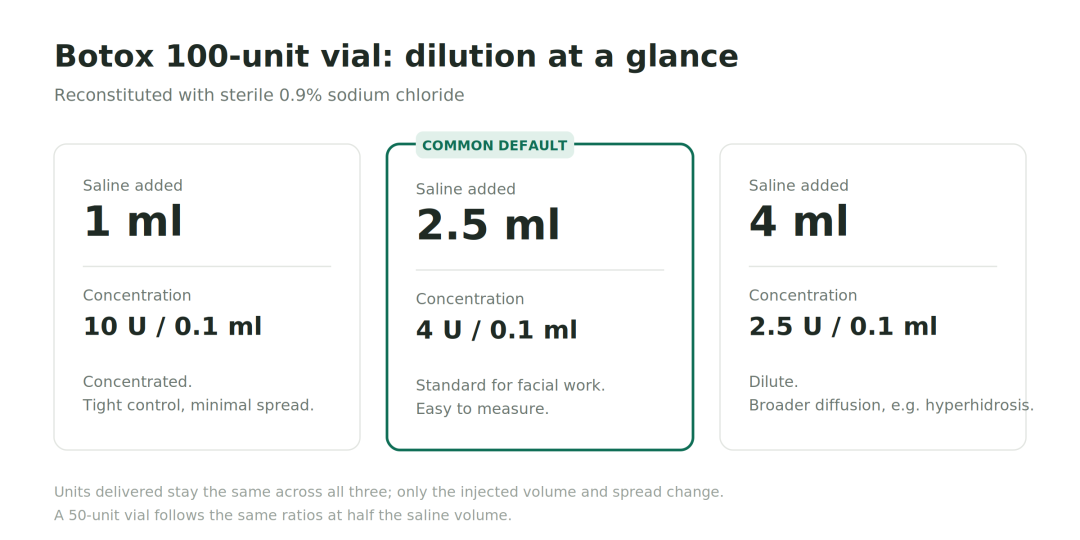
The licensed dilution table for a 100-unit vial sets out the relationship between diluent volume and concentration. Adding 2.5 ml of saline gives 4 units per 0.1 ml, which is the most widely used concentration for facial work. Adding 1 ml gives 10 units per 0.1 ml, a more concentrated preparation. Adding 4 ml gives 2.5 units per 0.1 ml, a more dilute one. A 50-unit vial follows the same logic at half the volume, so 1.25 ml produces the same 4 units per 0.1 ml.
The reason 2.5 ml has become a default is readability. A 20-unit glabella delivered across four points means 5 units, or 0.125 ml, per point at that concentration, which is an easy volume to measure and control on a 1 ml syringe. The same dose from a 1 ml reconstitution sits at 0.05 ml per point, where small drawing-up errors translate into larger dosing errors.
Concentrated or dilute: the diffusion question
Volume affects spread. A more dilute preparation occupies more space and tends to diffuse further from the injection point, which can be useful where broad, even softening is wanted, such as hyperhidrosis of the axillae. A more concentrated preparation stays closer to where it is placed, which suits precise work near muscles you do not want to affect, such as the fibres around the brow. Some experienced injectors argue the spread difference is modest within the normal range and that placement and dose matter more. The practical takeaway is consistency: pick a standard dilution for your Botox treatment menu, document it, and only vary it deliberately for a specific reason.
The reconstitution technique, step by step
Good technique protects both potency and sterility.
Bring the vial to room temperature and inspect it. Clean the rubber stopper with an alcohol swab and let it dry. Draw up the chosen volume of saline into an appropriately sized syringe with a drawing-up needle, and insert it through the centre of the stopper.
Let the vacuum do the work. An intact vial holds a vacuum that pulls the saline in. If the diluent does not draw in, the vacuum has been lost, sterility cannot be assured, and the vial should be discarded. Direct the saline against the side of the vial rather than blasting it onto the powder.
Mix gently. The protein is delicate, and the long-standing instruction is to rotate or swirl the vial rather than shake it vigorously, since foaming and shear forces were thought to risk denaturing the toxin. Modern handling studies suggest the molecule is more resilient than once believed, but gentle swirling remains sensible practice and costs nothing.
Record the date and time of reconstitution on the vial label. This single habit prevents the most common storage error and supports your record-keeping if a result is queried later.
Dosing across the face
Reconstitution feeds directly into dosing, because units are what you titrate and volume is what you place. The licensed starting points are a useful anchor. The glabellar complex is treated with around 20 units across the corrugators and procerus. Forehead botox targeting the frontalis is licensed at 20 units when treated alongside the glabella, giving a combined 40 units, with the lower placement chosen carefully to avoid brow ptosis. Lateral canthal (crow’s feet) lines take around 24 units across both sides.
These are guides, not prescriptions for every face. Muscle mass varies, and this is where Botox for men becomes a distinct consideration: men generally have bulkier, stronger frontalis and corrugator muscles and frequently need higher unit doses than the female averages quoted in the licence to achieve a comparable effect. Assessing the muscle at rest and at full contraction during the Botox consultation tells you more than any standard chart. The same assessment underpins safe Botox for wrinkles work generally, since dynamic lines respond well while deeply etched static lines may need adjunctive treatment and realistic expectation-setting.
Brand units are not interchangeable. The licence is explicit that doses in Allergan Units differ from other botulinum toxin preparations, so a practitioner moving between products cannot carry a dose across. The same caution applies to dilution habits. For the specifics of other toxins, the Faces blog covers Azzalure dosing and dilution and getting Bocouture right area by area, and the newer ready-to-use formulations such as Alluzience, the UK’s first liquid toxin, remove the reconstitution step entirely.
Storage and shelf life after mixing
Unopened vials are stored refrigerated at 2°C to 8°C. Once reconstituted, the licence states the product should be used within 24 hours and kept refrigerated at 2°C to 8°C in the interim. It is intended for single use, and any unused solution should be discarded.
Many clinics in practice reuse a vial across a session or even later, and there is published work suggesting reconstituted toxin retains potency beyond 24 hours under good conditions. That evidence does not change the licensed position, and a practitioner choosing to extend use is again making an off-label, documented decision that they would need to defend. Discard any solution that looks cloudy, discoloured or has visible particles.
This is also where the economics sit. Sensible dilution and session planning reduce wastage, which has a direct bearing on the Botox cost per treatment and therefore on margin, particularly for clinics buying single vials rather than in volume.
Common mistakes worth avoiding
The recurring errors are mundane and preventable. Inconsistent dilution between injectors in the same clinic produces inconsistent dosing and confused records. Forgetting to label reconstitution time leads to guesswork about whether a vial is still usable. Over-vigorous mixing introduces foam that makes accurate drawing-up harder. Using the wrong syringe graduation turns a clean 4 units per 0.1 ml into a mental arithmetic exercise mid-treatment. And reaching for bacteriostatic saline without recording why leaves an off-label choice undocumented.
Results, onset and aftercare
Dilution done well sets up predictable Botox results. Onset is typically visible at two to three days, with the effect peaking around two weeks, which is why review and any top-up are scheduled at the two-week mark rather than earlier. Duration sits at roughly three to four months for glabellar treatment in the licensed studies. Patients almost always ask how long does botox last, and an honest answer manages the rebooking conversation: the effect fades gradually, and consistency improves with regular, correctly dosed treatment rather than long gaps.
Standardised photography at rest and at full expression gives you reliable Botox before and after documentation, which is far more useful for assessing your own dosing than memory or patient report. On Botox aftercare, the practical points are to stay upright for a few hours, avoid rubbing or massaging the treated area, skip strenuous exercise and heat for the rest of the day, and gently exercise the treated muscles. Clear aftercare protects the result and reduces avoidable callbacks.
A note on side effects and patient understanding
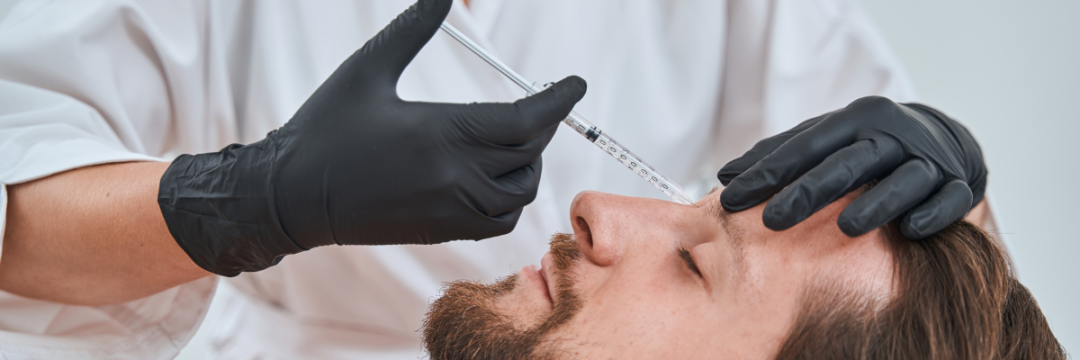
Most Botox side effects are local and transient: pinpoint bruising, mild swelling, occasional headache. The clinically significant risks are dose- and placement-dependent, such as brow or lid ptosis from product reaching unintended muscles, which is precisely why dilution and injection depth interact. Spread is a function of volume as well as technique. The well-documented Botox benefits for dynamic lines are real, but they depend on the toxin landing where it is intended and staying there, which loops back to the reconstitution choices made before the needle ever touched skin.
It also pays to remember what patients see. The person typing Botox near me or comparing a Botox clinic online is judging on results and trust, not on dilution ratios they will never know about. The technical rigour is invisible to them and entirely visible in the outcome.
Building a toxin service that holds up
Consistent reconstitution is one part of a treatment that stands up to scrutiny. The rest is the paperwork and supply chain around it. Practitioners building or tightening an anti-wrinkle injection service can use Faces Consent to standardise treatment-specific consent and aftercare forms, source product through a registered pharmacy with next-day delivery, and connect with prescribers where a remote prescription is needed. Set your standard dilution, document it, and let the records do the defending if a result is ever questioned. For the comfort side of treatment, the Faces guide to lidocaine in aesthetics is a useful companion read.
On supply specifically, where you buy matters as much as how you mix. Counterfeit and grey-market toxin is a real problem in the UK, and a vial bought outside the regulated chain undermines every careful dilution decision that follows it. Faces Pharmacy connects practitioners to verified UK pharmacies that dispense genuine Botox against a valid prescription, so you know exactly what is in the vial before you reconstitute it. Set up an account, link your prescriber, and order authentic stock from verified UK pharmacies you can trust.
FAQs
Can you reconstitute Botox with bacteriostatic saline?
The licence specifies unpreserved 0.9% sodium chloride. Bacteriostatic saline is widely used off-label for reduced injection discomfort, but that should be a recorded, justifiable decision rather than a default.
How long is reconstituted Botox usable?
The summary of product characteristics states 24 hours, refrigerated at 2°C to 8°C, single use. Some clinics extend this off-label based on potency data, again as a documented decision.
Does dilution volume change how far the product spreads?
Volume influences diffusion, with more dilute preparations tending to spread further. Placement and dose remain the larger drivers, so consistency of dilution matters more than chasing a particular ratio.
What concentration suits the forehead versus crow’s feet?
Many injectors use 4 units per 0.1 ml (2.5 ml in a 100-unit vial) across the face for readability, choosing more concentrated preparations only where tight control near the brow is wanted.
Should the vial be shaken or swirled?
Gently swirl or rotate. Vigorous shaking causes foaming that complicates accurate drawing-up; the historic concern about denaturing the protein supports careful handling regardless.