
A practitioner who has injected onabotulinumtoxinA for years switches a client to Azzalure, reaches for the same dosing they always use, and ends up either underdosing the glabella or, worse, dropping a brow. The error almost always comes from one place: treating Speywood units as if they were interchangeable with the units printed on a Botox vial. They are not, and that single misunderstanding sits behind a large share of disappointing results, early relapse and the occasional complication.
This piece walks through how the product actually behaves: what it is, how to reconstitute it, where it goes, how much to use per area, how quickly it works, how long it holds, and how it compares to the liquid toxin that shares its active ingredient. The aim is to leave fewer decisions to habit and more to the data.
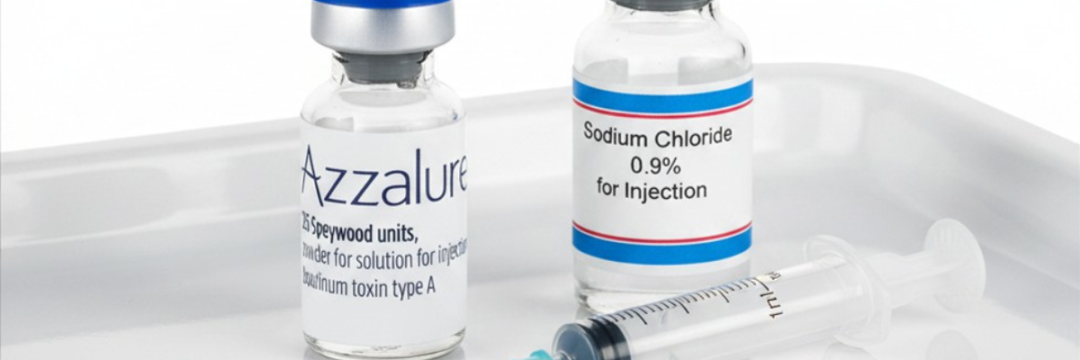
What Azzalure is and how it works
So what is Azzalure? It is a botulinum toxin type A product, the same molecule family as every other aesthetic neuromodulator, but sourced from the abobotulinumtoxinA line that also produces Dysport. Azzalure Galderma branding reflects the commercial arrangement: the toxin is manufactured by Ipsen and distributed for aesthetic use by Galderma in the UK and Europe. It blocks acetylcholine release at the neuromuscular junction, which stops the targeted muscle from contracting and softens the dynamic lines that contraction produces.
The detail that trips people up is the measurement system. Azzalure units are Speywood units, a potency measure specific to this preparation. They are not equivalent to the units on an Allergan or a Merz vial, and the manufacturer states plainly that they cannot be converted on a one-to-one basis. A vial holds 125 Speywood units.
Practitioners often ask whether Azzalure performs differently in practice, or put more bluntly, is Azzalure Botox good. The honest answer is that it is a well-evidenced, long-established toxin with phase III data behind its glabellar and lateral canthal licences, a slightly faster typical onset than some competitors, and a diffusion profile that suits broad muscles. It is neither inferior nor a budget substitute; it simply has its own dosing logic.
Azzalure vs Botox: the conversion that matters
The Azzalure vs Botox question is really a unit question. The widely used conversion ratio is 2.5 Speywood units to 1 onabotulinumtoxinA unit, with some injectors moving to 3:1 in heavier muscles or when they want a firmer hold. So where you might place 4 units of onabotulinumtoxinA, you would place roughly 10 Speywood units to achieve a comparable effect. Get the ratio wrong and the consequences are predictable: underdose and the patient feels the result fade within weeks; overdose and you raise the risk of brow ptosis or unwanted spread into neighbouring muscle. Neither helps retention. The safe default for most injectors is 2.5:1, adjusted by muscle bulk and clinical judgement rather than by guesswork.
Reconstitution and dilution
Correct Azzalure reconstitution is non-negotiable, because the entire dosing scheme depends on the concentration you create. The product comes as a white powder and must be reconstituted with 0.9% sodium chloride only.
The standard Azzalure dilution for a 125 Speywood unit vial uses 0.63ml of saline, which gives a concentration of 10 Speywood units per 0.05ml. That figure is the reference point for almost every published injection-point dose, so deviating from it means recalculating every site. An alternative Azzalure 125 units dilution uses 1.25ml of saline to give 10 units per 0.1ml, producing a larger injection volume per point and slightly more spread, which some practitioners prefer for broad areas but which demands care near the brow.
If you are new to the brand and wondering how to mix Azzalure in practice: clean the stopper with alcohol, introduce the saline slowly down the side of the vial rather than blasting it onto the powder, and mix with a gentle swirl rather than shaking, because agitation can denature the protein. The reconstituted solution should be clear and colourless. A dedicated Azzalure syringe graduated in 0.1ml and 0.01ml increments makes the 0.63ml measurement accurate, and Galderma supplies these precisely because standard insulin syringes can leave you guessing on the final tenths. Full handling and disposal instructions are in the Azzalure Summary of Product Characteristics.
Injection sites, depths and dosing
The licensed Azzalure injection sites and doses for glabellar lines are well defined: a total of 50 Speywood units divided across five points, 10 units each, injected intramuscularly at right angles into the two corrugators (two points per side) and the procerus near the nasofrontal angle. For lateral canthal lines (crow’s feet), the licence covers 30 Speywood units per side across three superficial points, injected at a shallow 20–30° angle.
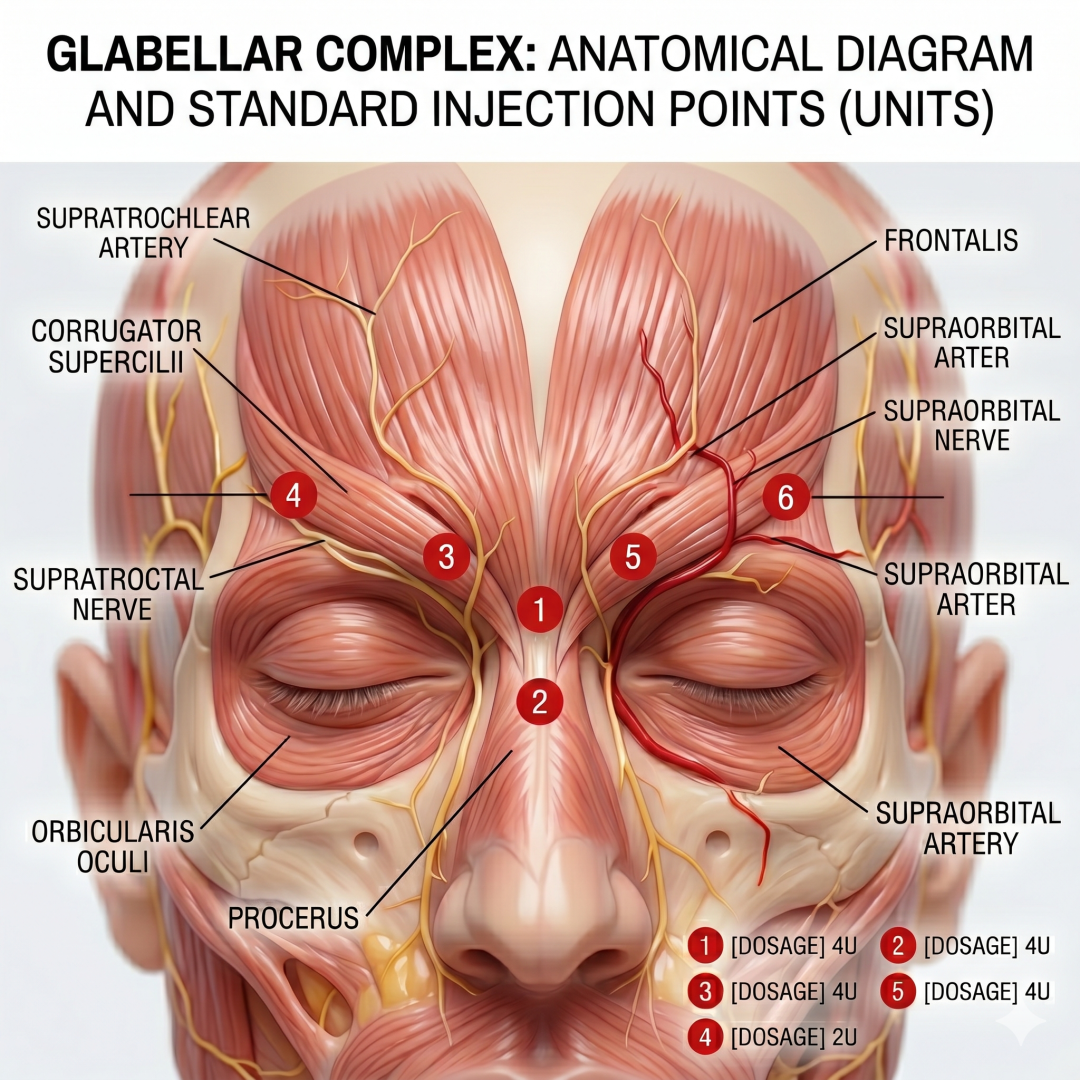
Mapping the Azzalure injection points onto live anatomy rather than a textbook is where skill shows. Corrugator length and brow shape vary, and placing the medial points too low or too lateral risks affecting the levator and dropping the lid. Keeping the procerus point at the nasofrontal angle and respecting a safe margin above the orbital rim are the two habits that prevent most ptosis cases.
Even with sound technique, the occasional lid heaviness or asymmetry happens, and how quickly it is managed shapes both the outcome and the patient’s confidence. Having senior clinical advice on call for those moments is worth setting up before you need it; the Complications Consultant help line is built for exactly that, giving you management guidance in real time rather than after the next clinic day.
For Azzalure units per area, the glabella and each crow’s-foot side have licensed figures above, but the forehead is where practitioners most often improvise. Azzalure units for frontalis treatment is off-licence and must be approached conservatively, because frontalis is the only muscle that lifts the brow. Over-relaxing it causes brow heaviness or a fixed surprised look. Many injectors use a total in the region of 20–40 Speywood units spread across the forehead, balanced against glabellar treatment so the depressors and the single elevator are not left fighting each other. The broader consensus on Azzalure Speywood units per area across the upper face, including the recommendation to keep concentration consistent, is summarised in the international consensus on aesthetic abobotulinumtoxinA use.
Onset and duration
Patients want to know how long does Azzalure take to work, and the realistic answer is a visible softening from around day two to three, with the full effect settling by day ten to fourteen. That early onset is one reason the brand retains loyal users.
On how long does Azzalure last, expect three to four months for most patients in most areas, shorter in highly mobile or muscular faces and longer in light movers. Reviewing at two weeks lets you correct any asymmetry within the same treatment cycle and sets realistic expectations for the next booking.
Alluzience vs Azzalure
The Alluzience vs Azzalure comparison comes up constantly now that Galderma offers both. Alluzience is the ready-to-use liquid abobotulinumtoxinA, so it removes the reconstitution step entirely, which improves dosing reproducibility and saves chair time. Its phase III data showed onset as early as 24 hours in a subset of patients and a duration reaching up to six months in some, which is the headline difference.
Framed the other way, the Azzalure vs Alluzience decision usually rests on workflow and price. Azzalure is the lower-cost, powder-based option with decades of real-world data and the flexibility to vary concentration; Alluzience trades a higher per-vial cost for liquid convenience and potentially longer hold. Neither is universally better, and because units differ between formulations you should never carry a dose across from one to the other without checking the relevant SmPC.
What Azzalure costs
Pricing causes confusion partly because of naming. Search terms like Azzalure Botox price and Azzalure Botox prices are everywhere, which only reflects how entrenched “Botox” has become as a generic label for all toxins. Azzalure is not Botox, but the search behaviour is worth understanding when you write patient-facing material.
The Azzalure price a practitioner pays at trade sits separately from what the patient is charged. Through Faces Pharmacy, a single 125 Speywood unit vial currently runs from around £69 to £78, while a dual-vial (2 × 125u) pack sits between roughly £133 and £155, most commonly near £140. Buying in larger multiples brings the per-vial figure down, with three-vial bundles working out at about £148 each. The reconstitution kit is a small add-on, with 0.63ml Speyside syringes available in packs of 25 for around £33. Because trade figures move with supplier, pack size and order volume, the sensible Azzalure cost to quote yourself is always the live price on the day you order.
Patient-facing fees are a different number again. The typical per-area charge across UK clinics runs in the region of £120–£250, depending on location and seniority. When you benchmark the Azzalure price UK market, that per-area band is the figure to compare, not the vial cost. And when a patient lands on an Azzalure Botox price UK quote while shopping around, the variation they see usually reflects practitioner experience and overheads rather than the product itself. For a practitioner-focused breakdown of buying and stocking the toxin, the Faces blog post on buying Azzalure online covers the supply side in more detail.
A quick note on the economics worth making to newer injectors: at roughly £70 a vial for 125 Speywood units through Faces Pharmacy, the consumable cost of a standard 50-unit glabella treatment is a small fraction of the per-area fee, so the margin lives in chair time and skill, not in the toxin itself. That framing helps when practitioners feel pressured to compete on headline price.
Buying licensed Azzalure and staying inside the rules
Sourcing has become a regulatory issue, not just a commercial one. Between 4 June and 6 August 2025, the UK Health Security Agency confirmed 41 cases of iatrogenic botulism in England linked to cosmetic injections, with evidence pointing to unlicensed products, as set out in the UKHSA and MHRA botulism warning. The MHRA has since seized thousands of vials of unauthorised toxin and confirmed that supplying unlicensed botulinum toxin can carry up to two years’ imprisonment under the Human Medicines Regulations 2012. Azzalure is one of the brands licensed for UK cosmetic use, so the protection here is straightforward: buy it through a regulated UK pharmacy against a valid prescription, keep your lot numbers, and never substitute a cheaper, unbranded import.
The prescribing route tightened in parallel. Since 1 June 2025, the Nursing and Midwifery Council has aligned with the GMC, GDC and GPhC in treating remote prescribing of botulinum toxin as unacceptable, meaning a prescriber must assess the patient face-to-face before any Azzalure prescription is issued. For a non-prescribing injector, that makes a reliable prescriber relationship part of your core setup rather than an optional extra.
Consent, aftercare and what patients report
Documentation is part of safe practice, not an afterthought. A treatment-specific Azzalure consent form should set out the off-licence use of areas like the forehead where relevant, the realistic onset and duration, and the recognised risks of ptosis and asymmetry, all discussed by the injecting practitioner rather than delegated. You can build one from the free botulinum toxin consent form template.
Clear Azzalure aftercare improves outcomes and reduces avoidable complaints: no rubbing or massaging the area for at least a few hours, staying upright for four hours, and avoiding strenuous exercise, alcohol and heat for the first 24 hours. A ready-made botulinum toxin aftercare form saves you rewriting the same guidance for every patient.
As for Azzalure reviews, the long-running APPEAL satisfaction study found that patients treated repeatedly for glabellar lines reported high and sustained satisfaction across multiple cycles, which matches what most clinics see: once a patient settles on the product and the injector dials in their dose, they tend to rebook rather than switch.
Book in a review-and-titrate first cycle
If you are adding Azzalure to your stock or moving patients across from another toxin, run the first cycle as a deliberate calibration: photograph at rest and on movement, dose to muscle bulk at a 2.5:1 conversion, and bring every patient back at two weeks to fine-tune before the result fully sets. Order your vials, Speyside syringes and saline through Faces Pharmacy so your kit and your dosing reference arrive together, and store the consent and aftercare forms in the Faces Consent app so the paperwork is signed before the needle is loaded. Because Azzalure is a prescription-only medicine, that order needs a prescription behind it; if you don’t hold prescribing rights yourself, the Faces Prescribers service can pair you with a registered prescriber so supply and paperwork move together rather than holding up your clinic list.
FAQs
Can Azzalure be used on the masseter?
Masseter treatment is off-licence but commonly performed for slimming and bruxism. Because the masseter is a large, strong muscle, it needs considerably higher Speywood totals than facial areas, placed across several deep intramuscular points, and benefits from review and titration over successive cycles.
Why does a patient’s result wear off faster than expected?
Common causes are underdosing relative to muscle bulk, an over-dilute mix changing spread, very active musculature, or a conversion error from another brand. Check the dose against the muscle, not against what a different toxin would have needed.
Does the vial need refrigerating before use?
Unopened vials tolerate a single exposure up to 25°C for up to 72 hours, after which they should be returned to a 2–8°C fridge for the rest of their shelf life. Do not freeze. Once reconstituted, use it within a single session on a single patient.
Can you mix Azzalure with another toxin brand in one appointment?
You can treat different areas with different products, but never transfer a dose figure between brands. Each has its own potency unit, so every area must be dosed to its own product’s protocol.
Is Azzalure suitable for a first-time toxin patient?
Yes. Its early onset and predictable glabellar dosing make it a sensible first treatment, provided you take a full history, document consent, set duration expectations and book a two-week review.