
A sole trader aesthetic practitioner going into December often has a diary booked three weeks ahead and a fridge that is almost empty. The toxin and dermal filler for those appointments must be paid for before the first patient arrives, but most of the income from those treatments only comes in once the appointments take place. Can Practitioners Buy Pharmacy Stock on Finance? That gap between paying for stock and being paid for treatments is the main reason practitioners ask whether they can buy from the Faces pharmacy marketplace on credit. It is also where business finance for aesthetic practitioners differs from the patient payment plans most clinics already know. The short answer is yes. Practitioners registered with Faces Finance can choose a buy now, pay later option at the pharmacy checkout, provided by the lender Payl8r. The detail matters, though. The repayment window is short, prescription items still follow their own supply route, and the credit agreement is with the practitioner, not the patient.

Why Stock Costs Put Pressure on Clinic Cash Flow
Aesthetic stock behaves differently from most retail stock, and that is why it strains cash flow. Unit costs are high. Toxins need cold storage between 2°C and 8°C, and once reconstituted they have a short usable life. Medicines dispensed against a prescription generally cannot be returned and resold, so over-ordering is money spent for good. Demand is seasonal too. The weeks before Christmas, the run-up to summer and wedding season all bring busier diaries, which means larger orders exactly when cash is tightest.
Most questions about finance for pharmacy products come down to timing, not affordability. A practitioner may have plenty of booked income on paper and still be short of cash on the day the order has to go in. Patient deposits taken through a booking system help, but deposits rarely cover the full cost of the stock for a busy fortnight.
Good cash flow management for pharmacy stock starts with ordering against confirmed appointments rather than expected ones. A diary with deposits taken shows the stock will turn into income soon. A diary built on hoped-for walk-ins does not. The Faces guide to planning clinic consumables stock covers par levels and reorder points in more detail. Finance works best on top of that kind of plan, not in place of it.
Can Practitioners Buy Pharmacy Stock on Finance? How Pharmacy Stock Finance Works on Faces
The facility is provided by Payl8r, the trading name of Social Money Limited, which is authorised by the Financial Conduct Authority under firm reference number 675283. Practitioners can check that authorisation on the FCA Financial Services Register before applying, and it is good practice to check any lender this way.
Once a practitioner’s finance registration is approved, a buy now, pay later option appears at checkout in the Faces pharmacy. The order is dispatched in the usual way and the seller receives full payment from Payl8r the next working day. The practitioner then repays Payl8r directly, and Payl8r collects the repayment, so the seller is not chasing invoices. Each checkout can be up to £2,000. Orders above that need a separate payment method for the balance.
These pharmacy purchase payment plans are built to cover a short timing gap. They are not meant for long-term borrowing, and treating them as long-term borrowing is where problems start.
Repayment Periods for Pharmacy Finance
A pharmacy order placed on finance is repaid within 6 months. That window matches a normal stock cycle in a busy clinic: stock is ordered, delivered, used across a fortnight of appointments and paid for from the income those appointments bring in. A practitioner who orders on a Monday for treatments that week and the next has the income from those treatments in hand before repayment is due.
This is a different product from patient finance, and confusing the two is a common mistake. When a clinic offers flexible payment options to clients, the patient takes out an agreement with Payl8r over three, six, nine or 12 months, and the practitioner is paid for the treatment up front. The practitioner never holds that debt. With stock finance, the practitioner is the borrower and the term is two weeks. The facility can spread the cost of pharmacy stock across a fortnight of treatment income, but it is not a way to carry stock for months.
What Counts as an Eligible Purchase
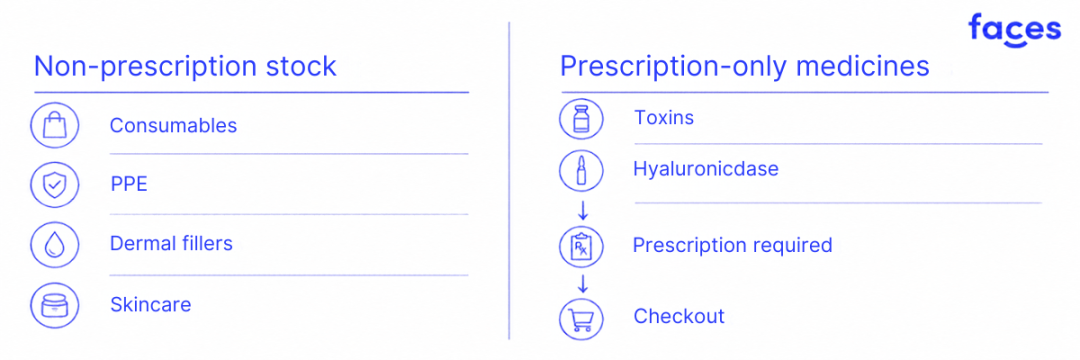
Finance for eligible pharmacy purchases applies to orders placed through the Faces pharmacy checkout where the pay-later option is shown. In practice, orders fall into two groups, and each works slightly differently.
The first group is non-prescription stock: consumables, PPE, cannulas, skincare and hyaluronic acid dermal fillers. Dermal fillers are regulated in the UK as medical devices, not prescription-only medicines, so qualified practitioners can buy them without a prescription, although sellers will check their qualifications. Finance for retail pharmacy products in this group is simple: the practitioner adds items to the basket and chooses buy now, pay later at checkout.
The second group is prescription-only medicines, which includes botulinum toxins and hyaluronidase. Under regulation 214 of the Human Medicines Regulations 2012, these can only be supplied against a valid prescription from an appropriate prescriber, and a pharmacist signs off each order before it is dispatched. Finance for prescription products changes how the order is paid for and nothing else. The prescription still has to come first, and that depends on a proper consultation. The GMC’s guidance on cosmetic interventions says doctors must not prescribe injectable cosmetic medicines remotely for patients they have not examined, and the nursing and pharmacy regulators take a similar position. Non-prescribing practitioners can find a prescribing partner through the Faces prescriber directory. The finance option can then be used once the prescription has been approved.
Finance Eligibility for Pharmacy Purchases
The facility is open to new and established businesses, and to both sole traders and limited companies. To register, a practitioner needs:
A verified Faces account, which means current insurance, a training certificate and photo ID on file.
A UK bank account that repayments to Payl8r can be taken from.
To meet Payl8r’s minimum credit criteria and pass its affordability checks.
Business structure affects how the credit is treated. Under section 189 of the Consumer Credit Act 1974, the definition of an “individual” covers sole traders and partnerships of two or three partners. Credit given to them can therefore come within the consumer credit framework even when it is used for business. A limited company is a separate legal person and sits outside that definition. The business-purpose exemption in article 60C of the Regulated Activities Order only applies to credit above £25,000, far more than any single stock order. In practice, sole traders should expect a real affordability assessment, not a formality.
When an application is declined, affordability is usually the reason. Incorrect details on the application are the next most common cause. A lower order value is usually the quickest way to resolve it.
How to Apply for Finance Through Faces
The registration is done once. After that, each pharmacy order placed on finance is a separate short-term agreement.
Step 1: Log in to the Faces dashboard and open Finance Hub.
Step 2: Enter the business details, including trading name, business structure and the bank account for repayments.
Step 3: Upload or confirm the insurance, training certificate and photo ID on the account.
Step 4: Wait for the review. Registration is usually reviewed within 24 to 48 business hours, and there is no set-up cost or monthly fee to register.
Step 5: Once approved, choose buy now, pay later at the pharmacy checkout and confirm the order with Payl8r. Orders placed during working hours are usually confirmed quickly.
The most common delay in a Faces practitioner finance application is an expired insurance certificate or training document. It is worth checking both before starting. Practitioners should also read the agreement shown at checkout every time. The repayment date and any charges are set out there, and that document, not any summary, is what applies.

Choosing Between Aesthetic Pharmacy Finance Options
Stock finance is one of several ways to pay for stock, and each suits a different situation.
Paying up front by debit card keeps things simplest and is the right choice when cash is available. A business credit card gives a similar short delay before payment, but interest is charged once the statement balance is carried over. Patient deposits taken at booking bring cash in before the appointment, and the Faces guide to ordering clinic stock from the booking system shows how the diary and the order can be linked. Patient finance supports the income side by making higher-value treatments easier for clients to book, but it does not pay for stock directly. The revenue maths behind buy now, pay later explains how both sides work together.
Pharmacy product finance for aesthetic practitioners fits between those options as a two-week bridge. A few rules make it work:
Only finance stock that will be used within the 6 months . Buying three months of filler on a fortnight’s credit turns a timing tool into a repayment problem.
Time the order so the repayment date comes after the treatment days, not before them.
Keep one financed order open at a time where possible, so each repayment can be matched to the appointments it paid for.
Record batch and lot numbers against each patient in the digital consent form and treatment record. Financed stock is still traceable stock, and traceability matters if a product recall or complication occurs.
The FCA began regulating deferred payment credit on 15 July 2026. Short-term credit is getting closer scrutiny across the market, so practitioners should expect lenders to ask for more information as the new rules settle in, not less. Clean business bank records, up-to-date documents on the Faces account and orders sized to the booked diary will make every future application easier.
Before the next big stock order, practitioners can register for Faces Finance from the Finance Hub in their dashboard. Registration is reviewed within 24 to 48 business hours, so doing it now means the pay-later option will already be at the pharmacy checkout when the December diary fills up.
FAQ
Can aesthetic practitioners buy stock on finance?
Yes. Practitioners registered with Faces Finance can use a buy now, pay later option at the Faces pharmacy checkout, provided by Payl8r, and repay within 6 months .
Do I need to be a limited company to use buy now, pay later for stock?
No. Sole traders and limited companies can both apply, as long as they meet Payl8r’s credit criteria and affordability checks. Sole traders should expect a fuller affordability assessment because of how consumer credit law defines an individual.
Can I buy botulinum toxin on finance?
Finance changes only how the order is paid for. Toxin is a prescription-only medicine, so a valid prescription from a prescriber who has assessed the patient is still needed, and a pharmacist signs off the order before dispatch.
Is stock finance the same as patient finance?
No. Patient finance is an agreement between the client and Payl8r over three to 12 months, and the practitioner is paid up front. Stock finance is the practitioner’s own agreement and is repaid within 6 months.
What happens if a stock finance repayment is late?
Contact Payl8r before the due date. The agreement shown at checkout sets out what happens and any charges for late payment, and a new financed order may not be possible until the outstanding one is cleared.