
A patient in consultation agrees with everything the assessment shows: lateral cheek volume loss, a strong masseter, dynamic forehead lines and dull, dehydrated skin. The plan runs over four months and several appointments, and the next question is whether all of it can go on one finance agreement. This is where treatment package finance becomes relevant. It is one of the most frequent questions an aesthetic practitioner hears once Faces Finance is live in an aesthetic clinic, and the answer is yes, with conditions. Those conditions come from the lender’s rules, the consumer credit regime that changed on 15 July 2026, and the professional standards governing how cosmetic treatment is recommended. Financing cosmetic procedures as a package works when all three are respected, and produces refund disputes when they are not. Can One Flexible Agreement Cover a Treatment Package Finance?

Can One Flexible Agreement Cover a Treatment Package Finance?
A point-of-sale credit agreement pays for services from a named merchant. The lender assesses the total financed, the term and the applicant’s creditworthiness. It does not require a separate agreement for each treatment. From the lender’s side, combined finance treatments are one purchase with several line items, provided the total sits within its limits and the itemised services are what the patient is buying.
Faces Finance is provided by Payl8r (Social Money Limited, FCA firm reference 675283), with terms of three, six, nine or twelve months. Interest-free credit repaid in 12 or fewer instalments within 12 months is now called Deferred Payment Credit. It has been regulated since 15 July 2026 under the FCA’s PS26/1 rules on Deferred Payment Credit. Interest-bearing terms were already regulated. For packages, the key consequence is borrower protection. The FCA confirms that Section 75 of the Consumer Credit Act applies to eligible Deferred Payment Credit purchases, so if a clinic fails to deliver sessions the patient has paid for, the lender can be jointly liable.
Three Constraints That Shape Every Package
The amount the lender will finance
Every lender sets a minimum and maximum treatment value per agreement, and a full contouring plan can exceed the maximum. The legitimate options are a deposit paid at the clinic to reduce the amount financed, or a phased plan with a separate application per phase. Splitting one phase into several small agreements to stay under the limit hides the true borrowing from the affordability check and should not be done.
The repayment term against the delivery timeline
If a six-session course runs over eight months and the patient repays over three, the patient has paid for treatment not yet delivered. If the clinic closes or the patient becomes unsuitable midway, that undelivered value becomes a refund problem. Where possible, the whole plan should be deliverable within the agreement term.
What happens if the plan changes partway through
Under Payl8r’s published process, an agreement is cancelled only when the retailer authorises a refund and returns the funds to the lender. Otherwise the patient stays liable. The clinic’s cancellation policy therefore needs a package clause stating the value of each session and how undelivered sessions are refunded through the lender. The Faces guide to handling cancellations and deposit refunds covers the wider principles.
Treatment Combinations for Finance That Make Clinical Sense
A package should exist because the clinical plan needs sequencing, not because it is easier to sell. The GMC’s guidance for doctors who offer cosmetic interventions states that financial or commercial interests must not affect recommendations, and the same principle is applied across the sector. The test is whether the plan would look the same if the patient paid in full on the day.
Facial contouring packages
A typical contouring plan pairs botulinum toxin type A with hyaluronic acid dermal filler. Toxin blocks acetylcholine release at the neuromuscular junction, which reduces contraction of the treated muscle. Onset is usually two to three days, with peak effect at around two weeks and duration of roughly three to four months. Licensed doses vary by product and indication, so check the SmPC on the electronic medicines compendium (emc). Masseter treatment is off-label and must be consented as such. Toxin is a prescription-only medicine, so a package that includes it cannot be sold before a prescriber’s face-to-face assessment.
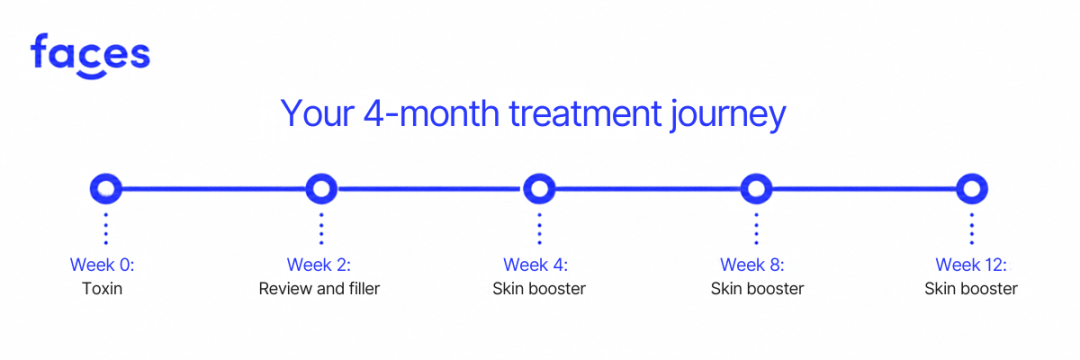
Filler restores structure by adding volume at the right depth, commonly supraperiosteal at the zygoma and chin. Many practitioners give toxin first and place filler at the two-week review, so the face is assessed at rest. Others treat on the same day to reduce visits. Both approaches have support. The package should reflect the sequence chosen.
Skin quality courses
Injectable skin boosters are commonly given as two or three sessions around four weeks apart, and microneedling at four to six week intervals. These are the clearest multi session finance treatment options, because the session count and spacing are set by protocol rather than budget.
What should stay off a package
Three things should stay off a package:
- Anything that depends on a review outcome, such as filler top-ups.
- Maintenance beyond the agreement term. Financing next year’s toxin pre-sells a prescription-only medicine to a patient who has not yet been reassessed.
- Any treatment where a contraindication is still being investigated, such as pregnancy, active infection at the site, a neuromuscular disorder or an unresolved reaction to previous filler.
Finance Treatment Plan Examples by Package Type
The following are structural finance treatment plan recommendations, not pricing guidance. A contouring plan delivered in about six weeks suits one agreement on any term. Three skin booster sessions plus a review suits one agreement of at least three months. A six-month skin course alongside injectables is often better split. The injectables are financed after the prescriber assessment, and the skin course is financed separately once the patient has tolerated the first session. Matching the amount financed to treatment the patient is ready for is what makes it a personalised finance treatment plan rather than a menu item.
A Treatment Package Finance Comparison
One agreement for the whole plan is simplest when the total is within limits and delivery finishes within the term. Its weakness is refund handling if the plan changes.
One agreement per phase creates a checkpoint for reassessment and keeps undelivered value low. However, each application is assessed separately, and a later phase may be declined.
Paying per session at the clinic suits patients who prefer paying monthly as they attend, without a credit agreement. It offers no structure where completing the course matters.
The finance treatment package cost to the patient depends on the term and the lender’s charges. Clinic quotes should therefore show treatment prices only and leave credit terms to the lender’s documentation. That keeps clinic materials clear of figures that trigger the representative example rules in CONC 3.5.
How to Structure the Application
A clean application for finance for treatments delivered over several visits starts with an itemised quote. It should list each treatment, area, session count and planned date, with one total. A vague “facial package” gives the lender, and later the Financial Ombudsman, nothing to work with in a dispute.
Decide on any deposit next, particularly where the plan sits near the lender’s maximum. The patient then applies through one of three Faces routes: the finance option in the Faces consent form, the booking link, or a direct finance link. The lender runs creditworthiness and affordability checks. The practitioner should not help complete the application or suggest that approval is likely.
No treatment should start until approval is confirmed and the patient has had time to reflect. The GMC expects a cooling-off period proportionate to the intervention. Record the finance discussion in the consultation notes alongside separate consent for each treatment, and carry the same record through to the aftercare forms issued after each session.
Compliance Lines That Apply to Packages
The ASA’s guidance on cosmetic interventions and social responsibility warns against time-limited offers that pressure people into procedures. In 2025 it upheld complaints against several clinics running Black Friday offers. “Bundle price ends Sunday” next to a finance option is exactly what regulators look for.
Under the Consumer Duty, firms in the credit chain must deliver good outcomes and identify customers in vulnerable circumstances. If a patient asks to stretch a plan further because they are struggling with existing repayments, that is a reason to scale the plan back.
Clinic pages promoting cosmetic treatment payment plans should describe finance plainly as a way of spreading the cost of aesthetic treatments. They should never present it as making treatment cheaper or approval certain. Calling finance “unregulated” is no longer accurate for agreements made since July 2026.
The treatments themselves face tighter rules too. The Department of Health and Social Care opened a consultation on restricting high-risk cosmetic procedures in England in October 2026. A financed package containing a procedure later restricted to healthcare professionals could become undeliverable by the clinic that sold it.
Why Patients Ask for Packages on Finance
Client buying behaviour in aesthetics has moved from single appointments towards planned courses, and patient payment options have followed. A patient who hesitates at paying for a full plan upfront can judge whether monthly payments for cosmetic treatments fit their budget. When the plan is clinically justified, that is a real gain in financial accessibility. The Faces article on how buy now pay later for aesthetic treatments affects UK clinics covers this demand in more depth.
The best treatment packages for finance are the ones that would be recommended anyway, with a defined end point and spacing set by protocol. Patients searching for affordable aesthetic treatments often compare headline prices. An itemised plan gives them something more useful to compare, and the Faces guide to budgeting for aesthetic treatments is worth sharing at this stage.

Before Offering Packages on Finance
Check each current package against four questions:
- Can it be delivered within the shortest available term?
- Does the cancellation policy value each session and send financed refunds back to the lender?
- Is any prescription-only medicine included before a prescriber assessment?
- Does any marketing for it carry a deadline?
Clinics that can answer all four cleanly are ready to offer finance treatment packages. HM Treasury is reforming the Consumer Credit Act, and the FCA is consulting on simpler promotion rules under CP26/15, so the detailed requirements will keep changing. The basic expectation will not: what a patient finances should match what they receive, and when they receive it.
Offer Packages With a Finance Option Built In
Register free with Faces Finance to add a finance option to the consent forms and booking links the clinic already uses. Patients can then apply for an itemised, multi-session plan in one application before treatment begins.
Frequently Asked Questions
Can patients get finance for multiple aesthetic treatments at once?
Yes. One agreement can cover several treatments itemised on a single quote, provided the total is within the lender’s limits. If it is not, a deposit or a phased plan is used. That is finance treatment combinations explained in one line.
Can patients pay for anti-wrinkle injections monthly?
Yes. Aesthetic clinic finance such as Faces Finance lets patients pay monthly over three, six, nine or twelve months, subject to the lender’s checks. It should only be arranged after the prescriber assessment.
Does applying for treatment finance affect a credit score?
Eligibility checks for aesthetic treatment finance are commonly a soft search, which does not affect a credit score. A completed agreement is a credit commitment and appears on the patient’s credit file.
What happens to the finance if a patient cancels part of a package?
The agreement continues unless the clinic authorises a refund and returns the funds to the lender. For eligible purchases, Section 75 also gives patients a claim against the lender if the clinic fails to deliver.
Do practitioners need FCA authorisation to offer finance?
Not usually. Merchants who broker Deferred Payment Credit are exempt. Interest-bearing finance options for aesthetic treatments are offered under the lender’s permissions, with the clinic acting as an appointed representative. This is arranged during Faces Finance registration.