
A practitioner has three Revolax syringes on the tray and a patient who wants softer crow’s feet, a more defined lip and a stronger chin in one sitting. All three boxes carry the same brand, the same hyaluronic acid concentration, the same lidocaine. Reach for the wrong one and the result is predictable: a lip that feels stiff, a chin that needed more product than it should have, or a fine line filled with a gel built for bone. The differences between Fine, Deep and Sub-Q are not cosmetic branding. They are rheological, and they decide where each belongs.
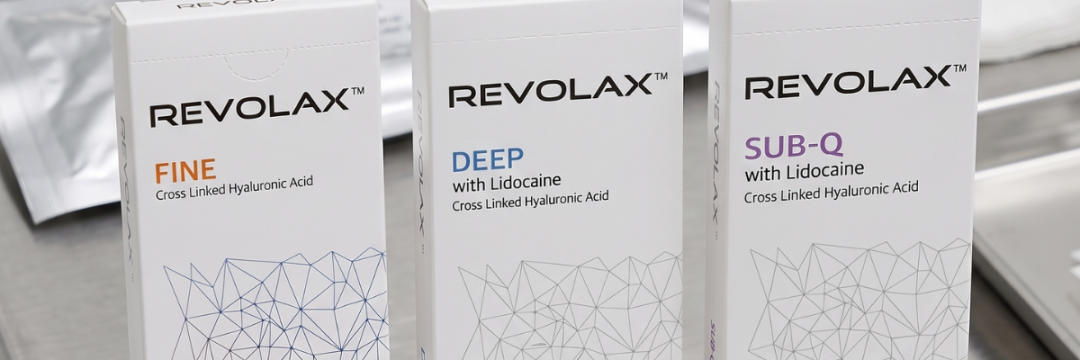
What the range is and how it works
Revolax is a range of monophasic, cross-linked hyaluronic acid fillers manufactured by Across, a South Korean company. The whole family shares a dense monophasic gel structure, which matters clinically because monophasic gels extrude smoothly and integrate evenly, and the cross-linking gives them resistance to migration and to enzymatic breakdown. The brand has become one of the most-used Revolax filler lines in UK clinics, largely on the strength of predictable handling at an accessible price.
To answer the question patients and newer injectors ask most, what is Revolax in practical terms: it is a Class III CE-marked medical device, a biodegradable HA gel derived from bacterial fermentation rather than animal sources, designed to be placed in the dermis or subcutaneous tissue depending on the variant. The range comprises three products, Fine, Deep and Sub-Q, separated by viscosity and intended depth.
A note on the chemistry, since it underpins everything that follows. The Revolax filler ingredients are consistent across the range: 24mg/ml of cross-linked hyaluronic acid, 0.3% lidocaine hydrochloride for comfort, with BDDE as the cross-linking agent present only in trace, negligible amounts after purification. Because the HA concentration is identical across all three, the difference between them is not how much HA is present but how the gel is cross-linked and structured. That structural difference produces three distinct viscosities and three distinct jobs.
Revolax Fine
Revolax Fine is the thinnest, lowest-viscosity product in the range with high viscoelasticity. It is built for the superficial dermis, where a heavier gel would show as ridges or a bluish Tyndall effect. Its indications are the delicate, superficial targets: crow’s feet, glabellar lines, fine forehead and perioral lines, and neck wrinkles. Placement is shallow, into the superficial-to-mid dermis, using fine linear threading or serial puncture rather than bolus deposits.
The product also has a lip role that catches some practitioners by surprise. Because of its softness and smooth spread, Revolax Fine for lips is well suited to the Russian lip technique, where small vertical droplets are placed to lift and define the cupid’s bow without adding heavy outward projection. The lightweight gel blends softly and resists the lumpiness a firmer product can produce in that vertical, droplet-based work. Russian lip work is precise and unforgiving, so it is worth being properly trained in it before offering it; a structured course through our partnered training schools closes that gap.
Duration for Fine sits at the shorter end of the range, commonly around nine to twelve months, because superficial placement in mobile tissue metabolises faster.
Common mistakes with Fine
The recurring error is using Fine for structural work it cannot support, expecting a thin gel to lift a fold or project a chin. It will disappoint and tempt over-injection. The opposite error is placing it too deep, where its superficial-tuned properties are wasted.
Revolax Deep
Revolax Deep is the mid-range workhorse and the most popular product in the line. It is thicker than Fine but not as dense as Sub-Q, designed for the mid-to-deep dermis and the subcutaneous plane. As a Revolax Deep filler, its indications are the bread-and-butter of facial augmentation: nasolabial folds, deeper forehead lines, marionette lines, chin and nose augmentation, and lip work where more body is wanted than Fine provides.
Its versatility is why it sells. The same syringe that softens a nasolabial fold can build a lip or refine a chin. On lips specifically, Revolax Deep lip filler use is widespread because the middle viscosity gives volume and structure while still integrating naturally, which suits classic horizontal lip augmentation better than the lighter Fine. As a general-purpose Revolax lip filler choice, Deep is the one most practitioners reach for when the goal is fuller, defined lips rather than the subtle vertical lift of the Russian approach.
Technique is depth-appropriate: linear threading and fanning in the deep dermis or subcutaneous layer, with bolus work on bone for chin or nose projection. Duration is longer than Fine, typically twelve to eighteen months, helped by deeper placement in less mobile tissue.
Common mistakes with Deep
The main pitfall is treating Deep as a do-everything product and placing it too superficially, where its density can show. It belongs at mid-dermal depth and below. The second is reaching for Deep when genuine structural lift over bone is needed across a larger area, which is Sub-Q territory.
Revolax Sub-Q
Revolax Sub Q is the densest, highest-viscosity product in the range, made for the deep subcutaneous and supraperiosteal planes. It is a structural filler. Where Deep adds volume, Sub-Q provides projection and scaffolding, holding its form under mechanical stress. Its indications are cheek augmentation, jawline definition, chin projection, non-surgical rhinoplasty and severe, deep folds where a foundation is being built rather than a line softened.
Placement is deep, on or near bone, using bolus deposits for projection and slow retrograde linear threads along the jawline. A larger-gauge needle or a cannula suits the firmer gel, and cannula work is widely preferred over larger areas like the mid-face and jawline to reduce vascular risk. This is advanced placement near major vessels, and it is the area where less experienced injectors are most exposed, so deep structural and contouring work is worth formal training before it goes on the menu. Sub-Q also has a niche lip application: Revolax Sub Q for lips is occasionally chosen where a very structured, long-lasting result is wanted, though most practitioners reserve it for deeper structural areas and consider it more product than the average lip needs. Duration is the longest in the range, generally twelve to eighteen months and often toward the upper end in low-movement areas.
Common mistakes with Sub-Q
The serious error is placing this dense gel too superficially, where it will be visible and palpable and difficult to smooth. Sub-Q demands deliberate moulding immediately after placement because it does not self-level the way softer gels do. Underfilling on a first pass and reviewing is safer than overcorrecting a firm, long-lasting product.
Choosing between them, plane by plane
The deciding question is never the area on its own but the depth and movement of the tissue. Superficial and mobile points to Fine. Mid-dermal volume and general lip and fold work points to Deep. Deep structural lift over bone points to Sub-Q. Full-face plans frequently use more than one: Sub-Q laid down for the scaffold, Deep for volume and contour, Fine for the superficial refinement on top. Layering this way works precisely because each variant was tuned for a different plane. For a wider view of where Revolax sits against other brands, our analysis of popular dermal filler products is a useful reference.
Contraindications, cautions and safety
The cautions apply across all three variants. Avoid in known hypersensitivity to hyaluronic acid or to lidocaine, in patients prone to hypertrophic scarring, and over any area of active infection or inflammation. Avoid placing immediately before or after laser therapy, chemical peels or dermabrasion, since the combined trauma raises the risk of an inflammatory reaction. Pregnancy and breastfeeding are generally treated as a reason to defer. A thorough assessment and a documented dermal filler consent form that captures these points should be completed before a single syringe is opened.
The serious shared risk is intravascular injection. The angular and facial arteries around the nasolabial region, the labial arteries in the lips, and the dorsal and lateral nasal vessels all carry occlusion risk, and nasal work sits closest to the anastomoses that can lead to visual loss. The denser the gel, the more consequential an occlusion, so the structural placement that suits Sub-Q and Deep demands the most caution: slow injection, low extrusion pressure, aspiration where appropriate, and cannulae in higher-risk zones.
Every clinic placing filler should hold hyaluronidase and a written vascular occlusion protocol, with access to a Complications Consultant for senior input when something goes wrong, and a non-prescribing injector needs a reliable prescriber arrangement to obtain hyaluronidase without delay. Indemnity is part of the same picture: confirm your insurance covers the specific areas and products you are placing, since deep structural work and emergency management both need to sit inside your cover.
Expected results and aftercare
Results are immediate across all three, with the final outcome settling over one to two weeks as swelling resolves and the gel integrates. Aftercare is standard for HA work: no makeup over the site for the first day, avoid strenuous exercise, heat, saunas and alcohol for 24 to 48 hours, and avoid pressure or massage unless directed. Mild swelling, tenderness and occasional bruising are expected. Lip patients should be told that day-one swelling overstates the final volume, which heads off the worried message a couple of days later. An aftercare form supports consent and cuts avoidable callbacks. The needles, cannulas and used syringes across a three-product treatment also need a compliant sharps and clinical-waste route, which a managed sharps service keeps in order and ready for the inspections the new licensing scheme will bring.
FAQs
What is the difference between Revolax Fine, Deep and Sub-Q?
Viscosity and intended depth. All three share the same 24mg/ml HA and 0.3% lidocaine, but Fine is the thinnest for superficial lines, Deep is the mid-range product for folds and general lip and facial work, and Sub-Q is the densest for deep structural lift over bone. The HA concentration is identical; the cross-linking and gel structure differ.
Which Revolax is best for lips?
It depends on the look. Deep is the usual choice for classic lip augmentation where body and definition are wanted. Fine suits the Russian technique and softer, more natural enhancement because of its lighter spread. Sub-Q is occasionally used for very structured results but is more product than most lips need.
How long does Revolax last?
Fine commonly lasts around nine to twelve months, while Deep and Sub-Q typically last twelve to eighteen months. Mobile areas such as lips metabolise faster, so longevity sits at the shorter end there regardless of variant.
Can the three be layered in one treatment?
Yes, and full-face plans often do. Sub-Q provides the deep scaffold, Deep adds volume and contour, and Fine refines superficially. Because each is tuned for a different plane, layering produces a cleaner, more natural result than forcing one product to do everything.
Is Revolax safe and CE-marked?
Yes, the range is a Class III CE-marked medical device legal for use in the UK when sourced genuine and used by a trained practitioner. As with any HA filler, the main serious risk is vascular occlusion, which is why hyaluronidase access and a clear protocol are essential.