
Your registration renewal date is eight weeks away. Your basic life support certificate is in a drawer at the clinic, the anaphylaxis update is a screenshot on your phone, the masterclass certificate is buried in an email from last spring, and the reflection you meant to write after that complication review is still a note to yourself. None of it is missing. It is just in six different places, and you are the one person who knows where.
This guide is about keeping a CPD portfolio for aesthetic nurses in the same place you already run the clinic diary. It explains what the Faces CPD portfolio does, based only on what the live page says on 26 November 2026, how it links with the Faces training courses directory, and what it does not do. It is written for nurse prescribers and aesthetic nurses, but the habits work for any practitioner who has to evidence learning.
Why a CPD portfolio for aesthetic nurses belongs next to your diary
For nurses, the rules come from the Nursing and Midwifery Council (NMC). Its CPD requirement for revalidation is 35 hours of CPD relevant to your scope of practice in the three years since you last renewed or joined the register, and at least 20 of those hours must include participatory learning. The NMC also says your records must show the CPD method, the topic and how it related to your practice, the dates, the hours (including participatory hours), the part of the Code most relevant to the activity, and evidence that you did it.
On top of that, the NMC revalidation guidance asks for five written reflective accounts on the NMC’s approved form, and a minimum of 450 practice hours for a nurse over the same three years. Every reflection has to link back to the Code. Doctors working in aesthetics follow the GMC’s revalidation guidance instead, but the practical problem is the same: evidence builds up slowly and goes missing quickly.
That is why it helps to record CPD where you already work. If the diary, consent forms and stock orders live in one system, the training that changes how you treat can sit alongside them, and you are not rebuilding three years of evidence in the fortnight before your renewal.
What the Faces CPD portfolio does
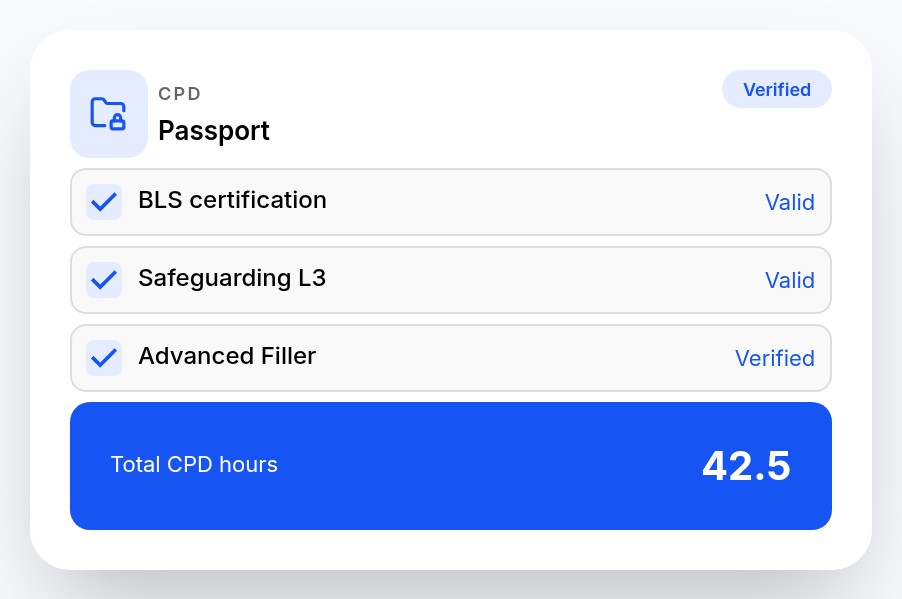
On the Faces site the feature is called CPD Passport. The page describes it as a secure digital platform for “certificates, courses and hours in one place”, built for registered healthcare professionals including nurses, midwives, allied health practitioners and aesthetics clinicians. These are the six features the page lists:
- Centralised CPD log and certificate storage. Upload certificates, course completion documents and training records, then find them again with search, date filters and category tags.
- Digital certificate verification. The page says each uploaded certificate receives a digital verification stamp, and you can share a secure link so an employer or insurer can check it.
- Expiry alerts. Set expiry dates for mandatory training such as BLS, safeguarding, infection control and manual handling. The page says alerts arrive 90, 30 and 7 days before expiry.
- Reflective practice log. Record reflective accounts, case-based discussions and self-directed learning alongside formal certificates, using structured templates.
- Shareable CPD profile. A profile page that summarises your portfolio, hours and credentials, which you can share with a new employer, agency or insurer.
- PDF export. Export the whole portfolio as a formatted report for an appraisal, a revalidation meeting or an insurance renewal.
The page sets out three steps to get started: create a free account and add your registration number, regulator and speciality; upload existing certificates by photo, PDF or drag-and-drop and add hours, dates and categories; then track progress, receive expiry alerts and share your portfolio with a single link. It also says certificates from any CPD provider can be uploaded, in formats including PDF, JPG, PNG and Word. Pricing is shown separately on the page, so check it there before you upgrade.
What it does not do
A tidy portfolio is a record, not a qualification. We do not claim that the NMC, the GMC or any other regulator accepts the Faces CPD portfolio, and storing evidence in it does not mean your CPD, reflections or practice hours have been accepted by anyone. You still submit your own revalidation, the NMC’s reflective accounts form is still mandatory (download it from the NMC forms and templates page), and your confirmer still decides whether your evidence meets the requirements.
The same goes for training standards. The Faces page itself notes that the Joint Council for Cosmetic Practitioners (JCCP) does not formally approve individual CPD storage systems. Treat the verification stamp as proof that a file has not changed since you uploaded it, not as proof that the course behind it was good. And keep patient details out of your reflections, as the NMC guidance asks.
Training courses and CPD in the same place

The training courses page lists courses from training providers and academies, filtered by category. The list on 26 November 2026 ran from foundation dermal fillers and toxin through micro-needling, chemical peels, skin boosting, laser and PRP to complications, anatomy and physiology, infection control, client consultation and refresher courses. Faces lists these courses; the provider is responsible for the content and any CPD claim. Our earlier guide to aesthetics training courses on Faces explains how to compare them.
For distance learning, the Online Courses aisle in the Faces shop sells courses like any other item, and several fit neatly into an annual mandatory training plan:
- Online CPD Basic First Aid Training: the listing says it covers responding as the first person at the scene, checking for hazards, the recovery position and CPR. More options are in First Aid Courses.
- Anaphylaxis for Healthcare Professionals Online Training: an anaphylaxis course for healthcare professionals, listed under Complications Courses.
- Ofqual Level 4 Award in Facial Anatomy & Physiology: the listing describes about 20 hours of self-paced study on facial anatomy, related pathologies and skin conditions. Ofqual is the regulator of qualifications in England, so check the qualification details with the provider.
- First Aid Kit – 20 Person: training is only half of emergency readiness. Restock the kit itself from the First Aid Kit aisle when you renew your first aid certificate.
Only count CPD hours or participatory hours if the course itself states them, and keep the certificate. When a course ends, upload it straight away and set its expiry date, so the next reminder arrives before your insurer asks. If you are reviewing cover at the same time, Faces also signposts aesthetics insurance and a complications consultant service.
A simple monthly CPD routine
- Upload each certificate on the day you receive it, with the date, hours and whether it was participatory.
- Add a line on how it relates to your practice and which part of the Code it touches. This is the detail people forget three years later.
- Write a short reflection while the learning is fresh, then copy it onto the NMC form when you need it.
- Set expiry dates for BLS, anaphylaxis, safeguarding and infection control as soon as you upload them.
- Once a quarter, check your total against 35 hours and 20 participatory hours, and look at the gaps.
- Six months before renewal, export the portfolio and book a reflective discussion with a colleague.
Our post on CPD, aesthetics training and licensing covers what still counts as the rules change, and the original CPD portfolio launch post has more background on the feature.
Why Faces
Faces is a booking system with a built-in pharmacy and marketplace. Clinics use it for online booking, digital consent forms, aftercare forms, client records and team tools, and the same platform includes Faces Pharmacy and a multi-seller marketplace. That means you can book appointments, take consent and order clinic stock from the same Faces platform, and keep your CPD portfolio and training search on the same site.
The link between those pieces is practical. A new course often means a new treatment, which needs its own consent and aftercare before the first booking. Our guides to practice management software and clinic services and to digital consent forms beyond the signature show how booking, consent and records fit together. Software supports good record-keeping; it does not replace your professional judgement or your regulator’s requirements.
Watch: Ash on training in aesthetics
For more practical clinic content, follow Faces on Instagram, Faces Pharmacy on TikTok, the Faces Pharmacy YouTube channel and Faces on LinkedIn.
Start your CPD portfolio on Faces
Start with the certificates you already have: the last BLS update, your prescribing qualification, your most recent masterclass. Add dates and hours, set the expiry alerts, and the next renewal becomes a review rather than a search. If you do not have a Faces account yet, you can register your clinic at the same time.
FAQs
Is the Faces CPD portfolio approved by the NMC or GMC?
Do not treat it as approved. The Faces CPD portfolio is a place to store and organise your evidence; your regulator, your confirmer or your appraiser decides whether that evidence meets their requirements.
How many CPD hours do nurses need for NMC revalidation?
The NMC CPD page says 35 hours over three years, of which at least 20 must include participatory learning, alongside five reflective accounts and 450 practice hours.
Can I upload certificates from any training provider?
The Faces CPD portfolio page says yes: it accepts certificates from any provider, in formats including PDF, JPG, PNG and Word.
Does Faces run the training courses?
No. The training courses directory lists independent providers, and online courses in the shop are sold by marketplace sellers. Check each provider’s terms and any CPD claim.
Do I still need the NMC reflective accounts form?
Yes. The NMC says your five written reflective accounts must be recorded on its approved form. You can draft reflections in Faces and transfer them.
Feature details are summarised from the live Faces CPD portfolio and training courses pages, and NMC requirements from nmc.org.uk, on 26 November 2026. Requirements can change, so check the regulator’s own guidance before you revalidate.
Ashley James Simpson-Davies INP MSc RN