
A client books a review two weeks after lip filler. In clinical photographs the result looks balanced. Swelling has settled and the borders are smooth. The client sees something else. She has photographed her mouth from several angles every morning since treatment. She points to an asymmetry of perhaps a millimetre on the upper lip. She has already booked a consultation with another clinic “in case” this one says no. She is close to tears, and she asks for “just a little more” to fix it.
Most aesthetic practitioners will recognise some version of this appointment. Sometimes it is ordinary post-treatment anxiety that settles with time and reassurance. Sometimes it is the first visible sign of body dysmorphia, a recognised mental health condition in which further cosmetic treatment tends to deepen the distress rather than relieve it.
This guide covers how the condition presents in an aesthetic setting, which screening questionnaires have evidence behind them, how to decline treatment without causing harm, and what a defensible record of that decision looks like.
BDD Meaning and Why It Matters in Aesthetic Clinics
The NHS overview of the condition defines body dysmorphic disorder as a mental health condition in which someone spends a great deal of time worrying about flaws in their appearance, flaws that other people often cannot see. Diagnostically, it sits within the obsessive-compulsive and related disorders, alongside OCD, rather than with eating disorders or general low confidence.
The diagnosis rests on a preoccupation with a perceived defect that is slight or invisible to others, combined with repetitive behaviours such as mirror checking, excessive grooming, skin picking, comparing and seeking reassurance. The preoccupation must cause significant distress or interfere with daily life. Insight varies widely. Some people accept their view may be distorted; others hold their belief with near-delusional certainty, which makes reassurance from a practitioner almost useless.
The condition matters in aesthetics for two reasons. First, it is far more common in clinic than on the high street. A 2024 meta-analysis of BDD prevalence in plastic surgery reports that recent reviews put the rate in dermatology and aesthetic settings at between 12.65% and 19.2%, roughly one in eight to one in five people seeking cosmetic care. Second, treatment rarely helps. Specialist clinical guidance from Professor David Veale explains that many people with the condition go through repeated dermatology and cosmetic treatments, gaining little satisfaction, before they finally seek psychological help. Even a technically excellent result can leave the preoccupation untouched, or simply move it to a new feature.
BDD Symptoms Practitioners Can Spot in Consultation
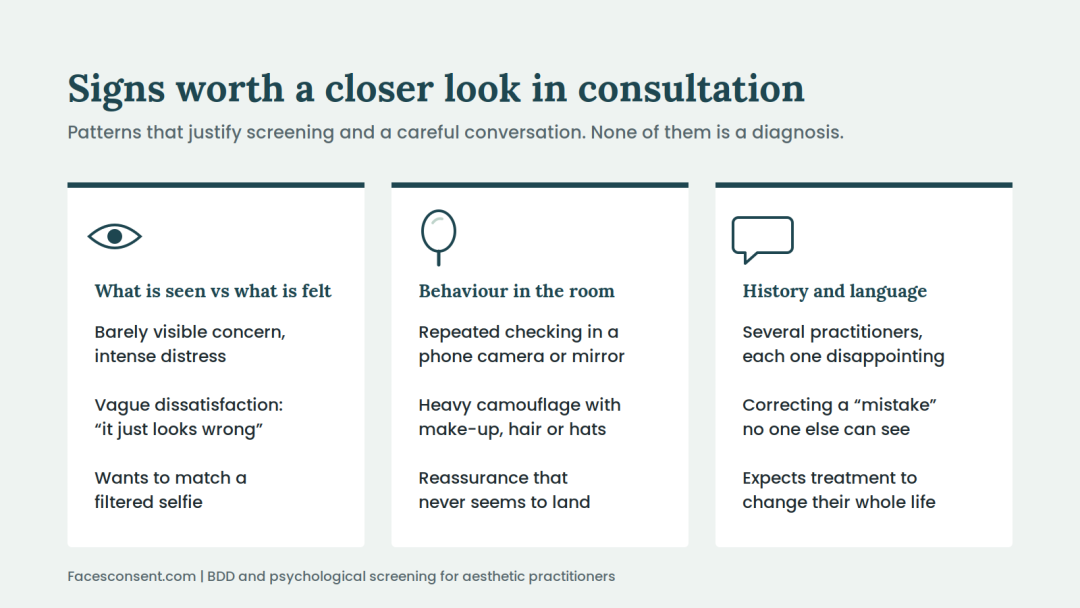
No single sign confirms the condition, and practitioners are not in a position to diagnose it. What a practitioner can do is notice patterns that justify a closer look before needles or devices are involved.
A Mismatch Between What Is Seen and What Is Felt
The most useful clinical signal is disproportion. A concern that is barely visible, or not visible at all, paired with intense distress should raise a question. So should vague dissatisfaction that cannot be pinned to a specific change “it just looks wrong”, or a request to match a filtered selfie rather than a realistic version of the client’s own face. The NHS symptom guidance notes the worry most often centres on the face, which is exactly where most injectable work happens.
Behaviour in the Room
Watch for repeated checking in a phone camera or compact mirror during the appointment, heavy camouflage with make-up, hair or hats, and signs of skin picking around the area of concern. Repeated requests for reassurance that do not land are typical: the client asks whether it looks better, accepts the answer, then asks again minutes later. Some clients refuse photographs entirely; others arrive with dozens of images taken under different lighting.
Treatment History and Language
Ask about previous treatments and listen to how they are described. A run of practitioners in a short period, dissatisfaction with each, requests to correct a “mistake” that cannot be seen, and cycles of filler followed by hyaluronidase are all worth noting. Language matters too. Statements such as “I can’t go out like this”, spending more than an hour a day thinking about the feature, or a belief that treatment will fix a relationship, career or social life suggest the concern is doing far more damage than the feature itself.
BDD Causes and Risk Factors Worth Asking About
The exact origin of the condition is not known. NI Direct’s health information lists genetics as one likely factor, with higher risk for people whose relatives have the same condition, OCD or depression. Appearance-related bullying, childhood trauma and strong perfectionist traits are frequently described in clinical literature, and research on visual processing suggests some people with the condition focus on fine facial detail rather than the face as a whole.
Co-existing conditions are common. The NHS points out that some people with the condition also live with OCD, generalised anxiety disorder or an eating disorder. This is why the medical history section of a consultation form should ask about past and current mental health, not only allergies and medications. A disclosed history of OCD or an eating disorder is not a reason to refuse treatment on its own, but it changes how carefully the rest of the consultation should be conducted.
Age also matters. The condition typically begins in adolescence, and injectable toxin and filler are already unlawful for cosmetic use in under-18s in England. Clients who have only just turned 18 deserve particular care, in line with the GMC’s key points on cosmetic interventions, which ask doctors to take extra care with requests involving children and young people.
BDD and Depression: Why Screening Is a Safety Issue
This is the part of the topic that turns screening from good practice into patient safety. A landmark study of suicidal ideation in BDD found that 78% of participants had experienced suicidal thoughts during their lifetime and 27.5% had attempted suicide. Later research on depression and suicidality in BDD confirms major depression as the condition’s most frequent companion. Critically, the original study found that many participants with suicidal thoughts had never told their clinician about their appearance concerns.
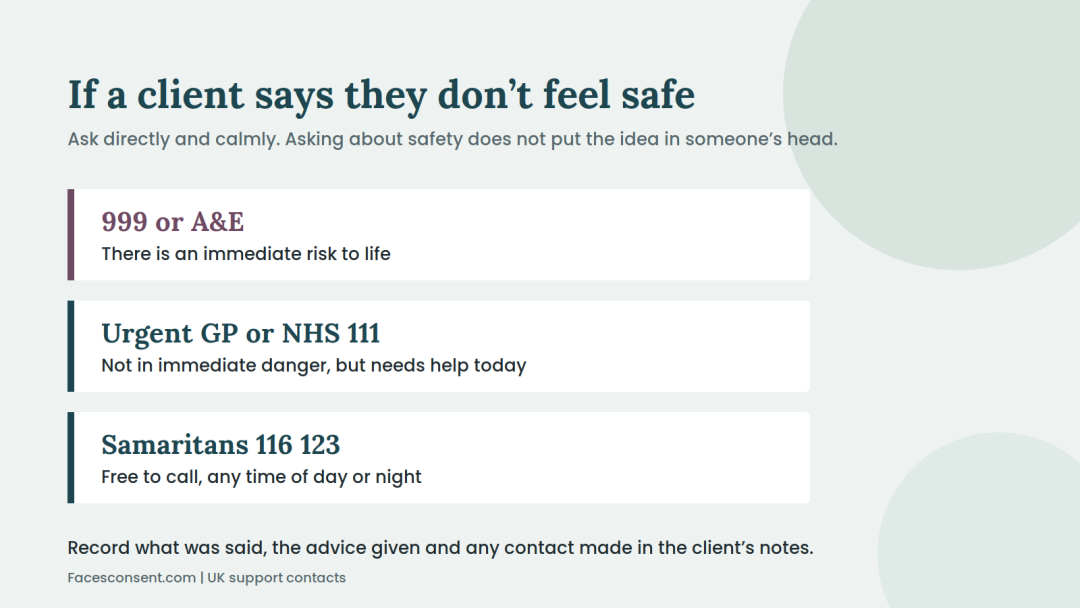
An aesthetic consultation may therefore be one of the few occasions where a professional sees the condition directly. Practitioners are not expected to assess suicide risk the way a psychiatrist would, but they do need to know what to do if a client expresses hopelessness or mentions self-harm. Asking directly whether someone is safe does not plant the idea; it gives them permission to answer honestly. If there is immediate danger, the response is 999 or A&E. Otherwise, the client should be encouraged to contact their GP urgently or NHS 111, and given the Samaritans number, 116 123, which is free and available at any hour. That conversation should be recorded in the client’s notes.
Choosing a BDD Test for Consultation Forms
Several self-report questionnaires exist, but only a few have been tested in aesthetic settings. A 2024 study evaluating aesthetic screening questionnaires cites a meta-analysis that judged just five instruments properly validated for aesthetic use: the BDDQ, its dermatology version (BDDQ-DV), the Dysmorphic Concern Questionnaire (DCQ), the BDDQ-AS and the Cosmetic Procedure Screening Questionnaire (COPS).
The BDDQ-AS is the most widely discussed for aesthetic work. According to a validation study of the BDDQ-AS, it is a short seven-item tool developed by Lekakis and colleagues, and its original testing found 89.6% sensitivity and 81.4% specificity for at least moderate symptoms. The COPS is longer and was designed specifically for cosmetic procedures, which some clinics prefer for its focus on appearance-related functioning.
The limitation every practitioner should understand is that screening tools over-identify. In the same 2024 rhinoplasty screening study, more than half of patients (55.1%) screened positive before surgery. The authors concluded that a positive result should not be treated as an automatic contraindication, and the University of Antwerp’s summary of the research stresses that a firm diagnosis still depends on input from psychologists or psychiatrists. A positive score opens a conversation. It does not close one.
In practice, the questionnaire works best when completed before the appointment as part of the pre-treatment form, so the practitioner can review answers in advance and plan the consultation rather than reacting on the spot. Check the licensing terms of any published questionnaire before adding it to a clinic form; some are free for clinical use and some require permission.
Saying No and Signposting BDD Treatment
Deciding Whether to Proceed
Doctors are bound by the GMC’s standards on communication in cosmetic practice, which require them to ask why a patient wants an intervention and what result they expect, and to weigh up the patient’s vulnerabilities and psychological needs before going ahead. Nurses, dentists and pharmacists answer to their own regulators on the same principles, and for non-healthcare practitioners these standards are the benchmark any complaint will be judged against.
Treatment can reasonably go ahead when the concern is visible, the distress is proportionate, expectations are realistic and the client functions normally. Declining is the safer choice when a positive screen coincides with significant distress or avoidance, the feature cannot be seen, previous treatments have repeatedly disappointed, or the client expects treatment to change their life. Where the picture is unclear, a cooling-off period and a second consultation are better than a same-day decision.
Words That Help and Words That Harm
The conversation should be private and unhurried, and it should not sound like a diagnosis. Phrases such as “Based on what we’ve talked about, treatment isn’t likely to give you the result you’re hoping for, so I’m not comfortable going ahead” keep the focus on clinical judgement. Acknowledging the distress matters: “What you’re describing sounds really hard to live with, and it deserves proper support.” Avoid “there’s nothing wrong with your face” (it dismisses a real experience), “I think you have BDD” (it is outside scope) and any offer of a small compromise treatment, which tells the client that persistence works. Do not refer them to another injector. Refund any deposit.
What Effective Care Looks Like
Clients often ask what happens next, so practitioners should be able to explain it simply. NI Direct’s treatment guidance sets out a stepped approach: cognitive behavioural therapy, individually or in a group, for milder cases; a choice of CBT or antidepressants for moderate cases; and both together for severe symptoms. This model of body dysmorphic disorder treatment follows NICE guideline CG31. The NHS treatment page explains that SSRIs can take up to 12 weeks to work, so early signposting matters. The most useful message for clients is that body dysmorphia treatment works for many people, and the starting point is a GP appointment.
Recording the Decision in Client Records
A decision to decline is only defensible if it is documented. The record should include the screening tool used and its score, observations from the consultation, the client’s stated reasons for wanting treatment, the clinical rationale for declining, the support information given and whether the GP was contacted with consent. Using digital consent forms for aesthetic clinics allows screening questions to sit inside the pre-treatment form, so answers are stored with the client record rather than on loose paper. If the same client returns months later, or a complaint arrives, the full picture is there.
Screening for psychological suitability is likely to become an expected part of the consultation as licensing develops. Clinics that build a validated questionnaire into every new-client form now, and train staff to have the conversation calmly, will be protecting both their clients and their own practice before it becomes compulsory.
FAQs
What is body dysmorphia?
It is a mental health condition in which a person becomes preoccupied with one or more flaws in their appearance that others barely notice or cannot see. The worry drives repetitive behaviours such as mirror checking, camouflaging and seeking reassurance, and causes real distress or disruption to daily life.
Do I have body dysmorphia?
Only a GP or mental health professional can diagnose it, so a practitioner asked this by a client should not answer yes or no. Signs worth discussing with a GP include spending more than an hour a day thinking about appearance, avoiding social situations, repeated checking and feeling that cosmetic treatments never fix the problem. Screening questionnaires can indicate concern, but they cannot confirm a diagnosis.
Is body dysmorphia a mental illness?
Yes. It is a recognised psychiatric condition classified within the obsessive-compulsive and related disorders. It is treatable, most commonly with CBT, SSRI medication or both.
How to help someone with body dysmorphia?
Listen without arguing about their appearance and encourage them to see their GP. Repeated reassurance tends to feed the checking cycle rather than ease it, so gentle support towards professional help is more useful. For practitioners, that means declining treatment kindly, signposting to the GP and, if there is any risk of self-harm, sharing urgent contacts such as NHS 111 or Samaritans on 116 123.
What does body dysmorphia mean?
The term combines “body” with “dysmorphia”, from the Greek for an abnormal or distorted shape. It describes a distorted perception of one’s own appearance, rather than any actual physical deformity. An older clinical name for the condition was dysmorphophobia.
Make Psychological Screening Part of Every New Client Form
Add a validated screening questionnaire to every new-client form this week. With customisable consultation and consent forms in the Faces app, screening answers, practitioner observations and signposting notes are saved to the client record before any treatment is booked, so every decision to proceed or decline is documented from the first appointment.