
It is ten past six on a Friday. Your last client of the week has just left, happy with their treatment and holding a card with your number on it. At half past nine that evening a message arrives: “Sorry to bother you, can I have a glass of wine tonight? And is it OK to go to the gym tomorrow? I can’t remember what you said.”
Every practitioner knows that message. You talked through the aftercare carefully, but the client was relaxed, a little excited and thinking about the mirror rather than the instructions. Verbal aftercare is easy to forget. Written aftercare, sent at the right moment and stored against the client’s record, is much harder to lose.
This guide covers what a good aftercare form should include, what to send and when, how to pair written instructions with simple take-home items, and how Faces brings aftercare forms, consent, booking and clinic stock together in one platform.
Why written aftercare matters for an aesthetics clinic
Aftercare is part of the treatment, not an extra. It tells the client what is expected, what to avoid, what is normal for the next few days and, most importantly, when to get in touch. Putting that in writing helps in three ways.
- The client has something to go back to. They can re-read the instructions at home, at the point they actually need them, rather than relying on memory.
- Your team gives consistent advice. When everyone sends the same treatment-specific form, the advice no longer depends on who was on shift or how busy the day was.
- You have a record. A form sent and stored against the appointment shows what information the client was given and when. That record supports good practice; it does not replace your clinical judgement or guarantee that every client reads and follows it.
Aftercare also closes the loop that consent opens. Before treatment you explain risks, alternatives and what to expect, and record that the client understands. Our guide to digital consent forms that go beyond a signature covers that first half. Aftercare is the second half: the same information, translated into practical steps for the days after the appointment.
What a good aftercare form should include
Your aftercare should always follow your own training, your product manufacturer’s instructions and, where a prescription-only medicine is involved, the prescriber’s directions. Within that, the strongest aftercare forms tend to share the same structure.
1. The treatment and the date
Name the treatment, the area treated and the appointment date. It sounds obvious, but a generic “post-treatment care sheet is easy to ignore. A form that clearly belongs to this client and this appointment is far more likely to be read.
2. What is normal, and for how long
Describe the common, expected effects for that treatment in plain English, with a rough time frame that matches your protocol. Clients worry less when they know what to expect, and they are more likely to spot something that does not fit.
3. What to do and what to avoid
List the practical dos and don’ts in short bullet points: skincare, make-up, exercise, heat, sun exposure, alcohol, travel or anything else your protocol covers. Keep each point specific. “Avoid strenuous exercise for 24 hours” is easier to follow than “take it easy”.
4. Warning signs and who to contact
This is the most important section. Set out the signs that mean the client should contact you straight away, the number or channel to use, what to do out of hours, and when to seek urgent medical help instead. Make sure the contact route on the form is one that someone actually monitors.
5. Follow-up and review
If your protocol includes a review appointment, say when it should happen and how to book it. Better still, book it before the client leaves. A review that sits in the diary is much more likely to happen than one the client intends to arrange later.
6. A clear record that it was sent
Whether you send aftercare digitally or hand over a printed card, record what was given. A digital form stored against the client’s profile is the simplest way to do that.
What to send next: an aftercare timeline
The title of this guide is a question many clinics never answer: what do you send next? A simple timeline makes aftercare part of the client journey rather than a single sheet of paper.
- Before the appointment: send consent and any pre-treatment advice, so the client arrives prepared and you are not rushing paperwork in the treatment room.
- At the end of the appointment: talk the client through their aftercare, hand over a printed card if you use them, and send the digital aftercare form so it is waiting on their phone.
- The next day: many clinics send a short check-in message. It reminds the client that the aftercare is there and that you are easy to reach.
- At review: if your protocol includes a review, use it to check how the client is getting on, update their notes and agree any next steps.
- Before the next treatment: send updated consent and medical history questions, so the record stays current.
This is where a connected system earns its keep. When booking, consent and aftercare live in different places, steps get missed. Our article on aesthetics clinic booking software as a connected workflow explains how to link each stage of the appointment.
How Faces aftercare forms work
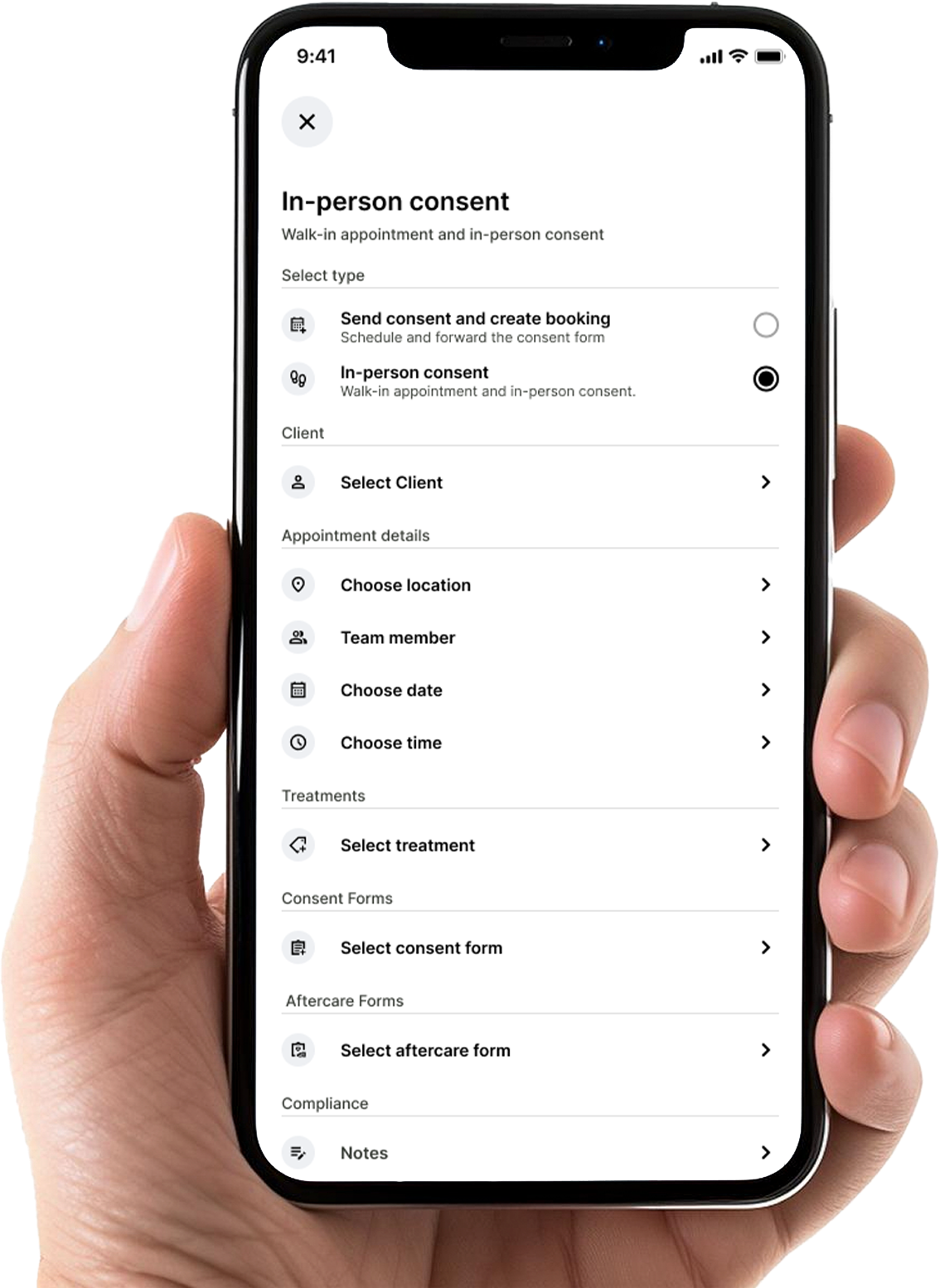
Faces has a public aftercare forms library covering a wide range of aesthetic and beauty treatments, alongside the consent forms library. Clinics using Faces can send forms digitally from the platform, so the client receives clear written instructions and the clinic keeps a record against the appointment.
- Browse the library. Open the aftercare forms page and find the treatments you offer.
- Check and adapt. Review each form against your own training, product guidance and protocols before you use it with clients. Templates are a starting point, not clinical advice.
- Send it with the appointment. Pair aftercare with the booking and consent steps, so every client gets the right form every time.
- Keep everything together. Booking, consent and aftercare sit in the same client record. Create a free Faces account to set it up.
For a walkthrough of how bookings run on the platform, watch Ashs video on choosing an aesthetics booking system.
Take-home aftercare items clients appreciate
Written aftercare is the essential part. A small take-home pack can make that information more memorable and leave clients with a good impression of your clinic. Keep it simple, keep it non-medicine and only include items that fit your protocol. The Faces shop has a dedicated aftercare aisle with several options on the day we checked:
- Printed aftercare cards. Business-card-sized reminders to sit alongside your digital form, such as brows SPMU aftercare cards (pack of 25), with more treatments in the treatment aftercare cards range.
- Cool compresses. Single-use compresses many practitioners include in take-home packs, such as heart and round shaped cool compresses (pack of 25) and pink lip ice packs. Browse the full compresses range. Tell clients how and when to use them, in line with your own aftercare.
- Aftercare bags. Branded or gift-style bags to hold the card and any items, such as the luxury box bag set (20 bags), with more in the aftercare bags category.

Prices and stock change, so check each listing before you order. Our smarter stock plan for clinic consumables explains how to keep aftercare items topped up without over-ordering. We have deliberately not linked any prescription-only medicines here: those cannot be advertised to the public, and any medicine a client needs after treatment is a matter for their prescriber.
Why clinics choose Faces
Faces is a booking system with a built-in pharmacy and marketplace. You can book appointments, take consent, send aftercare and order clinic stock from the same Faces platform, instead of juggling a diary app, paper forms and several supplier accounts. Faces includes Faces Pharmacy and a multi-seller marketplace, so clinics can buy products without leaving the system. Read more in our post on the booking system with a built-in pharmacy.
If you work with a prescriber, the find a prescriber directory helps you search for prescribers and clinics on the platform, and our guide on how to find an aesthetics prescriber in the UK covers the checks to make first.
Faces supports clearer records and safer admin. It does not replace professional judgement, and using digital forms does not by itself make a clinic compliant or guarantee any outcome. That responsibility stays with the practitioner and the clinic.
For more clinic tips, subscribe to Ash from Faces on YouTube and the Faces Pharmacy YouTube channel, and follow Faces on Instagram, TikTok and LinkedIn.
Send better aftercare from your next appointment
Pick your three most-booked treatments, check the matching aftercare forms against your own protocol, and send them with every appointment from next week. Add a printed card and a simple take-home item if it suits your clinic. Small, consistent steps like these are what clients remember.
FAQs
What is an aftercare form in aesthetics?
An aftercare form is written post-treatment guidance for a client. It explains what is normal after the treatment, what to do and avoid, warning signs, who to contact and any follow-up, so the client has clear instructions to refer back to at home.
Should aftercare be verbal or written?
Both. Talk the client through their aftercare at the end of the appointment, then give it in writing so they can re-read it later. A written form also gives the clinic a record of what was provided.
Can I use template aftercare forms as they are?
Use templates as a starting point. Review each form against your training, the product manufacturer’s guidance, your insurer’s requirements and, where relevant, the prescriber’s directions, and adapt it before using it with clients.
When should I send aftercare instructions?
Send them at the end of the appointment so they are waiting on the client’s phone, and consider a short check-in the next day. If your protocol includes a review, book it before the client leaves.
Does Faces include aftercare forms?
Yes. Faces has a library of aftercare forms alongside its consent forms, and clinics using Faces can send forms digitally and keep them with the client record, together with booking and access to the Faces shop.
This article is general information for aesthetics professionals and is not clinical, legal or regulatory advice. Always follow your own training, product guidance, insurer requirements and professional body.
Ashley James Simpson-Davies INP MSc RN