
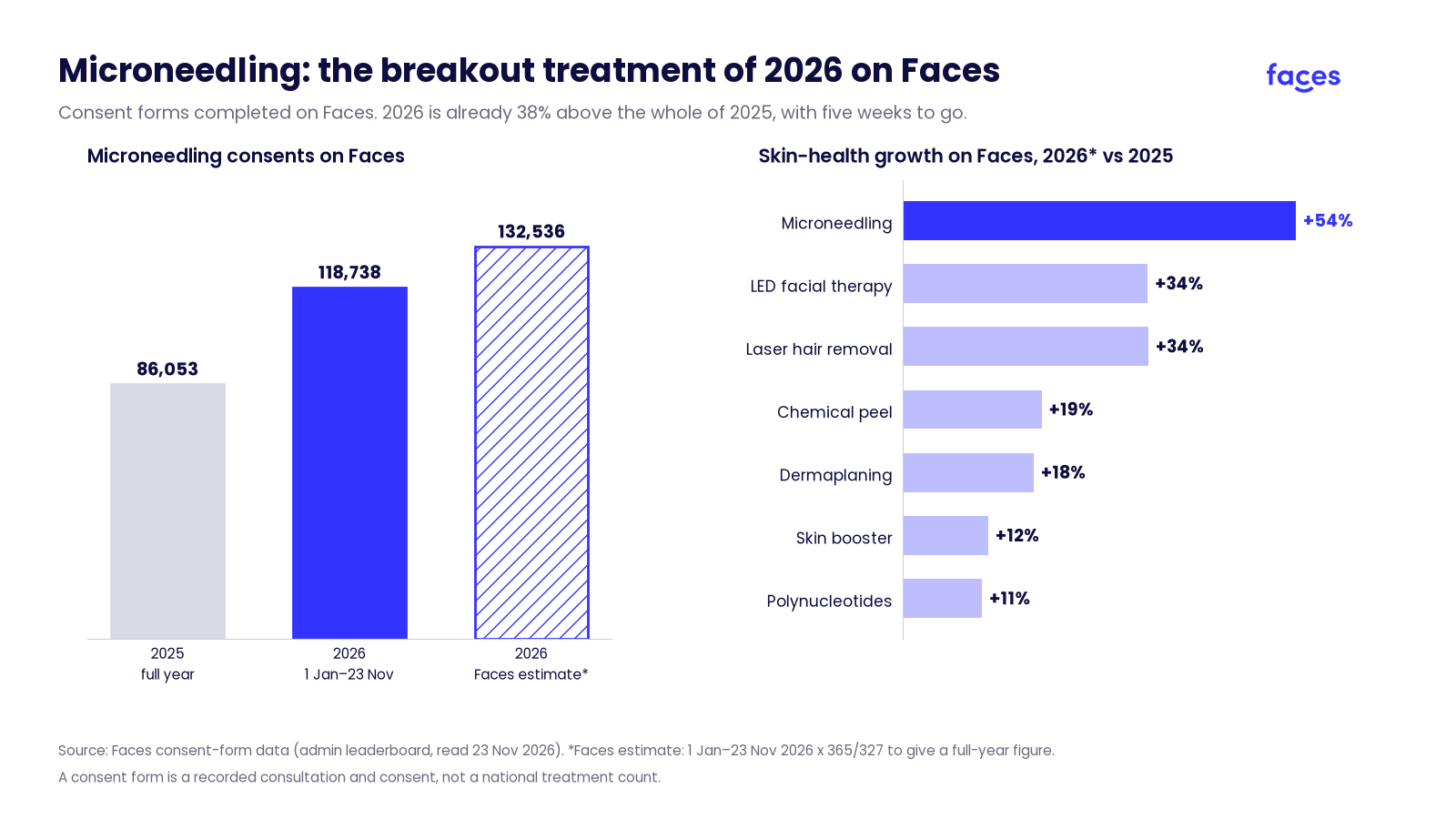
118,738 microneedling consent forms were completed on Faces between 1 January and 23 November 2026. That is already 38% more than the whole of 2025, with five weeks of the year still to go.
That is the headline from the second edition of the Faces UK Aesthetics Data Index, built from consent records on Faces. In the whole of 2025 the figure was 86,053. This year practitioners have recorded around 363 microneedling consultations and consents every day. Microneedling is now the third most-recorded treatment on Faces, behind botulinum toxin (every brand counted together) and dermal filler, and it is growing faster than either of them.
Skin treatments are becoming the science behind looking young
For years, anti-wrinkle injections were mostly about prevention: start early, soften lines before they set. Today botulinum toxin is also used as a cure and a bandaid for skin that is already damaged, and it is still the most-recorded treatment on Faces, with more than 517,000 consents across every brand so far in 2026.
What the 2026 data shows is the next step. Clients and practitioners are now looking at the foundations of skincare: collagen, texture, tone and long-term skin quality. Microneedling is becoming part of a regular routine, booked monthly or every six weeks, in the same way people plan a hair appointment. That rhythm is built into the professional protocols too: Dermalogica UK‘s Pro Microneedling service, for example, recommends a course of 3 to 6 treatments every 4 to 6 weeks.
That is the real story behind 118,738 consents. Looking young is no longer one treatment; it is a skin routine, built on science, recorded properly and repeated over time.
Microneedling’s breakout year, in numbers
- 118,738 microneedling consent forms on Faces, 1 January to 23 November 2026 (86,053 in the whole of 2025).
- +38% already, before the year is out. On a full-year basis we estimate around 132,500, which would be +54% (Faces estimate: 118,738 x 365/327 days).
- #3 most-recorded treatment on Faces in 2026, behind botulinum toxin (all brands combined) and dermal filler, and the fastest-growing of the three.
- 36.7% of all 323,490 microneedling consents ever completed on Faces happened in 2026 alone.
- A wider skin-health shift on the same basis: LED facial therapy +34%, laser hair removal +34%, chemical peels +19%, dermaplaning +18%, skin boosters +12% and polynucleotides +11% (Faces estimates for full-year 2026 vs 2025).
What’s happening: the UK is choosing skin health
Our numbers do not stand alone. On 18 November 2026, Quine Magazine reported that Dermalogica UK has seen a 61% year-on-year increase in microneedling treatments to August 2026, after 35,000 microneedling services across its UK stores, retailer treatment rooms and partner businesses in 2025. Two different datasets, measuring different things, point the same way.
The clinic market is moving with it. Rare‘s UK aesthetics trends 2026 analysis, drawn from Rare.Monitor tracking of 35,797 UK clinic locations, found that 90% of non-surgical aesthetic clinics now offer treatments beyond injectables, and 41% offer at least one regenerative treatment, up from around 38% a year earlier. One clinic in its survey summed it up: clients are becoming far more interested in skin health and long-term maintenance, instead of a fast fix.
Like for like, here is how the comparison works. Dermalogica’s 61% is a year-on-year rise in treatments in its own network to August 2026. Faces’ +38% is consent forms completed so far in 2026 against the full 2025 year, and +54% is our full-year estimate. Rare measures what clinics advertise, not how many treatments they carry out. None of these is a national treatment count, and no UK body publishes one, but the direction is consistent.
Top 5 microneedling devices, and who’s using them
Growth like this is powered by the devices in practitioners’ hands. Here are five well-known professional microneedling devices with UK distribution, in no particular order. This is an editorial pick based on each brand’s own published information, not a sales ranking or Faces data, and none of these brands has endorsed Faces or this article.
1. SkinPen Precision Elite (Crown Aesthetics)
SkinPen Precision Elite is made by Crown Aesthetics. In the US, the SkinPen Precision System was classified by the FDA through the De Novo route as a Class II device to improve the appearance of facial acne scars, and Crown says more than 90 validation studies support it. In the UK it is sold as a Medical Grade Class IIa device. Who’s using it: clinics trained through Crown’s SkinPen education programme, which patients can search with the SkinPen UK Find a Clinic tool.
2. Dermapen 4 (DermapenWorld)
DermapenWorld describes itself as the home of the original Dermapen. Dermapen 4 offers adjustable depths up to 3 mm and multiple speeds, and the brand lists FDA, ISO 13485 and CE marking. Who’s using it: DermapenWorld says the professional device is exclusively available to, and used by, its Authorised Treatment Providers, who are listed on its UK Find a Clinic page.
3. PRO Pen (Dermalogica)
Dermalogica UK‘s FDA-cleared PRO Pen (2026 edition) is intended to improve the appearance of facial acne scars in adults aged 22 and over, with interchangeable cartridges for microneedling and nanoinfusion. Who’s using it: it sits behind Dermalogica’s Pro Microneedling service, offered through Dermalogica flagship stores and Dermalogica professionals. Dermalogica UK delivered 35,000 microneedling services across its UK stores, retailer treatment rooms and partner businesses in 2025, according to Quine Magazine.
4. Morpheus8 (InMode)
Morpheus8 combines microneedling with fractional radiofrequency energy, and InMode announced an additional FDA clearance for soft tissue contraction in 2024. It is a deeper, energy-based treatment, the kind where the clinical setting and prescriber input matter most. Who’s using it: clinics supplied by InMode UK, which patients can search through InMode UK’s Find a Provider page.
5. m.pen [pro] (mesoestetic)
m.pen [pro] is mesoestetic‘s wireless professional microneedling pen, with five speeds and six depth settings from 0.25 mm to 2.5 mm, designed to work alongside the brand’s professional skincare solutions. Who’s using it: mesoestetic says its professional treatments are available in medical-aesthetic and aesthetic centres in more than 90 countries, and UK clients can search its centre finder.
Whichever device a clinic chooses, the same basics apply: device-specific training, a fresh sterile cartridge or tip for every client, and a record of what was used. On Faces, practitioners can note the device, depth and cartridge on the microneedling consent form template and send the microneedling aftercare template from the same client record.
Why it matters: Scotland has written microneedling into law
Growth this fast is exactly why standards matter. Quine’s report marks a first: Scotland is the first UK nation to name microneedling in law. The Non-surgical Procedures and Functions of Medical Reviewers (Scotland) Act 2026, passed by the Scottish Parliament and welcomed by the Scottish Government, received Royal Assent on 12 May 2026. According to Quine, it splits microneedling into two tiers by treatment depth, with higher-risk treatments moving into regulated clinical settings and lower-risk treatments coming under local authority licensing from September 2027.
On 10 November the British Beauty Council, in an update written by Victoria Brownlie MBE, set out what the Scottish Government’s first implementation guidance means in practice: from 6 September 2027, specified procedures must take place in a clinic registered with Healthcare Improvement Scotland and run or staffed by a doctor, dentist, or independent prescribing nurse, midwife or pharmacist. Non-prescribing practitioners can carry out those procedures within that setting.
In England, the Department of Health and Social Care published its consultation on high-risk cosmetic and wellbeing procedures on 21 October 2026. It proposes restricting a set of higher-risk procedures, including dermal micro-coring and blood procedures such as PRP, to specified regulated healthcare professionals in settings registered with the Care Quality Commission (CQC). Standard microneedling is not on that list. The consultation is open until 13 January 2027.
The industry is not waiting. Dermalogica UK and the British Association of Beauty Therapy and Cosmetology (BABTAC) launched in April 2026 the free Sharp Standards Microneedling Good Practice Guide, and have since updated it for Scotland’s new law. Lesley Blair MBE, CEO of BABTAC and CIBTAC, described the Scottish legislation to Quine as “a clear signal that our sector is moving from voluntary standards towards statutory ones.â€
What good, safe microneedling looks like
Good practice is the same whoever holds the pen. Drawing on the Sharp Standards guide and what we see on the platform every day, every microneedling appointment should have:
- Training and insurance that specifically cover microneedling and the device being used.
- A full consultation covering skin, medical history and medicines.
- Written, informed consent before treatment, recorded with the booking. Start with the free Faces microneedling consent form template, browse the wider Faces consent forms library, and read Digital Consent Forms for Aesthetics: Beyond a Signature for why the form is more than a signature.
- A sealed, single-use cartridge opened in front of the client. Clinics can stock sterile, single-use needle tips and microneedling pens and cartridges through the Faces marketplace.
- Clear aftercare, using the Faces microneedling aftercare template (or the full aftercare forms library), follow-up, and a route to a prescriber when a treatment goes deeper or a complication needs medical input. Clinics can find a prescriber on Faces, and our guide How to Find an Aesthetics Prescriber in the UK explains how.
If clients ask about home devices, our article At-Home Dermarollers or Professional Microneedling: Which Works Best? is a good place to start the conversation.
The future: data that supports innovation and safety
Scotland’s tiered model and England’s consultation are both built on an idea we support: the higher the risk, the more important the prescriber, the setting and the record. The smartest way to make that work is to use the tools the sector already has. Digital consent, e-prescribing with a verified consultation, and audit trails linking the practitioner, the device, the product and the aftercare make good practice easy to evidence and easy to inspect.
At Faces we are looking to support the industry with anonymised, aggregate data that helps innovation and safety. The UK still has no national count of these treatments, and decisions are better with evidence. As England’s consultation runs to 13 January 2027, we would welcome conversations with professional bodies, policy teams, brands and researchers who want to use that data well.
A comment from Ash
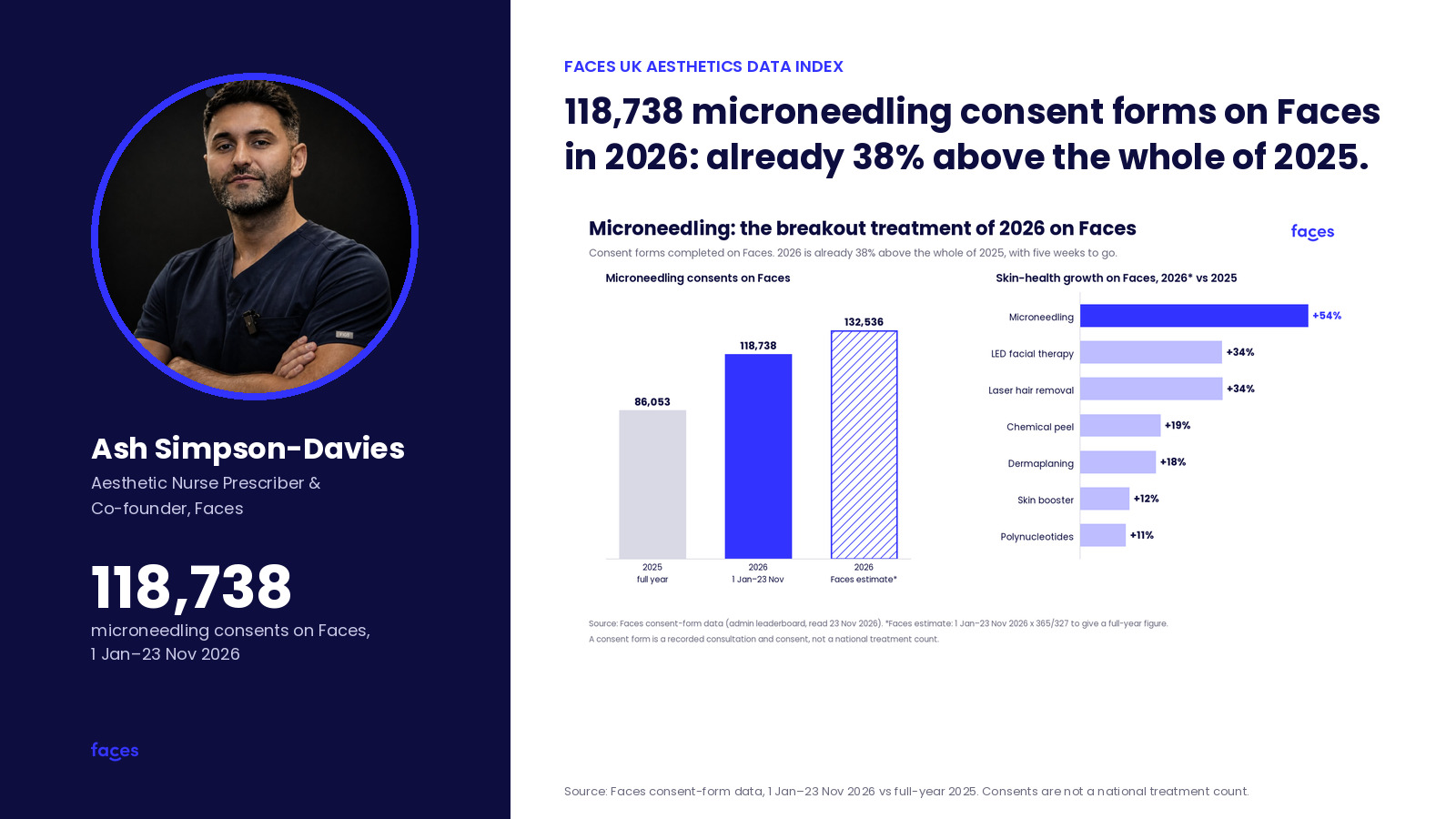
Ash Simpson-Davies, an aesthetic nurse prescriber and co-founder of Faces, said:
“Skin treatments are becoming the science behind looking young. Anti-wrinkle injections used to be about prevention; now they are also a cure and a bandaid for skin that is already damaged. What we are seeing in 2026 is people going back to the foundations of skincare, with microneedling becoming part of a monthly or six-weekly routine. 118,738 microneedling consent forms on Faces this year shows how fast that is happening, and it is great news when it is done well: a proper consultation, written consent, a sealed single-use cartridge, clear aftercare, and a prescriber involved when treatment goes deeper. At Faces we want our data to support industry innovation and safety, so every treatment leaves a record and good practitioners can prove it.â€
Why Faces can see this
Faces is clinic software for aesthetic, beauty and healthcare practices: online booking, Faces consent forms, aftercare, records and team tools in one place. The same platform includes Faces Pharmacy and the multi-seller Faces marketplace, so a clinic can order stock without leaving the system that holds its diary and consent records. That is why this data exists: each consent sits on the same record as the booking.
Software supports professional judgement; it does not replace it. You can see how the platform works on the Ash from Faces and Faces Pharmacy YouTube channels, and follow @facesconsentapp on Instagram and @facespharmacy on TikTok.
Get the next Index first
This is the second edition of the Faces UK Aesthetics Data Index, after our first edition on the UK toxin market. If you are a journalist, a professional body, a brand, a policy team, or a PR agency such as Kendrick PR or Cosmetic PR, and you want the next edition first, comment INDEX on the social posts that accompany this article, or get in touch through Faces.
Clinics that want booking, consent and ordering in one place can register for Faces at no cost to start.
FAQs
Does this mean microneedling grew 38% across the UK?
No. It means microneedling consent forms completed on Faces between 1 January and 23 November 2026 were 38% higher than in the whole of 2025. It is a measure of activity on this platform, not a national figure.
Is a consent form the same as a treatment?
No. A completed consent form is a recorded consultation and consent. It is strong evidence of activity, but not every consent becomes a treatment, and some treatments are recorded elsewhere.
How is botulinum toxin counted?
Practitioners can use a generic botulinum toxin form or a brand-named form on Faces. Because these are all the same type of treatment, we add them together and report botulinum toxin as one treatment. Microneedling ranks third on that basis, behind botulinum toxin and dermal filler.
How is the full-year figure estimated?
We multiply the 1 January to 23 November count by 365/327 (the number of days in the year divided by the days covered). 118,738 x 365/327 = about 132,500. It is a Faces estimate and assumes the rest of the year runs at the same daily rate.
Is microneedling covered by England’s proposed restrictions?
The October 2026 consultation lists dermal micro-coring, which removes a small core of tissue, not standard microneedling. Check the consultation document and your insurer and training provider for your own practice.
Where can I get a microneedling consent form and aftercare sheet?
Faces has a free microneedling consent form template and a free microneedling aftercare template. Both can be used digitally on Faces, linked to the client’s booking and record.
This article is general information for aesthetics and beauty professionals. It is not clinical, legal or regulatory advice. Device details are taken from each brand’s own published information. Always follow your own training, device and product guidance, insurer requirements and professional body.
Ashley James Simpson-Davies INP MSc RN