
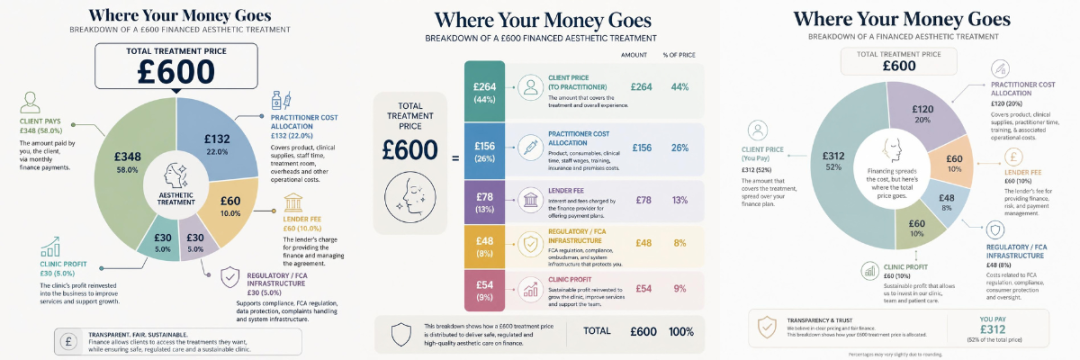
A £600 aesthetic treatment booked on finance appears to cost the client £600. The practitioner sees less. Between regulatory requirements, lending infrastructure, payment processing and merchant fees, finance fees are not free for anyone on the chain, understanding where those costs live is the first step to pricing profitably.

The Three Layers That Make Up A Finance Charge
An admin fees reaching a practitioner’s account as merchant cost covers three distinct functions: regulatory infrastructure, lender risk and payment processing. These are not interchangeable.
The regulatory layer is newest. Since 15 July 2026, interest-free deferred payment agreements up to twelve months have been supervised by the FCA, which means lenders now run affordability and creditworthiness assessments on every application, maintain compliance systems and consumer-facing records, and contribute to industry funding for the Financial Ombudsman Service. That supervision infrastructure carries cost, absorbed into merchant fees.
The risk layer is fundamental to lending. A lender funding a £600 aesthetic treatment agreement carries credit risk, the possibility the client stops paying and the practitioner keeps the earnings without the clinic ever recovering the shortfall. Lenders price that risk into fees. They also carry fraud risk, where a treatment never happens but the money has moved. That risk is factored in too.
The processing layer is operational. A payment must leave a client’s bank, arrive in a lender’s account, and be tracked against the merchant’s incoming cash. Each step, payment gateway, authorisation, reconciliation, chargeback handling has cost.
Payment Plan Fess And Understanding Finance Fees
The distinction between payment plan fees charged by the lender and clinic fees set by the practitioner is important for compliance.
A clinic fee is a charge the practice sets itself. It is not regulated, it belongs entirely to the clinic’s pricing model. A clinic choosing to charge clients £15 to set up an appointment is running a pricing decision, not a finance operation. When compliance questions arise, they are usually about price discrimination: whether charging a clinic fee on financed clients but not on cash clients breaches the clinic’s finance agreement or creates an interest-free claim problem.
Payment plan fees are set by the lender, not the clinic. When a client takes an interest-free offer on a £600 treatment, the lender funds that £600 on day one and the client repays it in instalments, interest-free. The clinic’s merchant fee, typically expressed as a percentage of the sale value, compensates the lender for credit and operational risk. Reading a finance agreement before launch is therefore essential: the percentage may differ between the clinic’s own borrowing and consumer credit products, and may vary by term length and sale value.
The hidden finance fees question in practitioner forums usually arises from confusion between these two layers. A client paying £600 for treatment and the clinic charging £15 plus a 5% merchant fee is not hiding anything—it is operating two separate pricing mechanisms. What requires disclosure is whether the finance option has terms the cash option lacks.
Treatment Pice And Treatment Cost Breakdown
The treatment price from a client perspective and a clinic perspective diverges where merchant fees apply.
A client booking a £600 anti-wrinkle treatment, £450 dermal filler treatment, or £300 SPMU correction using a financed payment plan sees a price of £600, £450 or £300, split into instalments. The total they pay over the agreement term is usually identical interest-free agreements hold cost flat.
The clinic’s side is different. If merchant fees on that £600 booking are 5%, the lender takes £30. The practitioner sees £570 instead of £600. If the clinic’s underlying cost to deliver that treatment was £400, the profit margin falls from £200 to £170 a 15% reduction. That is before any admin fee the clinic may charge separately.
This matters when pricing treatments for finance. Many clinics set the same price for financed and cash clients and absorb the merchant fee. Others increase the financed price to preserve margin. Some use a blended approach, charging a consistent non-finance price and keeping the merchant fee in higher-margin treatments to cross-subsidise lower-margin ones. Each is a valid strategy, provided it does not trigger compliance issues around interest-free claims.
Clinic payment fees and treatment price are therefore different questions. The finance agreement fees are the lender’s contractual requirement. How the clinic responds pass them to clients, absorb them, or use a blended margin is the clinic’s business decision.
Finance Charges Explained: The Regulatory Infrastracture
Since July 2026, the FCA’s Deferred Payment Credit regulation has made affordability assessment mandatory. This changes what fees include.
Before that date, a lender offering payment plans might have conducted rudimentary checks. Now, the lender must verify the borrower can sustain repayments without financial difficulty, document that assessment, and hold a contemporaneous record. Where the assessment suggests marginal affordability, the lender may decline the application or impose restrictions. That assessment process is labour-intensive and carries regulatory risk if later challenged. Merchant fees now reflect that cost.
For aesthetic practitioners, this means the finance infrastructure carries increased credibility. A practitioner introducing a client to financing through a regulated lender has taken a step the unregulated options lack: confirmation the lender has checked the client’s actual capacity to repay. That does not mean repayment is guaranteed, but the due diligence is now baked into the product.
It also means practitioner fees are partly paying for client protection the clinic benefits from incidentally. A client who would have taken on unaffordable credit through an unregulated lender is instead declined by a regulated one, or approved at a term the client can sustain. The clinic’s merchant fee contributes to that protection architecture. It is not marketing cost or processing cost alone.
Monthly Payment Fees: The Cost Of Splitting The Price
Not all payment splits carry the same fee. Lenders often charge different merchant rates for different term lengths.
A monthly payments fee for an aesthetic clinic finance arrangement might apply a 3% rate for three-month agreements and a 5% rate for six-month agreements, reflecting the increased credit risk of a longer timeframe. A client financing a £600 treatment over three months might attract £18 in merchant cost; the same treatment over six months might attract £30. The client’s price and monthly figure look the same across both structures, but the clinic’s outcome differs.
This is why checking the actual written fee schedule before launch is non-negotiable. A lender’s website may state “from 2%”, but the clinic’s contracted rate depends on the product mix, merchant category, sales history, and agreed underwriting model. That rate is also revisable on notice a merchant fee that applies today may not apply next year.
Some lenders offer second-line routing, where a client declined for one product is offered a higher-cost alternative rather than being refused entirely. That optional upgrade carries its own merchant rate and is the client’s choice to accept. From a compliance perspective, the clinic must make clear to the client which product they have accepted, and must avoid pressure tactics reminders that a higher-fee option exists, without the client requesting it, can breach advertising codes.
Interest Free Finance And Margin Preservation
Understanding where money goes requires separating the retail price a client sees from the underlying clinic economics.
A £600 anti-wrinkle treatment price tag typically includes material cost (botulinum toxin vial, syringes, sharps bins), staff time (practitioner injection, admin, follow-up messaging), premises overhead, indemnity insurance, and clinic operating profit. If materials cost £25, staff time £80, overhead allocation £95 and target profit £400, the price of £600 works.
Interest free finance merchant fees act as a reduction on the price realised, not on what is included in it. When the lender takes 5%, the clinic now has £570 to recover £200 of costs and keep £370 of the original profit. That is possible only if the original cost structure leaves room. If the £600 price was built on £100 profit margin rather than £400, a 5% fee eliminates it entirely.
This is why the revenue maths behind https://facesconsent.com/blog/the-revenue-maths-behind-buy-now-pay-later/ has to start with cost modelling before the finance discussion begins. Many practitioners work backwards from a competitor’s price without knowing that competitor’s cost structure. Financing on a price that was already marginal simply moves the margin problem into a different shape.
Understanding treatment finance fees therefore requires treating the finance-backed price as a subset of pricing strategy, not as a standalone transaction.
What Practitioners Encounter: Unread Fee Schedules
When practitioners flag apparent inconsistencies, they are usually encountering fees the agreement specifies but the clinic did not budget for.
A common scenario: a lender offers interest-free financing at 5%, but applies an additional £2.50 transaction fee on every agreement settled. The clinic models financing on the 5% figure and finds monthly figures off by hundreds of pounds when the transaction fee is applied to the real settlement. That is not a hidden fee, it is an unread fee schedule.
Another: a lender advertises flat merchant rates but applies a higher rate to agreements where the customer’s credit score falls below a threshold, or where the sale value is below a minimum. A practitioner financing high-volume low-cost treatments may encounter entirely different economics from one advertising treatment packages. That rate variation is disclosed in the agreement but feels hidden when the first real settlement arrives.
A third: lenders sometimes charge a merchant chargeback fee if a client disputes the charge or reverses the payment. That fee is contractual. It is also sometimes charged per chargeback rather than per-dispute, so if three chargebacks relate to one underlying client complaint, the clinic may face three fees. That provision is worth checking explicitly.
These are not hidden in the sense of undisclosed. They are in the agreement. They feel hidden to practitioners who have not worked through the arithmetic of what happens when dozens of real clients transact instead of one worked example. The best protection is requesting the full written fee schedule before any agreement is signed, and stress-testing real settlement scenarios against that schedule.
Offering Finance In An Aesthetic Clinic: The Demand-Side Picture
Why clinics decide to offer financing aesthetic treatments despite merchant fees points back to underlying client demand.
Research on aesthetic clinic finance adoption shows clients requesting payment plans on 15–30% of treatment enquiries, with higher uptake on multi-treatment courses and premium treatments over £300. Without finance, that percentage of inquiries convert to bookings at lower rates than comparable cash-paid clients. With finance, conversion lifts. The net effect higher total revenue from financed bookings despite lower per-booking margin is the argument for absorbing or accepting merchant fees as part of the operating model.
It is worth checking that assumption in your clinic’s own data. If payment plans represent 5% of inquiries and only finance half of those, merchant fees may not be worth the operational cost and compliance burden. If they represent 20% and finance three-quarters, the infrastructure cost makes sense.
Aesthetic Clinic Finance And Aesthetic Treatment Finance Strategy
Treating finance fees as strategic rather than incidental shapes pricing decisions.
One approach is to set a standard price across cash and finance clients and absorb the merchant fee where the margin allows. This is simpler operationally and more transparent to clients. The practitioner bears the cost directly.
A second is to price financed treatments higher, recovering the margin the merchant fee erodes. This requires regulatory care an interest-free offer must not imply the financed price is lower than the cash price when it is the opposite. The wording matters.
A third is a blended model: establishing a base treatment price that works across both payment methods, and allowing margin variation by treatment type. High-margin treatments subsidise the merchant fee on lower-margin ones. This only works at sufficient volume and requires careful tracking so the cross-subsidisation is intentional rather than accidental.
Each approach has cash-flow implications too. A clinic absorbing the merchant fee sees reduced per-appointment cash income immediately, even though client lifetime value may be higher. A clinic that increases the financed price sees the same price to clients (compliance permitting) but must manage the client expectation that payment plans cost more.
Offering Finance In An Aesthetic Clinic : Compliance And Promotion
Promoting finance carries its own cost, built into some merchant fee structures.
A lender may take a lower fee if the clinic handles all promotional messaging, client application and documentation. Another may charge a higher rate and handle marketing and compliance review centrally. That difference is a service level choice, not a hidden cost, provided it is stated at contract time.
Compliance itself is occasionally charged separately a lender may offer a merchant fee rate on all transactions, then charge additional cents per application for regulatory documentation and affordability assessments. More often, that cost is built into the per-transaction rate.
From a practitioner perspective, it is worth asking upfront: what is included in the merchant fee, what is additional, and how are additional charges applied? That question often resolves apparent inconsistencies in published vs. actual cost.
Before promoting payment plans for aesthetic treatments through any channel booking system, website, social media obtain written approval of the wording from your lender. Some lenders restrict promotional language to prevent breaches of the https://handbook.fca.org.uk/handbook/conc3/conc3s5 financial promotion rules, where stating a monthly figure can trigger representative example requirements. Understanding that boundary prevents costly compliance errors.
The Full Picture: Cost Of Aesthetic Treatments When Financed
Understanding the total cost of financing treatments requires adding the visible and less-visible costs together.
A client’s visible cost is the price: £600 for a treatment, unchanged whether financed or paid in full. The lender’s cost is credit risk, manifested as merchant fees paid by the clinic. The FCA’s cost is regulatory infrastructure. The clinic’s cost is operational onboarding clients onto a finance application, explaining terms, handling declines, managing settlements.
The https://facesconsent.com/v1/finance cost of aesthetic treatments where finance is offered is therefore not a cost that appears on the client’s quote. It is a cost the clinic encounters in the business model. Understanding it drives better decisions about whether finance is a strategic tool for your clinic or an add-on that complicates operations without sufficient return.
For practitioners considering financing aesthetic treatments, working through the numbers against your own cost structure, client demand and competitor positioning is more valuable than comparing merchant fee percentages in isolation.
FAQ
Can the clinic charge the client for the finance fee?
No. Payl8r does not allow the fees to be added on top of the treatment price.
Is 0% finance free for the clinic?
No. Zero per cent describes the borrower’s rate. The clinic typically pays merchant fees even on 0% offers, absorbing that cost into the business model. Confusing the two, assuming 0% means cost-free for the clinic is a common and expensive error.
Do all lenders charge the same merchant fees?
No. Fees vary by lender, product type, sales value, merchant track record and term length. Comparing one lender’s rate against another requires comparing the full fee schedule, not headline percentages. Request the written schedule from any lender before committing.
Should every clinic offer finance?
Not necessarily. Finance works where a meaningful percentage of your client base actively requests payment plans, where your margins can absorb merchant fees or financed pricing is acceptable to clients, and where the operational overhead of integrating a finance product makes sense for your clinic size. A single-practitioner clinic with small treatment values may find the burden outweighs the benefit.
Where does the FCA’s role fit into my finance fees?
The FCA regulates lenders, not merchants. You are not FCA-regulated to offer finance (with rare exceptions). You are, however, responsible for working with a regulated lender and for not breaching consumer credit rules in how you advertise or administer the finance product. Merchant fees partly reflect the lender’s FCA compliance cost.